Small business owners can apply these frameworks to reduce manual finance work, accelerate monthly closes, and make faster data-driven capital allocation decisions.
What is OpenAI’s AI-native finance function and what changed?
OpenAI CFO Sarah Friar published a blueprint on August 10, 2026 for rebuilding finance operations around AI. The blueprint targets a zero-day close and automated, continuously updated forecasting.
Friar set 2 bold ambitions when she joined OpenAI 2 years ago: a zero-day close and continuous forecasting. The work pushes finance beyond static spreadsheets toward live tools built on the full context of the business.
OpenAI’s finance team is rebuilding around AI to hit a zero-day close and continuous forecasting.
What is the evidence behind OpenAI’s AI-native finance function?
The evidence comes from Friar’s published post on the OpenAI Blog. An internal hackathon produced IR-GPT, a custom GPT grounded in approved materials for investor relations, and the team is also building custom GPTs for procurement and tax.
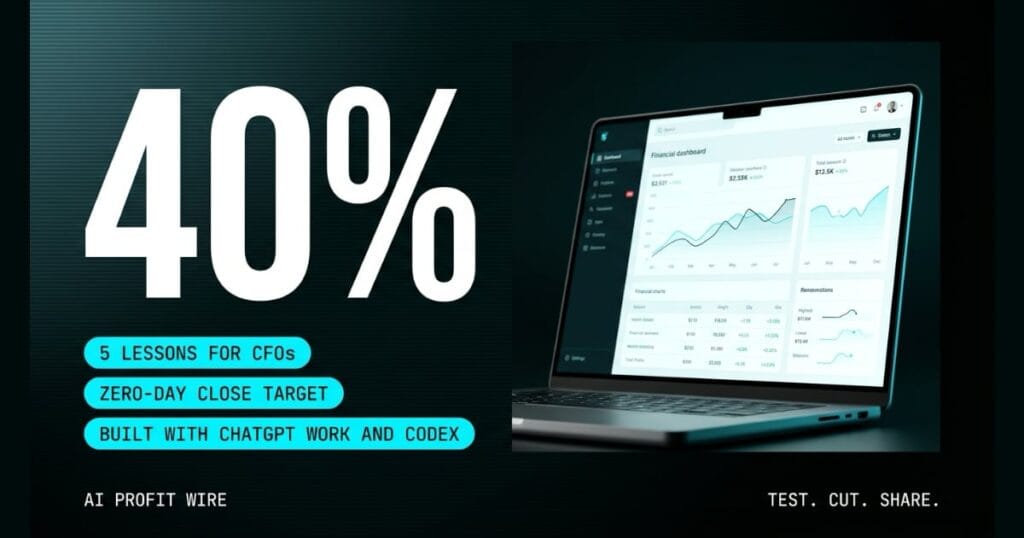
Recent OpenAI research shows 40% of finance professionals’ specialized AI use involves work outside traditional finance, and 22% involves engineering-related tasks. Everyone on Friar’s team builds custom AI dashboards and tools with ChatGPT Work and Codex.
One teammate with no coding background used Codex to build a tool that turns monthly advertising forecasts into weekly and daily plans. Marketing leaders can now see what changed, where to invest, and what additional spending could return.
IR-GPT taught the team a control lesson. Work that previously took hours, and sometimes continued overnight, can now produce a strong first draft in seconds. The human role remains central, with the investor relations team reading the draft, adding judgment, and checking consistency across investors.
OpenAI’s own finance team is the proof case for AI-native finance operations, with IR-GPT and the Codex-built advertising tool as concrete evidence.
How does OpenAI’s AI-native finance function compare to the alternatives, and what background do small business owners need?
Traditional finance teams spend enormous energy assembling the inputs to a decision. A forecast review might require finding the latest data, reconciling spreadsheets, explaining variances, building charts, and turning those documents into slides.
AI changes the unit of work. Finance leaders can redesign the full path from source data to decision, then determine which parts AI can analyze, coordinate, or complete.
The shift moves finance from static Excel models and PowerPoint decks toward live dashboards. You can read more about AI workflow signals for small business owners in our signals archive.
AI-native finance replaces static spreadsheet cycles with live dashboards that carry the analysis forward.
How does OpenAI’s AI-native finance function affect day-to-day operations for small businesses?
Small business owners can apply Friar’s 5 lessons directly. Give everyone AI access, redesign workflows around decisions, let finance professionals become builders, pair speed with clear accountability, and measure value per unit of intelligence.
The 40% number is the unlock: nearly half of specialized AI use by finance professionals happens outside traditional finance work. Founders who treat AI as a finance-only tool are missing the broader operational shift.
Clear accountability keeps the human role central. AI accelerates the work, but people own the result, and every forecast should carry a clear explanation tied to a reliable source.
Founders who apply these 5 lessons can compress their monthly close and free finance time for judgment work.
The month-end close hits your inbox as a spreadsheet with dozens of tabs and a Slack thread asking why Q3 numbers diverged from forecast.
You apply 1 of Sarah Friar’s 5 lessons and load the data into a custom AI dashboard built with Codex. The system surfaces the variance explanation, the supporting evidence, and 3 scenarios for how an adjustment would affect the quarter.
Your role shifts from assembling inputs to judging scenarios. The 40% of finance work that happens outside traditional finance is exactly the surface AI compresses first, and your team gains time to challenge assumptions while the outcome can still change.
What is the final verdict on OpenAI’s AI-native finance function?
OpenAI’s blueprint is a working model for how small business owners can rebuild finance around AI. The 5 lessons are practical, and the 40% number proves the shift is already underway inside finance teams.
Founders should start with 1 consequential workflow and expand through evidence. Give the team AI access, help them rebuild the work, keep accountability clear, and measure the outcome using Friar’s 4 questions: Did AI complete work that mattered? What did it cost? Was the result good enough to use? Did it help move faster or make a better decision?
The cheapest model is not always the most economical. If a better model gets to a reliable answer with fewer attempts and less review, it may cost less overall, which is why measuring value per unit of intelligence matters more than tracking token usage alone.
Apply these 5 lessons to compress your monthly close and free finance time for judgment work.
Source: OpenAI Blog
