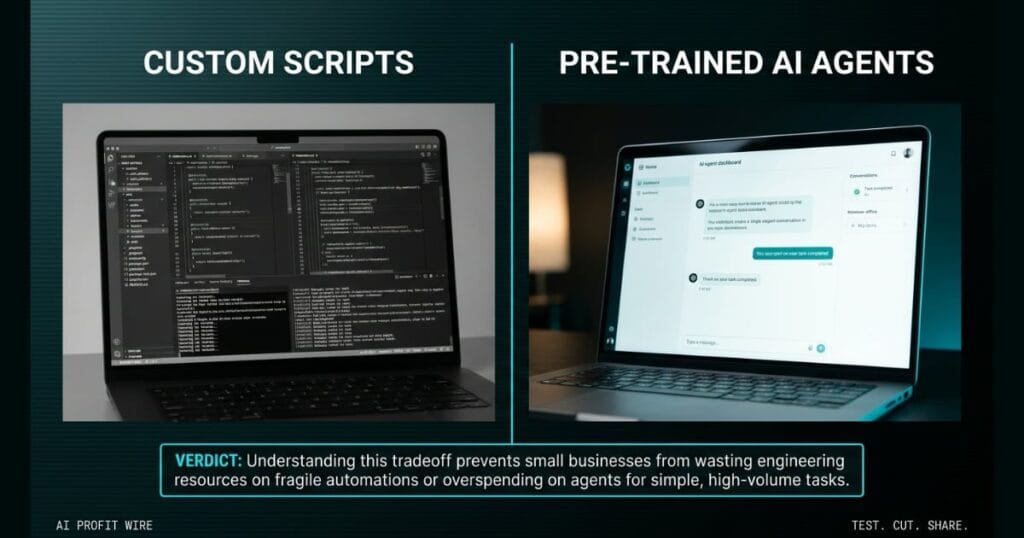
Understanding this tradeoff prevents small businesses from wasting engineering resources on fragile automations or overspending on agents for simple, high-volume tasks.
What is the choice between custom scripts and pre-trained agents, and what changed?
For teams doing autonomous outreach in 2026, the choice between building custom automation scripts and adopting pre-trained autonomous AI agents comes down to maintenance burden versus initial control. Custom scripts win on cost and precision for single, high-volume, API-driven tasks. Pre-trained agents win on time-to-workflow, resilience to UI changes, and the ability to operate across tools without public APIs.
A custom automation script is code you write using Playwright, Selenium, or LangChain that performs specific steps in a specific order. It logs into a tool, fills fields, clicks buttons, and reads results. A pre-trained agent is a software system trained on how to use a tool through observation and interaction, not explicit instruction.
The critical difference is that a script says “click button with ID submit-form,” while an agent says “complete this signup form” and learns which elements are the form fields even if the IDs change. The vendor owns the underlying model maintenance, you own the workflow.
Scripts give you control and a maintenance bill. Agents give you adaptability and a vendor dependency.
What is the evidence behind custom scripts vs pre-trained agents?
Building a Playwright script for web automation takes a few hours, but maintaining it costs far more. Selector drift happens when a vendor updates their UI, and XPath expressions that worked last quarter fail this quarter.
For a single script checking one tool, you notice the failure quickly. For 50 scripts across your operation, you notice when customers complain. Each fix takes time and requires engineering attention.
Error handling and retry logic are invisible costs. A basic script retries 3 times, but a production script needs exponential backoff, circuit breakers, and decision trees for whether a failure is recoverable. This code often exceeds the core automation logic in size.
Credential rotation adds another layer. If your scripts store API keys or session tokens, changing passwords means updating every script that uses them. Version management becomes a tax, where updating one library breaks 10 scripts and deploying a new Python version silently fails half your cron jobs.
The maintenance burden compounds with every script and every vendor UI update.
How do custom scripts compare to pre-trained agents, and what background do small business owners need?
Custom code is the right choice when your target system has a stable, documented API. You control the request format, parse the response precisely, and don’t depend on screen-reading logic. Banking integrations, data warehouse loads, and internal tool operations fit here.
When a single workflow processes millions of items per month, the fixed cost of script maintenance is amortized across high volume. A script sending 1,000,000 emails is more cost-effective than a pre-trained agent processing the same volume.
Pre-trained agents excel when automation needs are diverse and distributed. Many tools lack public APIs, including LinkedIn, Facebook ads platforms, and internal web apps. A pre-trained agent abstracts that work, handles the UI interaction, and adapts when the vendor updates their UI without your code changing.
Non-technical team members can express automation needs as descriptions rather than code. A sales operations person says “find all leads with these criteria and add them to this list” instead of writing a script or waiting for engineers.
Scripts win on deterministic, high-volume work. Agents win on variety, distribution, and UI resilience.
How does the script vs agent choice affect day-to-day operations for small businesses?
Day-to-day operations shift from engineering-led maintenance to workflow-led description. Low-volume, high-variety tasks that were expensive to script now become one agent with variable instructions, which is simpler than maintaining 100 scripts.
Workflows that change weekly benefit from agents because describing new rules in natural language is faster than regenerating scripts. Strict compliance and audit requirements favor custom code, where every decision and credential use is documented.
Small business owners tracking emerging AI automation signals should ask whether their team has engineering capacity for selector fixes, or whether they need a vendor to absorb that burden.
The script vs agent choice decides whether your team owns maintenance or offloads it to a vendor.
A Shopify store runs 50 custom scripts to sync inventory, route orders, and trigger customer emails. One Tuesday morning, Shopify ships a UI update and 12 of those scripts silently break, rerouting orders to the wrong warehouse.
You don’t find out until Friday, when customers start emailing about wrong deliveries and your support team spends the day fielding complaints. The vendor updated a single button ID, and your team burned the week rebuilding selectors that will break again next quarter.
A pre-trained agent reads “sync inventory across 100 different lists” once and adapts when Shopify changes a button ID. The vendor owns the model maintenance, and your team owns the workflow itself.
Run a custom script for the one workflow shipping 1,000,000 emails a month at fixed volume. Run a pre-trained agent for the 50 workflows that shift every quarter. That’s the honest split.
What is the final verdict on custom scripts vs pre-trained agents?
The honest truth is that custom scripts cost less upfront and more over time. Pre-trained agents cost more upfront and less over time. Choose based on how long you’ll run each workflow and how much your team’s time costs.
If your target system has a stable API, you run one high-volume workflow, and you have engineering capacity, script it. If your workflows change monthly, span tools without public APIs, or need non-engineers to build them, adopt an agent.
If three or more decision factors favor agents, adopt one. If the answers split evenly, use both: agents for variety and breadth, scripts for high-volume deterministic work.
Match the tool to the workflow’s volume, stability, and ownership cost, not to a vendor preference.
Source: AutoGPT Blog
