Small business owners can expect higher converting traffic and increased sales by ensuring their product data is structured for AI search assistants.
What is Shopify AI Search and what changed?
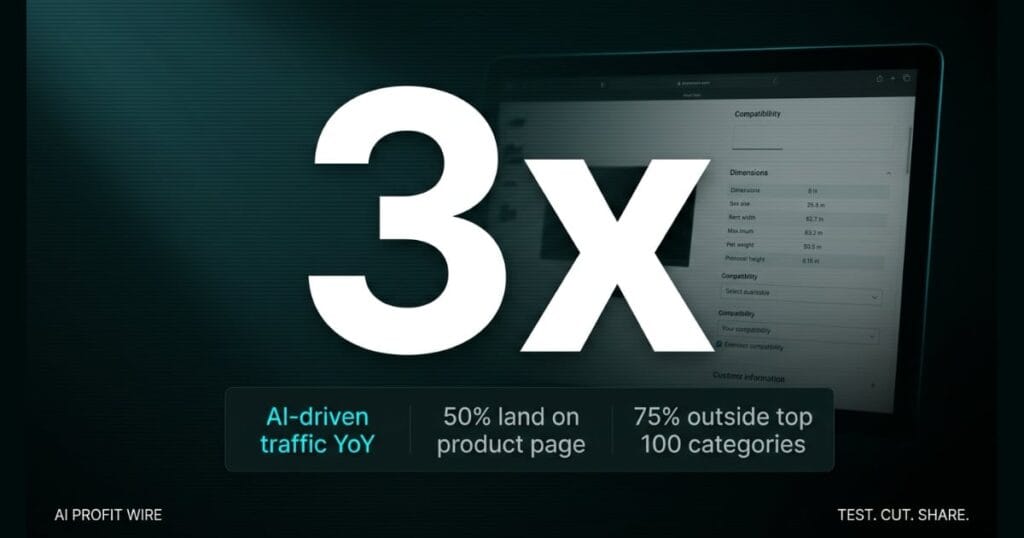
Shopify reported that AI-driven traffic and orders to its stores tripled year-over-year in Q2. This signals a shift in how buyers find products online.
The company credited its soaring Q2 revenue to AI search, noting that traditional search sessions are still up 1.3x over the past 2 years. AI is acting as a complement to search rather than a substitute. Finkelstein told analysts that search remains one of Shopify’s largest sources of buyer traffic, and it’s still growing.
Shopify built connectors to AI tools like Claude, ChatGPT, Perplexity, Manus, Replit, and Vercel. These integrations let AI agents make multiple calls into Shopify’s catalog to find products based on specific buyer intent.
AI search is generating new e-commerce demand instead of cannibalizing traditional search traffic.
What is the evidence behind Shopify AI Search?
Shopify’s Q2 earnings call provided hard numbers on AI search performance. Revenue rose 36% to $3.6 billion, outstripping Wall Street’s forecast of $3.4 billion.
Internal data shows 50% of AI-referred sessions land directly on product pages. This is 2.5x more than what Shopify sees with traditional search traffic.
Furthermore, 75% of AI-attributed purchases in Q2 happened outside the top 100 categories, which Shopify called its sweet spot. Gross operating profit also rose 31% to $1.71 billion, beating analyst expectations of $1.63 billion. The company also pointed to its trusted checkout experience as a factor in AI-driven conversion.
Shopify’s financial results prove that AI search drives higher-converting traffic and sales.
How does Shopify AI Search compare to the alternatives, and what background do small business owners need?
Traditional search engines rank products by popularity against a handful of keywords. AI agents work with richer structured data to match products with the buyer’s specific intent.
When a buyer asks an AI assistant for a car seat that fits 3 across a sedan, traditional search focuses on the keyword “car seat.” An agent understands the dimensions, vehicle type, and the need for 3 seats.
The AI searches across all those constraints at once to find the product that actually works. This compresses the shopping journey, landing buyers directly on the exact product they need 2.5x more often. For merchants, this means fewer abandoned carts and higher average order values, because the buyer arrives already confident in their choice.
AI search delivers higher-converting traffic by understanding buyer constraints, not just matching keywords.
How does Shopify AI Search affect day-to-day operations for small businesses?
Small business owners must ensure their product data is structured for AI search assistants. If an AI tool can’t parse your inventory, it will bypass your store for a competitor.
Optimizing for AI agents requires detailed product descriptions, accurate dimensions, and clear specifications. This structured data allows tools to recommend your products accurately, and you can track how AI-referred traffic performs in your analytics alongside other AI signals. Merchants who treat their product feeds as APIs for AI agents are seeing the highest returns from this traffic.
With 75% of AI-attributed purchases happening outside the top 100 categories, niche merchants have a distinct advantage. The long tail of e-commerce is benefiting the most from this shift.
Founders must treat their product feeds as structured data APIs for AI agents to consume.
You’re staring at 400 product listings that all have a title, a price, and one blurry photo. Your best-selling item is a car seat that fits 3 across a sedan, but your listing just says “car seat” with no dimensions, no vehicle compatibility, and no weight limits.
A buyer asks an AI assistant for exactly that: a car seat for 3 across their sedan. The AI agent queries every store’s structured catalog at once. Your listing has zero structured data, so the agent skips it entirely and lands on the competitor who listed exact width, weight range, and vehicle compatibility. Shopify’s data shows 50% of AI-referred sessions land directly on that competitor’s product page.
The fix isn’t a new tool or a bigger ad budget. The fix is adding the dimensions, the specs, and the constraints to the listings you already have. That’s what the AI reads, and that’s what gets your product on the page before your competitor’s.
What is the final verdict on Shopify AI Search?
Shopify AI search is a measurable revenue driver, not a traffic killer. Traffic and orders tripled year-over-year while traditional search continued growing.
The data proves that 50% of AI-referred sessions land directly on product pages, 2.5x more than traditional search. This compresses the buyer journey and increases conversion rates.
With 75% of AI-attributed purchases happening outside the top 100 categories, niche small business owners have a clear opportunity. Structuring product data for AI agents is no longer optional.
Small business owners must structure their product data for AI agents to capture this high-converting traffic.
Source: TechCrunch AI
