Switching to these newly priced models could lower your AI API costs by up to 80% without sacrificing performance.
What are the new Luna and Terra models and what changed?
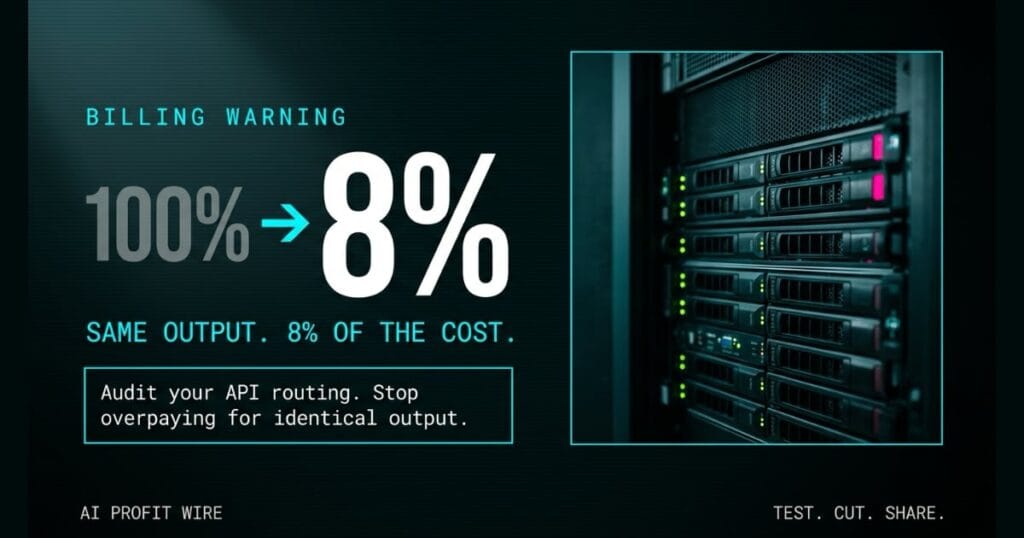
OpenAI reduced the price of GPT-5.6 Luna by 80% and Terra by 20%. Luna at max thinking effort now scores roughly the same as GPT-5.4 xhigh, the best possible model from 4 months ago, at only 8% of the cost.
This means 10 to 12 times more work capacity if you route routine tasks to Luna with selective Terra and Sol usage. The pricing shift represents a major operational advantage for small business owners running API-dependent workflows.
A competing model, DeepSeek V4 Flash, costs $0.14/$0.28 per million input/output tokens with a 1M-token context window, which is less than Luna’s $0.20/$1.20. Qwen’s 2.4T model approaches frontier performance for coding and professional work at $2/$6.
New models deliver frontier-level output at 8% of the previous cost.
What is the evidence behind the new Luna and Terra pricing?
The evidence comes from Ben’s Bites, a recognized industry newsletter that tested these models and reported their commercial pricing. The benchmark claims indicate performance matching previous frontier capabilities.
DeepSeek V4 Flash costs $0.14/$0.28 per million input/output tokens, which is less than Luna’s pricing of $0.20/$1.20 per million tokens. These are documented, published prices, not projections.
The source also highlighted that a 2.4T model from Qwen approaches frontier performance for coding and professional work at $2/$6. These figures provide a concrete baseline for evaluating your current AI spend.
The commercial pricing data confirms a massive drop in API operational expenses.
How do cheaper GPT alternatives compare to the alternatives, and what background do small business owners need?
Small business owners need to understand that sticking to older, expensive models is no longer a technical necessity but a financial drain. Newer models match the performance of systems that cost 10 to 12 times more just months ago.
The source notes that Luna Max is effective for chatting, research, and reading or writing files for day-to-day tasks. However, you might need to tap in Sol High to clean up messes on coding tasks like building a Chrome extension.
This means you can’t blindly route all tasks to the cheapest model. You must match the model’s specific capability to the job. Weighing these options is just like evaluating a specialized AI customer support tool against a general-purpose API for specific use cases.
Founders must test these cheaper models against their specific daily workloads before migrating completely.
The Founder Lens
The low hum of the bait station compressor fills the storage room, a steady drone you only notice when it suddenly stops. You’re reviewing last month’s vendor invoices for your pest control company, and the chemical concentrate bill is 5 times higher than it was 4 months ago.
You check the logs and realize the technician has been spraying the premium commercial-grade solution for basic residential ant jobs. The premium chemical works, but the standard concentrate gets the exact same kill rate for those simple perimeter jobs at a fraction of the price. You’re overpaying for capability you don’t need on those tasks.
Your API routing is doing the exact same thing right now, burning $1.20 per million tokens on a heavy model for basic text generation when a $0.14 model delivers identical output. You need to audit the routing logs and stop overpaying for premium on basic tasks.
How do cheaper GPT alternatives affect day-to-day operations for small businesses?
Switching to these newly priced models directly lowers your AI API costs, with Luna running at 8% of the previous frontier cost. This translates to an immediate reduction in monthly operational expenses.
The source points out that this cost reduction offers 10 to 12 times more work or play capacity if you stick to the cheaper models for routine tasks. You can reallocate those savings into other growth areas.
However, the article also notes that some cheaper models struggle with specific tasks like building Chrome extensions, requiring a more capable model to clean up the mess. You must implement a tiered routing system to maximize the savings.
A tiered API routing strategy is now mandatory to capture these operational cost savings.
What is the final verdict on the new cheaper AI models?
The data is clear that frontier-level performance is no longer locked behind premium pricing. Small business owners can immediately cut their AI operational expenses by testing and adopting these cheaper alternatives.
Luna runs at 8% of the cost of the previous best model, and OpenAI reduced Luna’s price by 80%. Those who ignore this shift will continue to burn capital on outdated pricing for identical output quality.
You must verify the model’s capability on your specific tasks before committing, but the financial upside is too large to ignore. Luna Max handles day-to-day tasks well, but keep a heavier model available for complex coding work.
Founders who ignore this pricing shift are voluntarily overpaying for AI output they can get at 8% of the cost.
Source: Ben’s Bites
