Businesses must carefully design AI automation to enhance rather than replace human interactions to maintain team morale and customer satisfaction.
What is ChatGPT Slack automation and what changed?
ChatGPT Slack automation connects OpenAI’s ChatGPT to a Slack workspace so the AI can read messages and send replies on behalf of a user. Slack is the internal messaging tool OpenAI staff use to coordinate work, and many employees have wired their ChatGPT directly into it.
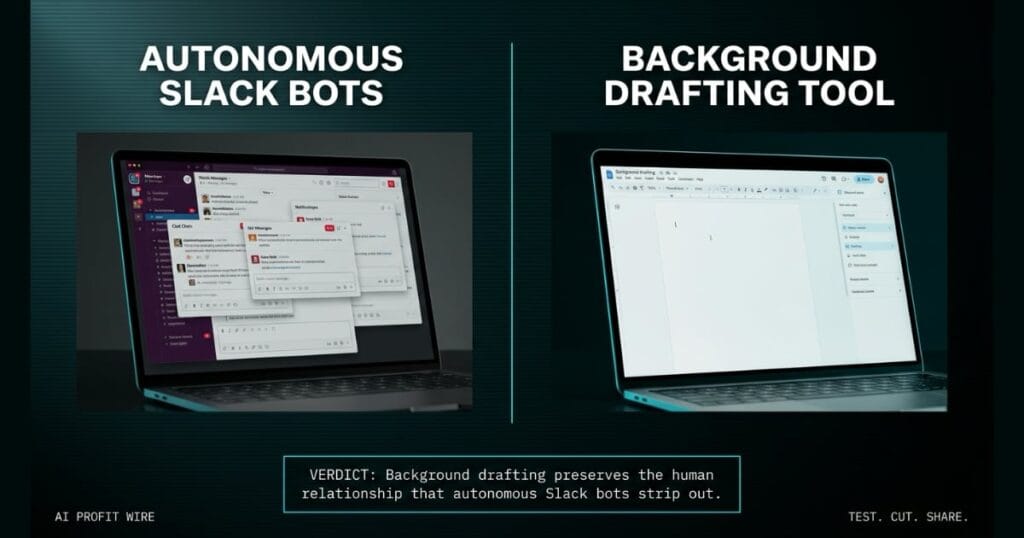
The change Greg Brockman flagged is that these AI agents now message human coworkers directly to request help with tasks. The setup lets the AI act autonomously instead of staying in the background as a drafting tool.
Coworkers receive requests from a bot instead of from the person they work with, which changes the social dynamic of the ask. The AI becomes an automated middleman rather than a background assistant.
ChatGPT Slack automation turns the AI into an automated middleman between coworkers.
What is the evidence behind ChatGPT Slack automation?
The evidence comes directly from Greg Brockman, President and Co-Founder of OpenAI, reporting what he observes internally at his own company. He stated that people really don’t like when a coworker’s ChatGPT contacts them asking for help with a task.
Brockman noted that employees are perfectly happy doing that same work if asked by the human coworker directly. The friction isn’t the task itself, it’s the automated delivery method.
This behavior reinforces how much people care about human relationships and helping each other, which is the core insight Brockman drew from the observation. Employees want AI to give time back, or enhance time together, rather than become a layer separating people.
Employees reject AI bots asking for help because the bot removes the human relationship from the request.
How does ChatGPT Slack automation compare to the alternatives, and what background do small business owners need?
The alternative to autonomous bot messaging is using AI as a background assistant that drafts messages for a human to review and send. The human stays in the loop on every interpersonal request, and the AI handles the drafting work.
Autonomous bot messaging skips that review step and sends the request directly from the AI to the coworker. The coworker receives a request from a script, not from the person they actually work with.
Brockman framed the choice in his own words, saying people want AI to give time back, or enhance time together, rather than become a layer separating people. Autonomous bots save a few seconds but cost the social rapport, while background drafting keeps the human in the loop.
Background drafting preserves the human relationship that autonomous Slack bots strip out.
How does ChatGPT Slack automation affect day-to-day operations for small businesses?
For small business owners, the operational takeaway is that AI bots messaging staff to delegate tasks create the exact friction Brockman describes. If you’re routing internal requests through a customer support chat tool or any AI agent, the same risk applies to your internal workflows.
Staff who would happily do the work for a human coworker resent the request when a bot delivers it. The task still gets done, but the social rapport erodes, and the favor feels like an automated directive.
Brockman’s framing is direct, people want AI to give time back, not separate them from the coworkers they help. The fix is to restrict autonomous AI to backend tasks like data entry, scheduling, and drafting, then let a human send the request.
Keep AI on backend tasks and let humans ask humans for help.
The smell of mint fluoride hangs in the air at the front desk of a busy dental practice when the scheduling software pings the receptionist. An automated AI bot, hooked up to the internal messaging system, asks her to pull patient records for an upcoming root canal. The request looks efficient on paper, a bot delegating a routine task without slowing down the hygienist.
She glares at the screen, annoyed that a script is demanding her time, even though she would handle the request instantly if the hygienist walked over and asked. The bot is the separating layer Brockman described, turning a routine collaborative favor into an automated directive. The task is the same, but the asking has lost the human rapport that makes the favor land softly.
When your AI routes internal requests through bots instead of humans, you build the exact layer people resent. A human asking another human for help preserves the relationship, and the task still gets done. The seconds saved by the bot cost you the goodwill that keeps a small team running.
What is the final verdict on ChatGPT Slack automation?
The final verdict is that AI should give time back or enhance time together, not become a separating layer between coworkers. Brockman confirmed that even at OpenAI, employees resent when a ChatGPT bot asks them for help.
People want AI to support human relationships, not replace the asking with a bot. Founders who deploy bots to message staff are building the layer Brockman warned against.
Restrict autonomous AI to backend processing, and keep humans in the loop for any request that needs another person to do the work. That is the line Brockman drew, and it applies to every small business deploying AI internally.
Restrict autonomous AI to backend processing and keep humans in the loop for any request that needs another person to do the work.
Source: simonwillison.net
