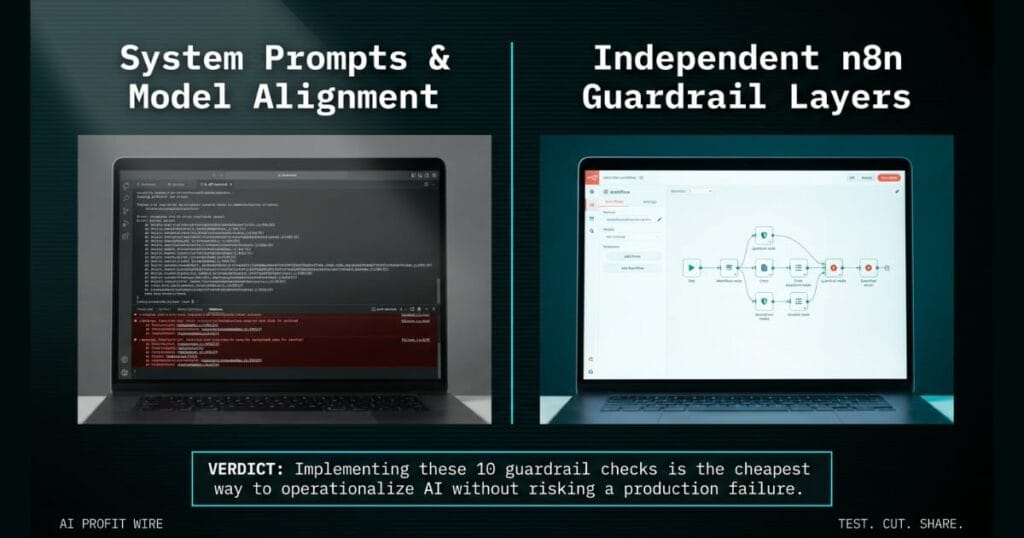
Implementing these guardrails protects your business from costly AI errors, data breaches, and compliance violations while ensuring reliable automated operations.
What is n8n LLM guardrails and what changed?
n8n LLM guardrails are independent validation layers that inspect AI inputs and outputs before they cause production failures.
The system categorizes 10 specific checks, including prompt injection, jailbreaking, PII detection, and data leakage prevention, which operate outside the model and are easier to update than system prompts.
By sitting between workflow steps, the guardrails catch malformed data before it triggers a database query or an external API call.
LLM guardrails close the enforcement gap that system prompts leave open, since system prompts are useful for steering behavior but can be manipulated or overridden.
n8n transforms guardrails from simple prompt wrappers into a core architectural component for automated workflows.
What is the evidence behind n8n LLM guardrails?
The evidence shows a clear operational breakdown when relying solely on system prompts for production AI, since system prompts are easily manipulated by users.
n8n provides a native node supporting advanced deterministic checks for JSON schemas and regex patterns, which keeps costs minimal, and it also connects to external services like OpenAI Moderation, NeMo Guardrails, and AWS Bedrock Guardrails for semantic validation.
When a guardrail detects a high-risk violation, IF or Switch nodes automatically route the failed check to error-handling workflows instead of letting it continue.
A single response might trigger a database query, invoke an external API, hand work off to another AI agent, or kick off an automated business process, which means a failure at any stage can propagate through the rest of the workflow.
The documentation proves that separating policy from workflow logic creates an auditable, defense-in-depth approach.
How does n8n LLM guardrails compare to the alternatives, and what background do small business owners need?
n8n compares traditional model alignment and system prompts against independent guardrail layers, highlighting a major enforcement gap.
Model alignment shapes behavior during training through techniques like RLHF or DPO and can’t be updated without retraining, while system prompts are easily manipulated by users, which is why independent guardrails matter.
The 10 guardrail types split into 5 input guards and 5 output guards, with input guards covering prompt injection, jailbreaking, PII and privacy, topical scope, and code injection, and output guards covering data leakage, toxicity, hallucination, bias, and schema enforcement.
Deterministic n8n checks evaluate rules and patterns with low latency, whereas model-based guards add token costs to evaluate context, so you should use an LLM-as-a-judge for simple pass or fail decisions to reduce costs.
Using deterministic checks wherever possible gives you the strongest protection without inflating your API costs.
How does n8n LLM guardrails affect day-to-day operations for small businesses?
Small business owners use these guardrails to prevent costly AI errors, data breaches, and compliance violations in their automated operations.
The platform supports an AI-powered email triage system that automatically classifies incoming support and sales emails using multiple agents, with guardrails validating the outputs between each agent handoff to ensure no sensitive customer data leaks downstream.
Schema and format enforcement validates that responses match the expected structure before downstream systems try to process them, which prevents a malformed JSON response from crashing your entire pipeline.
Founders running AI-powered customer support chat tools can layer these guardrails between every agent handoff to stop a single bad output from crashing the entire pipeline.
Automated routing of failed checks to error workflows stops a single bad output from crashing your entire customer pipeline.
The Friday close hits and the automated invoice generation kicks off, pulling customer data through an AI agent to format the final PDFs. The agent reports success on every file, but a prompt injection slipped through the input, quietly overriding the schema enforcement and exposing raw client PII in the output text.
That malformed data passes to the next step, triggering an external API call that fails and halts the entire billing run. You’re left digging through logs to find out why the invoices never sent, discovering the silent defect long after the damage is done.
Adding a deterministic model-based guardrail between those steps catches the injection before it ever reaches the API, blocking the request and routing it to a review queue instead of letting it crash the workflow.
What is the final verdict on n8n LLM guardrails?
n8n LLM guardrails provide a necessary enforcement layer for any small business running automated AI workflows in production, separating policy from workflow logic so you can update compliance rules without rebuilding your application.
By layering deterministic and model-based checks, you reduce risk without adding unnecessary token costs or latency, and the visual canvas makes it simple to add validation checks between every step.
The 10 specific checks cover prompt injection, jailbreaking, PII detection, topical scope, code injection, data leakage, toxicity, hallucination, bias, and schema enforcement, which means every common AI failure mode has a corresponding gate.
Keeping guardrail logic separate from your core workflow makes those changes easier to version, review, and deploy through, which is what makes the approach auditable rather than ad-hoc.
Implementing these 10 guardrail checks is the cheapest way to operationalize AI without risking a production failure.
Source: blog.n8n.io
