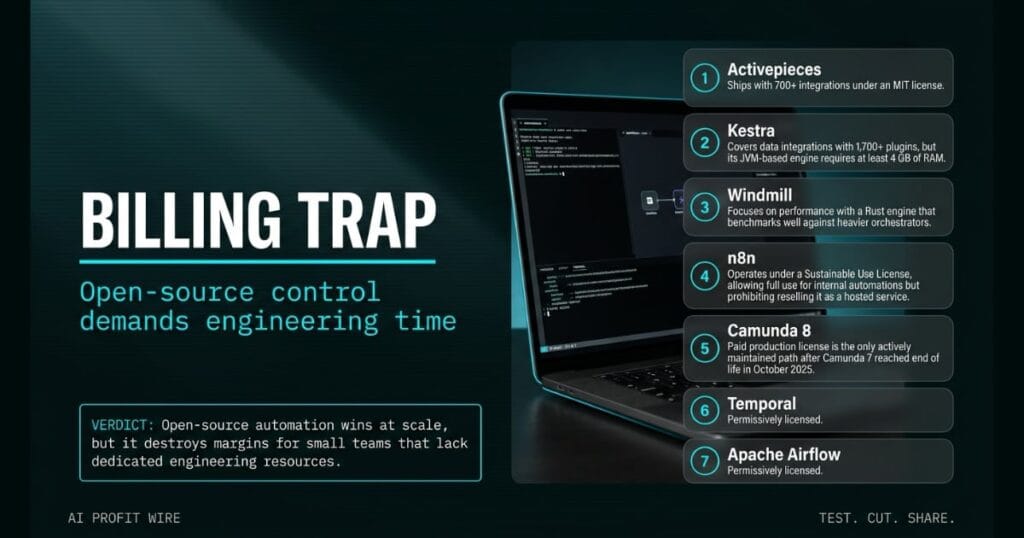
Switching to open-source automation can eliminate expensive per-task and per-seat SaaS subscriptions, significantly reducing operational costs as your business scales.
What is open-source workflow automation and what changed?
Open-source workflow automation tools provide code visibility and control, allowing teams to self-host and avoid per-seat billing.
They trade SaaS subscriptions for infrastructure and engineering time, which changes the cost structure entirely.
The shift is beneficial once volume climbs into the hundreds of thousands of executions, but it may not be worth it for a 5-person team running a handful of workflows.
The report compares tools across deployment model, secrets handling, access control, and auditability, which are the five dimensions that actually determine production readiness.
Open-source provides control, but it demands your own engineering time to secure and maintain.
What is the evidence behind open-source workflow automation?
The report compares 7 distinct tools: n8n, Apache Airflow, Activepieces, Windmill, Camunda 8, Temporal, and Kestra.
Activepieces ships with 700+ integrations under an MIT license, and Kestra covers data integrations with 1,700+ plugins but its JVM-based engine requires at least 4 GB of RAM.
Windmill focuses on performance with a Rust engine that runs scripts in Python, TypeScript, and Go, and auto-generates UIs from your code, though SAML SSO and advanced audit features sit behind a separate enterprise tier.
n8n operates under a Sustainable Use License that allows full use for internal automations but prohibits reselling it as a hosted service, and Camunda 7 reached end of life in October 2025.
Apache Airflow 3.0, released in 2025, modernized the execution model, but the tool still shows its origins as a scheduled data pipeline tool rather than general business automation.
The evidence shows distinct tradeoffs between memory footprint, licensing restrictions, and integration depth.
How does open-source workflow automation compare to the alternatives, and what background do small business owners need?
“Open source” doesn’t mean the same thing across every tool, and the gap shows up the moment legal reviews the license.
Activepieces, Temporal, Apache Airflow, and Kestra are permissively licensed, while Windmill uses copyleft AGPLv3 that can force you to open-source your own code or buy a commercial license.
Camunda 8 now ships its self-managed components under a source-available license, paid for production use, which means the free tier is evaluation-only.
Transparency lets you inspect the code, but it doesn’t configure encryption, scope access, or stream an audit trail to your SIEM platform, so you must assess these dimensions independently.
Most modern engines separate scheduling from execution, which means you can add capacity exactly where the load lands rather than scaling the entire stack.
You’re trading vendor safety for raw control, which requires a technical foundation to manage securely.
How does open-source workflow automation affect day-to-day operations for small businesses?
Switching to open-source automation can eliminate expensive per-task and per-seat SaaS subscriptions, which significantly reduces operational costs as your business scales.
You must handle your own infrastructure and security setup, including encrypted credentials, RBAC, and audit logs, with SSO and advanced audit features often sitting behind separate enterprise licenses.
Popular projects ship integrations faster, surface bugs sooner, and leave a trail of forum answers for edge cases, while smaller projects can be sharper technically but leave you closer to the source code when something breaks.
Founders weighing this tradeoff can track related automation signals to see where open-source tools actually deliver margin in practice.
Day-to-day operations shift from managing SaaS limits to managing your own infrastructure and security audits.
The new server rack hums in the back office, and your lead technician is deep in RBAC configuration instead of shipping client work. The team bought it to escape per-seat SaaS billing, but the engineering time is bleeding margins faster than the subscriptions ever did.
The source report is blunt about this tradeoff: open-source automation is beneficial once volume climbs into the hundreds of thousands of executions, but it may not be worth it for a 5-person team running a handful of workflows. Kestra alone demands at least 4 GB of RAM for its JVM engine, and that is before you add SSO or SIEM integrations.
The math only flips when your execution volume justifies the labor, which means founders running low-volume operations should stay on closed SaaS and stop pretending otherwise. The open-source route rewards scale, and it punishes teams that buy it for the ideology instead of the volume.
What is the final verdict on open-source workflow automation?
Open-source automation eliminates per-seat billing and allows you to scale on your own terms, but it requires engineering time to configure encryption, access control, and SIEM integrations.
A 5-person team running a handful of workflows will likely lose money on the infrastructure time, while businesses running hundreds of thousands of executions see the tradeoff become beneficial.
You must evaluate your specific volume and technical capacity before making the switch, because the wrong choice destroys margins for years.
The license matters as much as the feature set, since AGPLv3 and source-available licenses can both trigger commercial obligations that permissive licenses avoid.
Open-source automation wins at scale, but it destroys margins for small teams that lack dedicated engineering resources.
Source: blog.n8n.io
