Implementing these AI writing workflows can save time on drafts while protecting the business from legal or reputational errors.
What’s AI writing for business and what changed?
AI writing for business is shifting from single prompts to guided systems with clear steps, owners, and risk controls. The AutoGPT Blog identifies 5 changes that’ll matter most in 2026.
Teams will break each task into clear stages, giving every step a source, a goal, and a person who checks the result. This approach saves time without letting rapidly created copy weaken trust.
Workflows will move dull tasks to AI, while people choose the message, confirm the facts, and approve the final copy. Companies that set these rules early can produce more useful content and make fewer costly mistakes.
AI writing for business in 2026 is about controlled workflows, not unchecked generation.
What’s the evidence behind AI writing for business?
The report details 5 measures for value and cost, including approval time, first-pass approval, claim fixes, reader action, and cost per asset. Teams must build a baseline from the old process and compare the same content type across work cycles.
The evidence outlines 4 risk levels for review, ranging from low risk internal recaps to critical crisis reports. A low risk social post needs a tone and clear error check, while a critical official report requires a legal check and version log.
The data shows brand guides must turn into 1 short set of controls covering approved names, banned phrases, and rules for private data. Teams should put each rule beside good and bad examples for clarity.
Tracking approved work and matching review to risk provides the hard evidence for AI writing value.
How does AI writing for business compare to the alternatives, and what background do small business owners need?
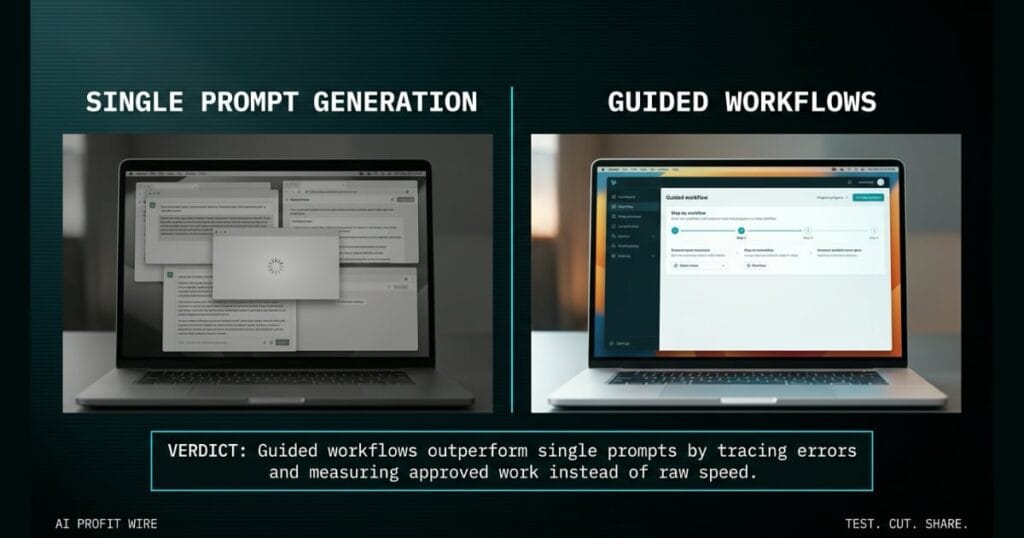
Single prompt generation often produces safe wording because the AI has seen similar patterns many times, which requires heavy human editing. Guided workflows divide the work into 4 stages, making errors easy to trace and fix.
Comparing hourly word count to the 5 new measures reveals that more output can mean extra edits, confused readers, or weak sales. Tracking the time and cost of approved work provides a clearer picture of actual ROI.
An AI writing assistant can flag a missing source, changed figure, or banned phrase before review, which manual editing often misses. Work should stop when figures clash, preventing weak reviews for serious claims.
Guided workflows outperform single prompts by tracing errors and measuring approved work instead of raw speed.
How does AI writing for business affect day-to-day operations for small businesses?
Small businesses must assign a final reviewer for 4 risk levels and stop work when a source is missing. A short delay costs less than a public correction, which directly protects the bottom line.
Teams need to label AI generated content inside the company to see where it saves time and where it pushes work to an editor. Reviewing results with business leaders helps decide if a clear brief or safer template is the best fix.
Writers spend less time fixing clumsy sentences and more time deciding what the copy must say. A brief must name the reader, main claim, proof, limits, and reviewer to make the AI tools work better. If you want to see how this maps to a specific SEO writing stack, our NeuronWriter intelligence report breaks down the workflow layer.
Daily operations shift from fast drafting to strict risk matching and clear briefs.
The sharp smell of cutting fluid hangs in the air as a machinist finishes a production run. The parts look perfect, but the raw steel was never checked against the original blueprint.
A single missing source in an AI draft is exactly like skipping the caliper check on a critical dimension. The machine spits out the part, reports complete success, and leaves a hidden defect that causes an assembly failure later.
You can’t measure the machine’s value by counting how many chips it made in an hour. You have to track the cost per approved part, because a short delay to verify the cut costs less than scrapping a finished order.
What’s the final verdict on AI writing for business?
The strongest teams will use clear workflows, useful brand rules, and review levels that match the risk. They’ll judge results by approved work, reader response, and fewer errors.
People will still choose the main idea, check the proof, and own the final call, which removes dull work without handing every decision to software. This model prevents long reviews for tiny tasks and weak reviews for serious claims.
The advantage comes from better choices, not from filling more pages in less time. Good judgment grows more valuable as basic drafting gets faster, because a weak idea stays weak even when its sentences arrive in 10 seconds.
AI writing for business succeeds when humans control the workflow and verify the risk.
Source: AutoGPT Blog
