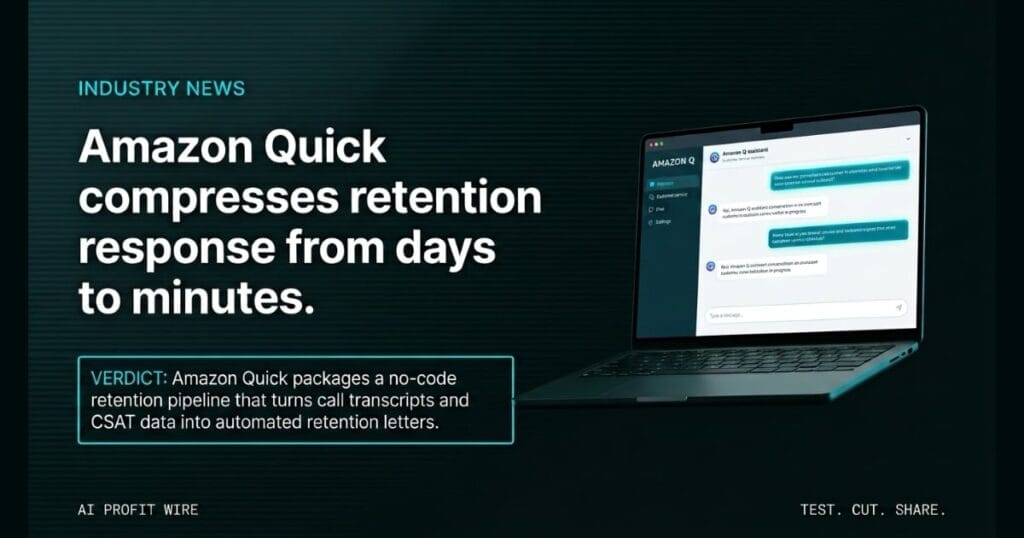
Automating customer retention workflows can significantly reduce response times and prevent churn, directly impacting revenue and customer lifetime value.
What is Amazon Quick retention pipeline and what changed?
Amazon Quick now ships a no-code customer retention pipeline that detects at-risk customers from call transcripts and CSAT data. The pipeline scores customers by retention priority using a custom MCP Action, then generates personalized retention letters automatically.
The walkthrough published on the AWS Machine Learning Blog walks founders through five sequential steps: download at-risk customer data, score customers, generate retention letters, save as PDF, and upload to Amazon S3 for delivery.
AWS frames the operational win as compressing the retention response window from days to minutes. The pipeline replaces the manual review of CSAT spreadsheets and call transcripts that previously let dissatisfied customers churn before anyone reached them.
Amazon Quick packages a no-code retention pipeline that turns call transcripts and CSAT data into automated retention letters.
What is the evidence behind Amazon Quick retention pipeline?
The AWS blog post describes a scenario where a retention team took five days to identify and contact dissatisfied customers. By the time someone manually reviewed CSAT spreadsheets and call transcripts, those customers had already churned.
The pipeline identifies customers with CSAT scores at or below 2, then uses a custom MCP Action to score retention priority based on CSAT and issue recency. The MCP Action is a serverless endpoint that extends Quick Automate with custom business logic.
The pipeline picks the top two highest-priority cases and drafts bonus-credit letters that reference each customer’s specific issues. AWS provides a sample contact center dataset and call transcript documents to walk through the build end to end.
The evidence is an operational walkthrough, not a benchmark. AWS shows the pipeline working on sample data, with no published performance metrics.
How does Amazon Quick retention pipeline compare to the alternatives, and what background do small business owners need?
The Amazon Quick pipeline connects four components in sequence: Quick Dashboard monitors contact center KPIs like CSAT, First Call Resolution, and Average Handle Time. Quick Chat Agent queries structured data and unstructured transcripts in natural language.
Quick Flows turns the Chat analysis into a scheduled or on-demand automation. Quick Automate executes the multi-step pipeline that ingests the at-risk customer list and scores them through the custom MCP Action.
Small business owners need to weigh the promise of a no-code pipeline against the actual setup, which requires an AWS account, a Lambda function, an API Gateway endpoint, and a registered MCP Action connector. The no-code label is generous for a build that involves Python and AWS CLI commands.
The pipeline is real, but the no-code framing understates the engineering lift required to stand it up.
How does Amazon Quick retention pipeline affect day-to-day operations for small businesses?
Small business owners can deploy this pipeline to identify at-risk customers before they churn, then trigger automated retention letters without manual review. The operational win is collapsing the response window from days to minutes.
Founders who want a lighter entry into AI-powered customer support can explore AI chat and lead-capture tools to understand the baseline before committing to a full AWS pipeline build.
The pipeline requires ongoing maintenance of the MCP Action scoring logic. As your CSAT data and call transcripts evolve, the scoring weights need adjustment or the retention priority output loses accuracy.
Day-to-day operations shift from manual transcript review to monitoring the MCP Action scoring logic and the retention letter output.
The 7 AM crew briefing at the landscaping company ends with three voicemails from clients furious about a missed appointment last week. The CSAT spreadsheet in the office laptop shows two of those clients rated the service at or below 2, but nobody opened the file until the voicemails came in. By then, two of the three had already booked a competitor for next month.
Amazon Quick’s pipeline collapses that response window from days to minutes. The Chat Agent reads the CSAT data and the call transcripts, surfaces the at-risk clients, and the custom MCP Action scores them by retention priority. The top two cases get a bonus-credit letter drafted automatically, referencing the specific appointment failure that triggered the bad review.
The catch is the build. The no-code label covers the Quick Automate flow, but the scoring step requires a Lambda function, an API Gateway endpoint, and a registered MCP Action connector. If you do not have an AWS-literate operator on call, the pipeline stays half-built and the voicemails keep coming.
What is the final verdict on Amazon Quick retention pipeline?
Amazon Quick delivers a working retention pipeline that compresses response time from days to minutes using CSAT data, call transcripts, and a custom MCP Action. The operational concept is sound and the sample data walkthrough is complete.
The no-code framing oversells the actual build, which requires AWS Lambda, API Gateway, and a Python MCP server. Small business owners without AWS expertise will need help to stand it up.
Founders with AWS-literate operators should pilot the pipeline on a sample contact center dataset before rolling it into production. The compression of the response window is real, but the maintenance overhead is not zero.
Amazon Quick retention pipeline is a viable build for AWS-fluent founders who want to automate at-risk customer outreach, not a true no-code tool.
Source: AWS Machine Learning Blog
