Small businesses can leverage Fish Audio's open-source or paid API tools to create natural-sounding voiceovers, automate customer support, or build AI avatars, potentially reducing audio production costs.
What is Fish Audio and what changed?
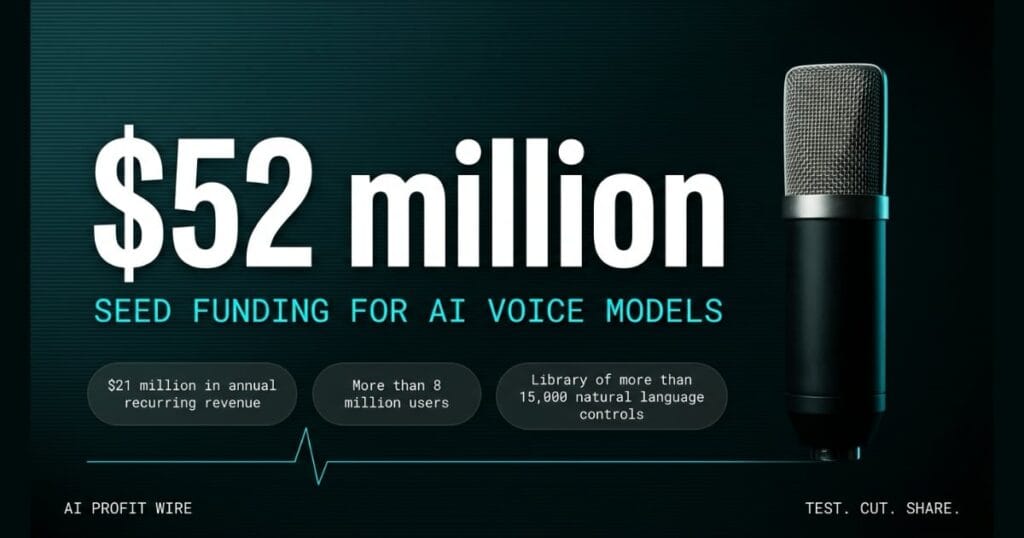
Fish Audio is a startup building expressive AI voice models for creators and enterprises, and it just secured $52 million in seed funding. The round was led by Coreline Ventures and Capital Today, with participation from 359 Capital and several other firms.
The company plans to use the capital to develop an audio understanding model and a speech-to-speech model this year.
Fish Audio is scaling its paid API and enterprise platform to meet rising demand for controllable AI voices.
What is the evidence behind Fish Audio?
Since launching last year, Fish Audio has attracted more than 8 million users to its open-source and hosted models. The platform generates $21 million in annual recurring revenue and has earned 31,000 GitHub stars for its Fish Speech repository.
The company has launched 5 models in the last year, including 4 speech generation models and 1 speech-to-text model.
The user growth and $21 million ARR validate strong market demand for highly expressive voice controls.
How does Fish Audio compare to the alternatives, and what background do small business owners need?
The speech generation market is crowded, with competitors like Cartesia and Speechify fighting for creator and enterprise budgets. Fish Audio differentiates itself with a library of more than 15,000 natural language controls for fine-grained developer adjustments.
While 3 of its speech generation models are open-source, the latest S2.1 Pro model is only available through a paid API.
Competing against well-funded AI labs requires Fish Audio to maintain its technical acumen and cost-efficient model training.
How does Fish Audio affect day-to-day operations for small businesses?
Small businesses can use the platform to create natural-sounding voiceovers, automate customer support, or build AI avatars. HeyGen and Sanas already use the enterprise APIs to power realistic avatars and natural-sounding, low-latency voice agents for calls.
Creators can submit a short voice sample or a contract to prove ownership, and unauthorized voices are removed in under 3 minutes. You can read more about how these capabilities compare to AI voice synthesis and text-to-speech tools to see which fits your budget.
Integrating these APIs can reduce audio production costs, but requires monitoring usage to protect your margins.
The supplier invoice for mulch just doubled because the vendor added an automated blending surcharge. You pay the higher rate because the alternative is buying raw ingredients and mixing it yourself on-site, which burns 4 hours of crew labor.
Fish Audio operates on the exact same premise with its S2.1 Pro model. The open-source tools are free, but deploying the 15,000 natural language controls for low-latency calls requires the paid API.
That $21 million in ARR shows founders are willingly paying the surcharge to avoid training their own models on a single GPU. You trade money for time, but you must verify the 3-minute takedown process actually protects your brand voice from being cloned by a competitor.
What is the final verdict on Fish Audio?
Fish Audio has proven product-market fit with $21 million in ARR and 8 million users. The $52 million seed round provides the runway needed to compete against larger AI labs on fine-grained voice controls.
Small businesses can leverage the paid API to automate support and sales ops, but must manage the risk of unauthorized voice cloning.
The platform delivers immediate ROI for enterprises needing expressive, low-latency voices without the infrastructure costs.
Source: TechCrunch AI
