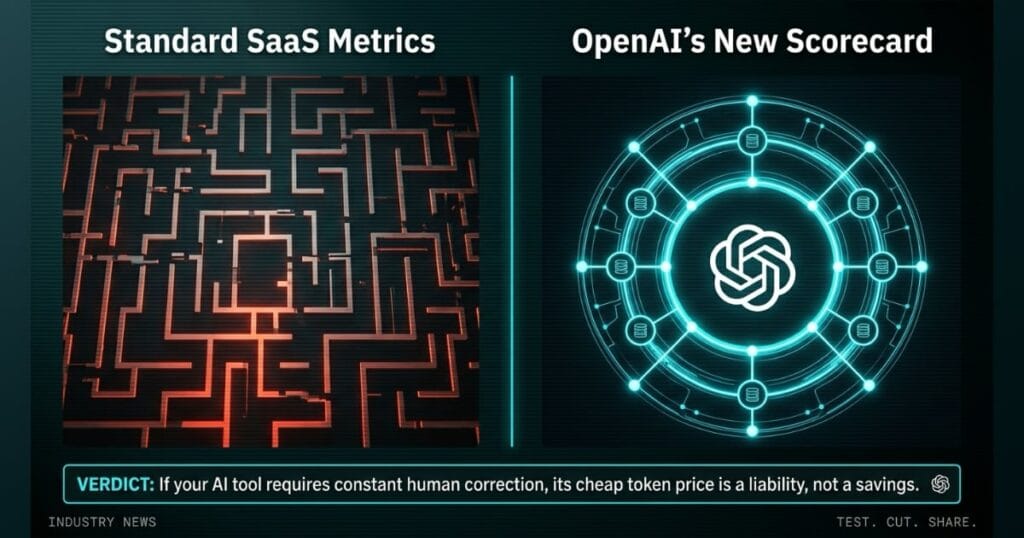
Provides a practical framework for small business owners to evaluate if their AI tools are genuinely saving time and money or just adding costs.
What is OpenAI’s Useful Intelligence Per Dollar and what changed?
OpenAI published a new enterprise scorecard to help businesses measure the actual value of their AI investments. The framework shifts focus from basic adoption metrics to a new standard called Useful Intelligence Per Dollar.
According to CFO Sarah Friar, the market historically measured software success through seats purchased and active users. The new scorecard demands businesses measure work accomplished by calculating the full cost of producing a successful outcome.
This methodology requires enterprises to define what constitutes a completed task and compare it against pre-AI operations. It forces leaders to look beyond affordable tokens, which don’t always equate to value if a model takes longer to fulfill a task.
The shift changes the fundamental metric from user adoption to actual work accomplished.
What is the evidence behind OpenAI’s AI ROI scorecard?
A PwC survey in January revealed that only 12% of CEOs think AI has delivered cost and revenue benefits. This sharp scrutiny prompted OpenAI to release its scorecard built on 4 principles.
First, enterprises must measure useful work by defining what done actually constitutes within their operations. Second, they must consider the cost of successful outcomes by factoring in employee time, human review, retries, and rework.
Third, the framework stresses dependability, noting that accurate and consistent results require less input from human staff. Finally, it asks businesses to consider whether investment buys more work as usage grows and if economics improve at scale.
The evidence shows traditional adoption metrics fail to capture true AI ROI.
How does OpenAI’s scorecard compare to the alternatives, and what background do small business owners need?
The scorecard contrasts with standard SaaS metrics that rely on counting seats purchased and licenses renewed. OpenAI argues this older approach fails to capture the real economic value of AI models.
The framework directly challenges the assumption that models with the cheapest tokens provide the best value. It points out that affordable tokens sometimes take longer to fulfill a task than more expensive models.
By tracking outcomes, total cost, and cost per outcome over time, businesses can determine the exact level of model required. OpenAI highlights 3 tiers of model capability, including Sol as the most comprehensive, Terra as mid-level, and Luna as the most affordable.
Comparing total outcome costs exposes the hidden expenses behind cheap token pricing.
How does OpenAI’s AI ROI scorecard affect day-to-day operations for small businesses?
Small business owners must audit their AI tools to see if they genuinely save time or just add costs. The scorecard requires defining what a finished task looks like and comparing it to how things were done before AI.
Owners need to track the exact cost of successful outcomes, including employee time spent reviewing and fixing AI errors. This reveals whether an accurate, consistent model saves more money than a cheap alternative that requires constant human intervention.
Using a structured ROI framework like this is critical when adopting any of the AI tools we track for small business operations. It prevents you from paying for seats that look active on a dashboard but deliver no actual work.
Small businesses must track human review time and retries to find their true AI cost per outcome.
The discount ink supplier’s invoice lands on the counter next to the wide-format printer, with a per-ounce price that undercuts the premium brand. Only 12% of CEOs say their AI tools delivered real cost and revenue benefits, and the ink math works the same way when you ignore the cost of retries.
The cheaper cartridges clog the printheads and force the team to redo every other print job. Wasted media piles up next to the press, and the front desk schedules fewer client jobs because actual production time per print has doubled.
You calculate the total cost of a successful outcome by factoring in the wasted media, the extra staff hours, and the lost booking slots. The discount on the ink invoice is an illusion, and your AI tools work exactly the same way when you ignore the hidden cost of human review and rework.
What is the final verdict on OpenAI’s AI ROI scorecard?
OpenAI provides a practical framework that forces small business owners to stop celebrating seat adoption and start tracking work accomplished. It exposes the hidden costs of cheap models by factoring in employee time, human review, retries, and rework.
With only 12% of CEOs seeing cost and revenue benefits from AI, this scorecard offers a necessary reality check. It demands you track outcomes, total cost, and cost per outcome over time to see if your economics actually improve at scale.
If your AI tool requires constant human correction, its cheap token price is a liability, not a savings.
Source: AI Business
