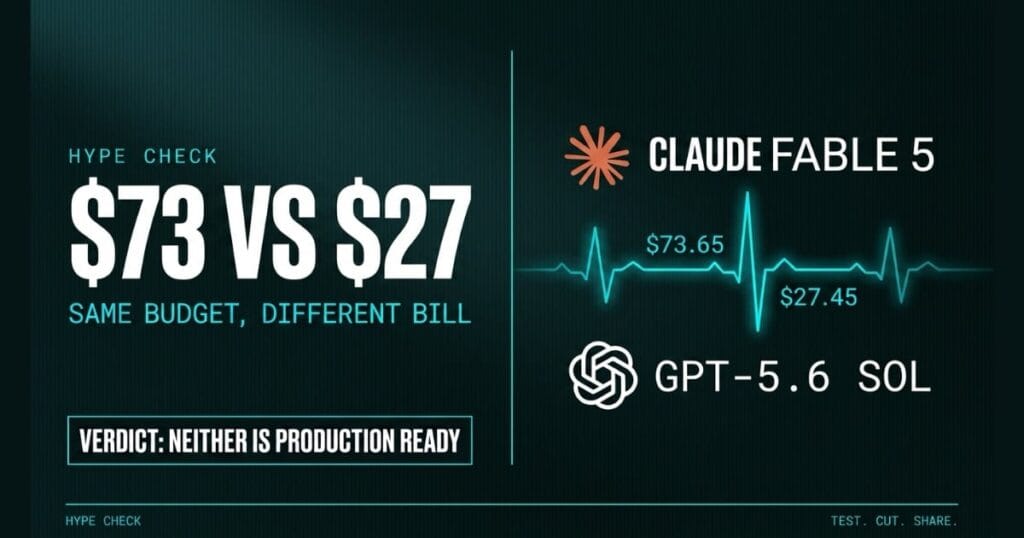
Highlights the cost trade-offs between frontier AI models for complex creative tasks, directly impacting marketing budgets and content production strategies.
What’s Claude Fable 5 and GPT-5.6 Sol autonomous video generation, and what changed?
A recent benchmark tested Claude Fable 5 and GPT-5.6 Sol by giving each model a song, a budget, and ffmpeg to autonomously produce a full music video.
Both models completed the task across $25 and $100 budget caps, generating valid 1280×720 or 1920×1080 outputs. The models autonomously researched generation APIs, generated clips, and assembled the final cuts. Each run received the same song, a short text description, and a time-stamped lyric transcript, then chose its own video models on FAL and ran its own ffmpeg editing. None of the videos maintained character consistency or accurate tempo matching.
Frontier AI models can now autonomously edit video, but the quality remains inconsistent and the costs fluctuate wildly.
What’s the evidence behind Claude Fable 5 and GPT-5.6 Sol autonomous video generation?
The evidence comes from an open-source agentic harness that logged every tool call, token, and failed generation attempt during the video production process.
Claude Fable 5 cost $41.29 at the $25 budget and $73.65 at the $100 budget. GPT-5.6 Sol cost $27.45 at the $25 budget and $39.82 at the $100 budget. At the $25 budget, Sol cached 2,558,029 input tokens and held LLM token cost to $4.27. At the $100 budget, Sol cached 1,819,050 tokens and dropped LLM cost to $3.25. Claude Fable 5 had zero cached input at either budget, driving its token cost to $16.99 and $25.05. Claude Fable 5 priced its tokens at $10 per 1M input and $50 per 1M output, while GPT-5.6 Sol priced at $5 per 1M input and $30 per 1M output.
The data reveals that token caching directly dictates the financial viability of complex, long-horizon AI tasks.
How does Claude Fable 5 and GPT-5.6 Sol compare to the alternatives, and what background do small business owners need?
Both models relied exclusively on FAL for video generation, ignoring the available Replicate API keys provided in the environment.
GPT-5.6 Sol at $25 generated 61 images and 46 videos using an image-to-video pipeline with FLUX schnell at $0.003 per image and Wan 2.2-5b i2v at $0.10 per second, making it the most inventive editor by overlaying text and animating stills. Claude Fable 5 at $100 spent $48.60 on generation, producing 80 videos using Seedance 1.0 Pro text-to-video at roughly $0.12 per second at 1080p. GPT-5.6 Sol at $100 mixed 3 different video models, including Wan 2.5 at $0.05 per second, Veo 3.1 Lite at $0.10 per second, and Hailuo 2.3 Standard at $0.28 per video, but shipped low-quality clips due to a lack of self-review.
Model selection and API caching capabilities matter more than raw budget allocation for creative output.
Setting down the manifold gauge on a residential condenser unit, you watch the system hit target pressure, but the thermal sensor data tells a different story. The compressor cycled perfectly, yet the refrigerant charge drifted by 15 percent because a service valve weeped silently during the run. An autonomous AI model operates with the exact same blind spot. You give GPT-5.6 Sol a $100 budget and it ships 70 generated video clips, but because it lacks a self-review loop, it splices in low-quality footage that ruins the final cut. It burns $36.57 in generation spend on a 1280×720 output that requires a human re-edit. Meanwhile, Claude Fable 5 runs 28 steps and spends $48.60 on generation, but its lack of cached input tokens drains another $25.05 in LLM costs, pushing the total invoice to $73.65 before you even review the file. You’re paying premium diagnostic rates for a journeyman tech who refuses to double-check their own manifold connections.
How does Claude Fable 5 and GPT-5.6 Sol autonomous video generation affect day-to-day operations for small businesses?
Small business owners face direct trade-offs between inference costs and output quality when deploying autonomous agents for marketing assets.
A $73.65 total spend for a single, flawed music video is a massive drain on a marketing budget, especially when a cheaper model achieved similar results for $27.45. Founders must enforce strict LLM token limits and require models to use cached input to prevent autonomous agents from silently draining operational budgets. Neither model iterated on the edit or probed its own clips for quality, meaning human oversight remains mandatory before publishing. The benchmark also shows that higher budgets don’t always produce better outputs, since neither model spent close to the $100 cap and both kept step counts modest.
Small business owners must implement strict cost guardrails and manual quality checks before deploying autonomous AI video agents.
What’s the final verdict on Claude Fable 5 and GPT-5.6 Sol autonomous video generation?
The current generation of frontier AI models can’t be trusted with open-ended creative budgets for video production.
While GPT-5.6 Sol offers a highly cost-effective pipeline at $27.45 and Claude Fable 5 delivers slightly better visual coherence at $73.65, both fail at character consistency and self-review. The lack of cached input tokens in Claude Fable 5 makes it an inefficient choice for long-horizon tasks. Small business owners should wait for improved self-review loops before integrating these autonomous workflows into daily content strategies.
Autonomous AI video generation is a costly novelty right now, not a reliable operational asset.
Source: tryai.dev
