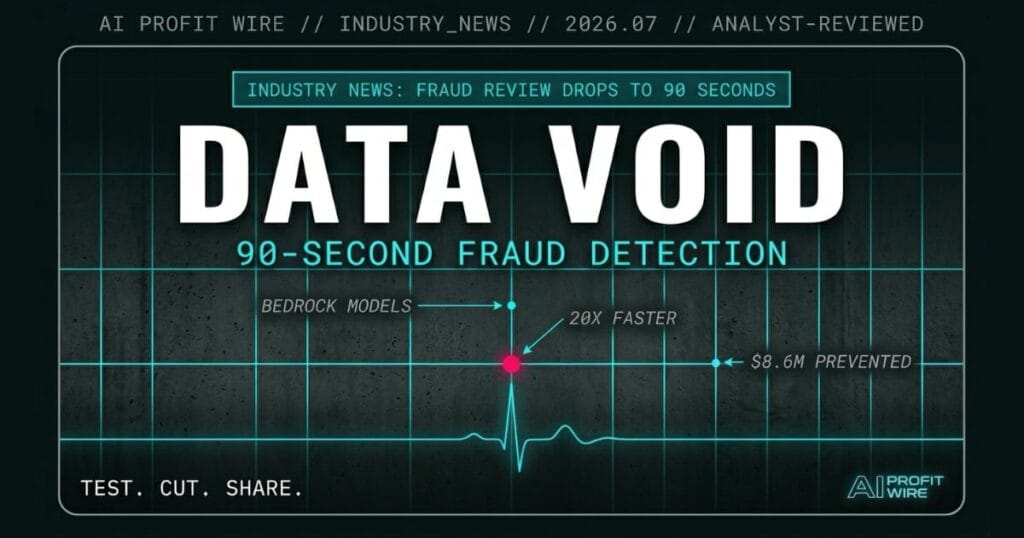
Slashes fraud review time by 20x, significantly reducing operational overhead and risk for any business processing financial paperwork.
What’s Inscribe’s Amazon Bedrock fraud detection system and what changed?
Inscribe built an agentic AI system on Amazon Bedrock that reasons across loan documents the way an expert fraud analyst would.
The system detects tampered, fabricated, and AI-generated financial documents in under 90 seconds, a 20x improvement over the 30-minute manual review a typical application used to take. Inscribe has built document fraud detection for banks, lenders, and fintechs since 2017, and this agentic version replaces a single-question tool with a system that plans steps, calls multiple models, and synthesizes a final decision without a human triggering each step.
This is a 20x speed jump on a task where the manual version was already too slow to keep pace with fraud.
Manual review broke down for 3 compounding reasons. Scale meant institutions had to hire proportionally more analysts as application volume grew, driving up cost without improving detection. Static, rule-based fraud checks missed sophisticated schemes like deepfakes, AI-generated fake documents, and coordinated identity theft rings. And different analysts reached different conclusions on similar cases, which created both compliance risk and fairness problems that no amount of additional headcount actually fixed.
What’s the evidence behind Inscribe’s fraud detection speed?
Fraud now appears in 1 of every 16 documents submitted, and AI-generated forgeries grew 5x between April and December 2025, according to Inscribe’s own 2026 State of Document Fraud Report.
3 verified customer results back the performance claim. BHG Financial cut manual review time by more than 90% and prevented millions in fraud losses. Logix Federal Credit Union prevented more than $3 million in potential loan fraud in 8 months. BCU prevented $5.6 million by catching coordinated fraud rings submitting multiple applications, a pattern manual review was missing entirely.
These are named customers reporting dollar figures, not vendor-supplied benchmark claims with no accountability behind them.
BHG Financial’s own director of fraud management described the shift in plain operational terms, saying the deployment turned fraud detection from a manual, subjective process into a scalable, transparent system the team can trust every time. That is the actual claim worth testing against a vendor demo: not whether the tool catches fraud in a controlled sample, but whether the review process stays consistent once the same system runs against 10 applications one week and 10,000 the next.
How does Inscribe’s agentic AI affect day-to-day operations for small businesses?
Inscribe uses different models for different tasks instead of one model for everything, which is the detail that actually drives the cost and speed numbers.
Claude Haiku 4.5 handles high-volume parsing and initial classification at roughly 40% lower inference cost than a larger model, while Claude Sonnet handles the harder cross-document reasoning and generates the final audit-ready report. For a small accounting firm spending 10 hours a week manually verifying client tax documents, a 20x speedup turns that into a 30-minute check, which is the difference between hiring another admin and scaling the same headcount further. You can track how model-matching strategies like this show up across other AI deployments in our archive of pipeline-filtered AI signals for small business owners.
Matching cheaper models to routine tasks and reserving expensive models for hard reasoning is what makes this economically viable at scale.
A general contractor opens a stack of subcontractor bids for a 6-unit renovation and has 40 minutes before the client call to catch anything that doesn’t add up. One invoice lists labor hours that don’t match the crew size on the permit application. Another quotes material costs that are 15% below every other bid on the same job, which usually means someone is cutting corners or padding the number somewhere else. A sharp estimator catches maybe half of these on a good day, because the job is reading dozens of documents against each other while the phone keeps ringing. Inscribe’s system does the same cross-referencing a careful contractor already does by instinct, except it checks every document against every other document in under 90 seconds instead of the 40 minutes a human has before the next call, and it does not get tired on the tenth bid of the afternoon the way a person does.
What’s the final verdict on Inscribe’s fraud detection system?
Inscribe’s agentic system is a verified, production-proven fraud detection upgrade backed by named customers and dollar figures, not a lab demo.
The 20x speed improvement holds up against 3 independent customer results, and the multi-model architecture on Amazon Bedrock gives a concrete reason the cost and speed numbers are both real at the same time instead of one being sacrificed for the other, which is usually the tradeoff vendors quietly hope nobody checks.
Any business processing financial paperwork at volume should treat agentic document verification as a near-term operational upgrade, not a future consideration.
The underlying architecture also explains why this scales past a single pilot. Documents land in cloud storage the moment they’re uploaded, get queued automatically, and move through a pool of worker processes that scale up during business hours and back down overnight, so a firm reviewing 10 applications and one reviewing 10,000 run on the same system without a manual capacity plan in between. That kind of elastic infrastructure is exactly what lets a small firm access the same detection quality as a large bank without building or maintaining any of it themselves.
Source: AWS Machine Learning Blog
