Drastically reduces the time and cost required to create branded, content-rich presentations for client pitches and internal meetings.
What’s Gemini in Google Slides and what changed?
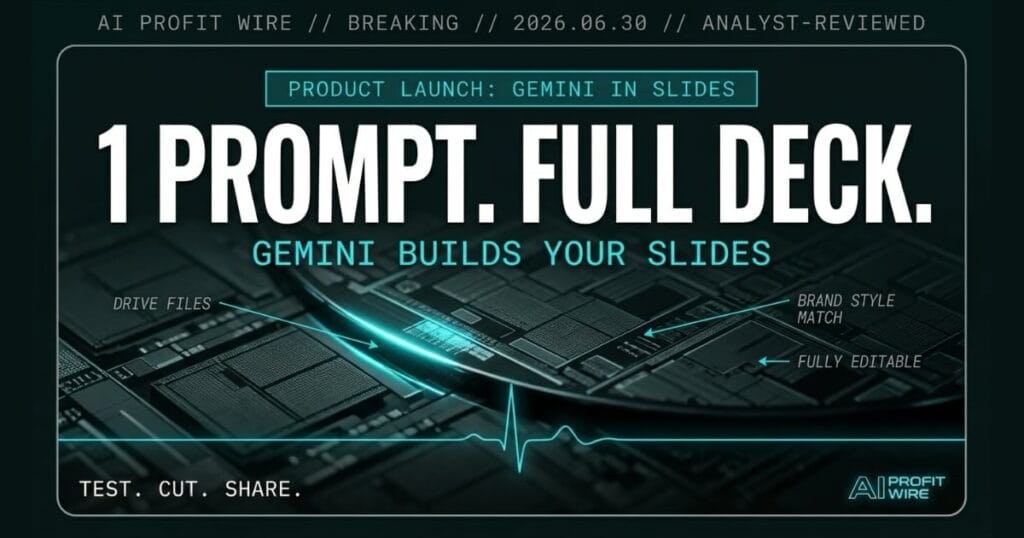
Google integrated Gemini directly into Google Slides to generate complete multi-slide presentations from a single text prompt, grounding output in existing Drive files, matching styles from reference decks, and producing fully editable slides. The feature rolls out across Google Workspace Business and Enterprise plans, plus Google AI Pro and Ultra consumer tiers.
The update builds on 2 prior releases: the Gemini app Canvas presentation generation launched October 28, 2025, and the in-Slides editable brand-matched generation that followed in March and April 2026. The current version pulls context from Drive files, emails, and chats, applies style references from existing decks, and suggests enrichment content from your communications history.
This moves presentation creation from manual assembly to prompt-based generation while preserving full editability inside the Google Workspace stack.
What’s the evidence behind Gemini in Google Slides?
Google announced the feature on its official Workspace Updates blog with specific capability claims. The integration references your Drive files for content sourcing, analyzes your existing presentations to learn your design language, and produces slides that adhere to your brand style automatically. A Google Workspace community post confirms Gemini in Slides understands the context of your work and adheres to your company brand guidelines.
The feature is available to Google Workspace Business Starter, Standard, and Plus; Enterprise Starter, Standard, and Plus; Essentials tiers; Education plans; and Nonprofits. Consumer access runs through Google AI Pro and Ultra. There is no admin control required for the Gemini-app Canvas feature, lowering the adoption barrier for teams without dedicated IT.
The evidence points to a mature product launch with clear commercial intent to retain Workspace subscribers against competing AI presentation tools like Beautiful.ai, Gamma, and Tome.
How does Gemini in Google Slides affect day-to-day operations for small businesses?
Small business owners can now produce client pitches, investor decks, and internal reviews without starting from blank slides. The workflow connects content gathering and formatted output: Drive files, emails, and chats feed directly into the generation process, and style references ensure brand consistency without manual template work. For teams already on Google Workspace, there is no new vendor to onboard, no API to configure, and no export friction between tools.
The operational impact is the elimination of a recurring time sink. Presentation assembly, the copy-paste-and-align phase that precedes actual content judgment, consumes hours per week across client-facing roles. Gemini in Slides compresses that phase to seconds. The output stays editable, which means the AI handles the formatting while the human handles the judgment. For founders tracking operational AI signals for competitive positioning, our live archive of pipeline-filtered AI capabilities and cost trends reshaping small business workflows tracks how bundle features reshape vendor decisions.
The operational impact is elimination of a recurring time sink that compounds across every client-facing role.
A 40-slide client proposal sits blank on a monitor while a marketing specialist wastes 3 hours copying brand hex codes and aligning text boxes. The drag is not the thinking, it is the assembly. Gemini in Google Slides removes that assembly layer by pulling your actual documents, your actual communications, and your actual brand standards into a generated starting point you can still manipulate. The prompt does not replace your judgment. It replaces the copy-paste and alignment tweaking that used to precede it. For a small business owner already paying for Google Workspace, this is recovered capacity that compounds across every pitch, every proposal, and every internal review.
What’s the final verdict on Gemini in Google Slides?
Google Workspace subscribers should treat this as a standard feature to adopt immediately, not a speculative experiment to monitor. The integration depth and native editability remove the typical adoption barriers that slow small business AI uptake. Competitors in the AI presentation space now face a bundling threat from a platform already embedded in most SMB workflows. Beautiful.ai, Gamma, and Tome all charge standalone subscriptions for capabilities that Google now includes in existing Workspace plans.
The strategic implication is broader than presentations. Google is methodically layering Gemini into every surface where Workspace users already spend time: Gmail, Docs, Sheets, Slides, Drive. Each integration raises the switching cost of leaving the Google stack and reduces the marginal value of adding a standalone AI tool. For small business owners, the question shifts from “which AI tool should I buy” to “am I using what I already pay for.”
Adopt it, benchmark your current presentation time against the new workflow, and reallocate the recovered hours to revenue-generating work.
Source: workspaceupdates.googleblog.com
