Significantly reduces operational costs by switching from opaque, five-figure enterprise contracts to predictable or self-hosted pricing.
What is Workato and what changed?
Workato is an enterprise integration platform as a service (iPaaS) that connects business applications through automated workflows called recipes. A recipe pairs a trigger with a sequence of actions, and the platform bills each action as a metered task.
Workato serves more than 17,000 customers using a cloud-only runtime. It was built for large, IT-governed teams syncing data across CRM, ERP, and HR systems.
The platform remains a Gartner-leading product, but its per-task billing model and custom quote pricing typically start in the 5-figure range annually, with no public tier or free option.
Workato is a high-cost enterprise iPaaS built for IT-governed teams, not lean small business owners.
What is the evidence behind Workato alternatives?
Engineering teams leave Workato when its cloud-only runtime, per-task billing, and limited code execution collide with real production needs.
Per-task billing means costs track volume instead of value, and a busy month produces an invoice nobody expected. The cloud-only runtime prevents regulated teams from keeping data inside their own infrastructure.
Limited code execution also slows teams that need complex, multi-branch logic and deep debugging. The platform’s ceiling routinely hits teams that think in code.
The pricing model and architectural constraints create unpredictable invoices that kill operational margins.
How does Workato compare to the alternatives, and what background do small business owners need?
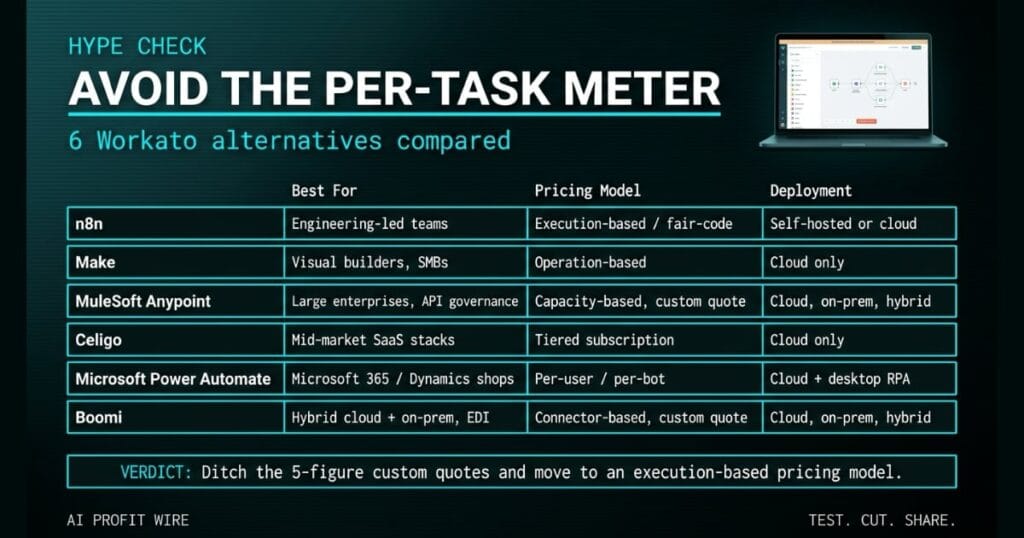
n8n, Make, MuleSoft, Celigo, Microsoft Power Automate, and Boomi each close a different Workato gap across deployment, pricing, and code extensibility.
n8n is a source-available platform with self-hosting options and execution-based pricing, where 1 workflow run counts as 1 execution regardless of step count. It includes 1,000+ native integrations, a Code node for JavaScript and Python, and AI nodes for production-grade agentic workflows.
Make is a cloud-only visual builder for SMBs that uses operation-based pricing. It’s faster to learn than Workato but lacks self-hosting and deep governance.
Microsoft Power Automate starts at 15 dollars per user each month, but unattended RPA bots cost 150 dollars or more apiece per month. Premium connectors sit behind paid tiers, and step outside the Microsoft ecosystem to see licensing paywalls stack up.
MuleSoft and Boomi target large enterprises with deep API governance. MuleSoft licensing often runs into 6 figures and requires dedicated developers for its proprietary DataWeave language and three-layer API design.
Celigo offers tiered subscriptions for mid-market SaaS stacks. It provides moderate extensibility through JavaScript and SuiteScript but remains a managed cloud platform with no self-hosting option.
n8n is the strongest choice for teams wanting full code control and predictable costs without 5-figure custom quotes.
The print shop’s automated billing software just spat out the monthly invoice, and a banner month of seasonal promo orders pushed the task count far higher than the previous cycle. The vendor meters every print job, every email confirmation, and every shipping label generated through the system.
The shop owner didn’t move more product, but the invoice moved far higher because the per-task meter scales with activity, not value. A 5-figure Workato contract applies the same structure to workflow automation, where every action inside a recipe is a metered task.
Switching to an execution-based model means a busy month costs the same as a slow one, because 1 workflow run counts as 1 execution regardless of how many steps it holds. The 17,000-customer base that pays per task is the proof that most teams don’t audit the meter until the invoice surprises them.
How does Workato affect day-to-day operations for small businesses?
Workato doesn’t affect daily operations for small business owners because the platform’s 5-figure custom quotes and IT-governed feature set target large enterprise teams. Most SMBs never enter the sales conversation.
Small business owners running SaaS-to-SaaS automation look to alternatives like n8n and Make, which you can track alongside other operational signals across the Wire.
The 6 alternatives profiled in the source split into heavyweight iPaaS platforms (MuleSoft, Boomi) for API-led integration and lighter code-first builders (n8n, Make) for faster deployment.
Day-to-day operations for small business owners happen on n8n, Make, or Power Automate, not on Workato.
What is the final verdict on Workato alternatives?
Workato is overkill for most small business owners due to its opaque pricing and cloud-only constraints. The 6 alternatives each close a specific gap.
n8n and Make provide the necessary connector depth without the 5-figure entry fee. n8n specifically removes the cloud lock-in through self-hosting, with execution-based pricing that doesn’t penalize a busy month.
Teams should migrate automations with the highest throughput first. This ensures the fastest ROI by moving the most expensive tasks to a favorable pricing model, which is the operational logic the source recommends.
Ditch the custom quotes and move to a transparent, execution-based pricing model on a platform you can self-host.
Source: blog.n8n.io
