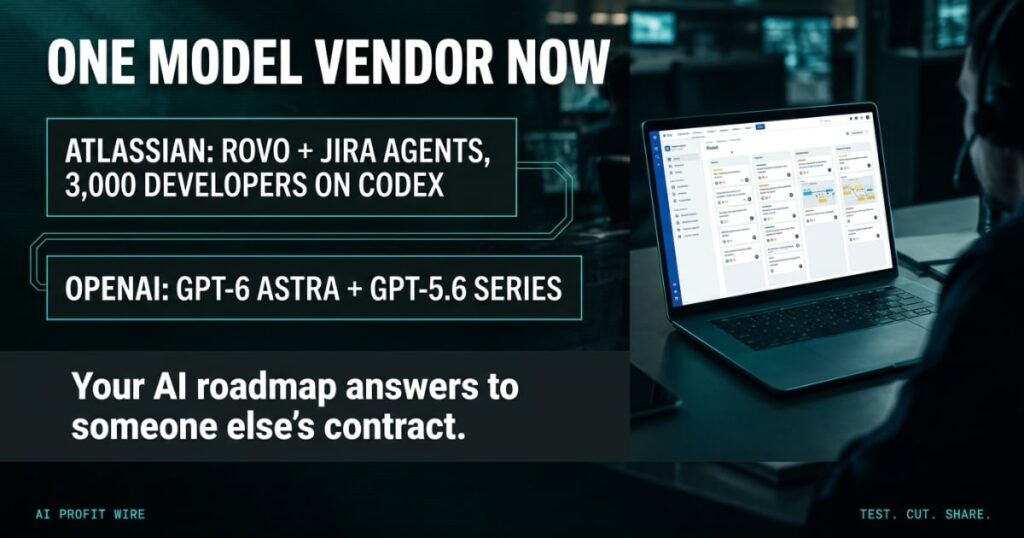
Integrates project management data with advanced AI models to reduce time spent searching for internal project status and blockers.
Atlassian and OpenAI have expanded a partnership that began in 2023, and the practical outcome is specific: OpenAI frontier models, including GPT-6 Astra and the GPT-5.6 series, will power agents across Atlassian’s platform and its Rovo AI layer.
For the large share of small and mid-size technology, consulting, and services businesses that run delivery work inside Jira and Confluence, the AI inside those tools now follows a contract they have never read.
Your project management stack now has a single AI model vendor baked into its roadmap.
What is the Atlassian OpenAI partnership and how does it work?
The OpenAI announcement states the mechanics: under a new agreement, OpenAI frontier models power agents across Atlassian’s platform and Rovo, which combines OpenAI intelligence with Atlassian’s Teamwork Graph.
The Teamwork Graph documentation describes that graph as an enterprise context layer connecting people, projects, documents, and decisions, which is what gives the agents their understanding of how a company works.
The agreement gives Atlassian expanded access to the latest OpenAI frontier models as OpenAI advances capability, efficiency, and price-performance.
The partnership is a model supply agreement with your workflow as the endpoint.
Does Rovo actually connect enterprise knowledge to AI agents?
The stated mechanism is real and documented: Rovo draws on the Teamwork Graph to link Jira tickets, Confluence documents, and relevant discussions into one assessment.
The announcement’s own example: a product manager preparing for a launch asks Rovo whether the team is on track, and Rovo connects tickets, documents, and discussions to identify engineering blockers, flag missed milestones, and surface decisions that need attention.
Atlassian’s Rovo product page positions the same capabilities for production use, with admin controls over what the AI accesses.
The claim is grounded in the vendor’s own usage, which serves as the proof of concept.
How does the Atlassian OpenAI partnership affect your business?
Any team running delivery, engineering, or product work inside Jira and Confluence is affected, which covers a large share of small and mid-size technology, consulting, and services businesses.
The practical consequence: AI features you adopt inside Rovo inherit OpenAI’s model decisions, including capability shifts, deprecations, and price-performance changes as the GPT-6 and GPT-5.6 lines advance.
The integration also extends outward, because Atlassian plugins bring Jira work items, Confluence content, and people directly into ChatGPT and Codex prompts, subject to permissions.
If Jira runs your week, this partnership runs your AI stack.
What do the developer numbers say about the partnership?
More than 3,000 Atlassian developers use Codex across their terminals, IDEs, and code review workflows, according to the announcement.
The plugin route runs both directions, which is what separates an announcement from an integration. ChatGPT users reach Atlassian context, and Atlassian agents reach frontier models, under the same agreement.
Through Atlassian plugins powered by the Teamwork Graph, Codex users can access relevant work items and technical documentation while they write, test, and ship software.
The companies are also exploring deeper Jira integrations for assigning work to AI agents, tracking progress, and reviewing results, paired with DX, Atlassian’s developer productivity platform.
3,000 internal developers on Codex is the adoption number that makes the integration sticky.
The delivery board opens at 9 a.m. and every ticket now sits under an assistant banner nobody on the team approved. The agency’s sprint rituals, the client escalations, the definition of done, all of it flows through an AI layer whose next model change is decided in a contract between two other companies.
Ecommerce owners know this pattern: the storefront platform changes its checkout fee and your margin moves overnight. An agent platform changing its model vendor works the same way, except the change lands inside your team’s daily decisions instead of your invoice.
The 3,000-developer figure is the tell that this is load-bearing already, not a pilot program, and load-bearing dependencies deserve the same review as any supplier contract.
What should you do about the Atlassian OpenAI partnership now?
Audit which of your team’s workflows depend on AI features inside Atlassian products, and mark the ones that would degrade if the underlying model changed.
If your team tests Rovo’s agent features, start with a read-only use case like launch readiness checks before granting agents the ability to act on tickets, and keep a human reviewing results as the Jira agent integrations roll out.
If your business runs on other tools, treat this as a template: every major work platform is pairing with a frontier model vendor, and the AI inside your tools will follow contracts you do not see.
Map your model dependencies this week, before the features become load-bearing.
This announcement joins a run of platform-model alliances as every vendor picks its reasoning layer. You can read the rest of the AI partnership news we have covered to see how the map is forming.
Source: OpenAI Blog
