Increases productivity by replacing manual typing with high-accuracy, personalized speech-to-text that handles background noise.
What is Wispr Flow and what changed?
Wispr Flow is an AI-powered dictation platform that allows users to interact with mobile and desktop environments using speech. It moves beyond simple transcription by formatting thoughts and learning a user’s specific vocabulary.
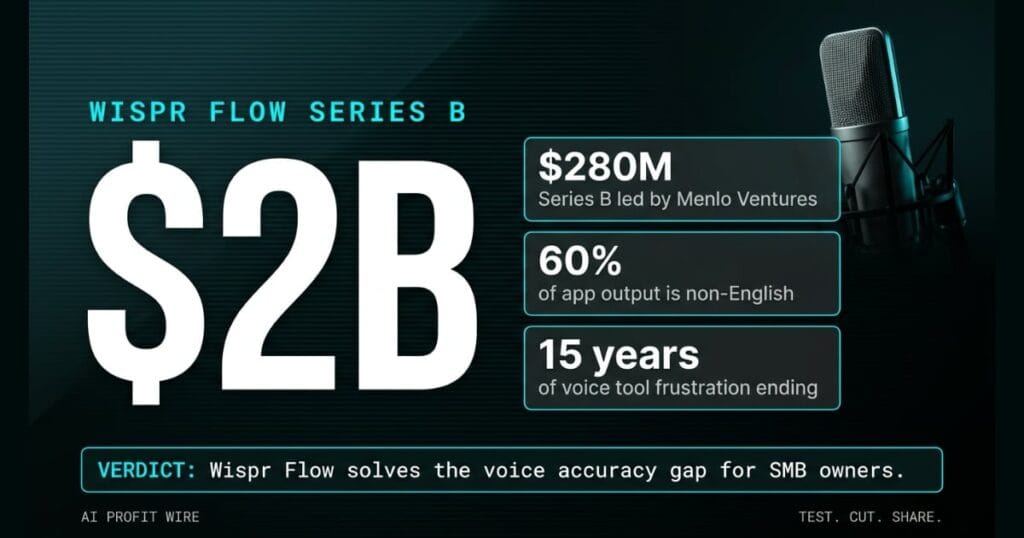
The company recently completed a $280 million Series B funding round at a $2 billion valuation. The San Francisco-based startup confirmed the Series B investment on Monday, following a $30 million Series A last May.
Wispr also released a tool called Notetaker, designed for capturing information during meetings with multiple people. The Notetaker tool replaces manual meeting minutes by recording and structuring multi-person conversations.
Wispr Flow transforms voice-to-text from a basic transcription service into a personalized productivity tool.
What is the evidence behind Wispr Flow?
The $2 billion valuation is backed by significant venture capital interest. Longtime investor Menlo Ventures led the Series B round, with returnees including Notable Capital, NEA, Neo Ventures, 8VC, and MPV Ventures.
New investors include Acrew Capital, Forerunner Ventures, the Together Fund, and Goodwater Capital. Other investors include Dallas Cowboys quarterback Dak Prescott, Pittsburgh Steelers wide receiver DK Metcalf, and gymnast Livvy Dunne.
The company’s growth is evidenced by its global reach. About 60% of the app’s output is currently non-English, which signals real adoption outside English-speaking markets.
Strong institutional backing and global scalability drive the company’s high market valuation.
How does Wispr Flow compare to the alternatives, and what background do small business owners need?
Wispr Flow differs from legacy voice tools by focusing on output quality that mirrors the user’s actual way of talking. It doesn’t just transcribe words but formats thoughts into natural text by learning individual vocabularies.
CEO Tanay Kothari noted that people had been trying voice tools for 15 years and getting the same disappointing result. Wispr addresses this by learning individual vocabularies to reduce errors.
The company is developing a proprietary speech model called Canto, designed to handle difficult conditions like background noise, music playing, or strong local accents. The upcoming model targets the scenarios where legacy voice tools fail.
Wispr Flow solves the accuracy gap that made previous voice-to-text tools impractical for professional use.
How does Wispr Flow affect day-to-day operations for small business owners?
Wispr Flow saves users significant time by replacing manual typing with high-accuracy dictation. Owners can interact with mobile and desktop environments via speech instead of typing each word.
The Notetaker tool eliminates the need for manual meeting minutes by recording multi-person conversations. This allows founders to focus on the conversation rather than the keyboard.
Founders scaling their audio content stack can pair Wispr Flow with a synthesis tool, which we cover in our ElevenLabs intelligence report.
Personalized AI dictation recovers administrative time lost to manual typing.
A crop-dusting logbook sits open on the passenger seat of the truck. The agronomist hits the dictation button and the app transcribes ‘pyrethroid applied per acre’ cleanly, which is the moment 15 years of voice tool frustration finally ends.
The reason that matters is that the old voice apps forced hours of cleanup per shift, correcting words the model didn’t know. Wispr Flow learns the user’s vocabulary, which is the structural fix that justifies a $2 billion valuation.
60% of Wispr’s output is non-English, which means the same vocabulary-learning fix holds up across languages, not just in English-speaking markets. A founder who avoided voice tools for the last decade should reconsider whether the accuracy gap has actually closed.
What is the final verdict on Wispr Flow?
Wispr Flow is a viable solution for small business owners who avoided voice tools due to poor accuracy. The $280 million investment suggests the technology is production-ready.
The ability to handle 60% non-English output makes it an asset for businesses with global teams. The upcoming Canto model will further expand its utility in noisy environments.
Wispr Flow is a production-ready dictation tool for founders who previously gave up on voice accuracy.
Source: AI Business
