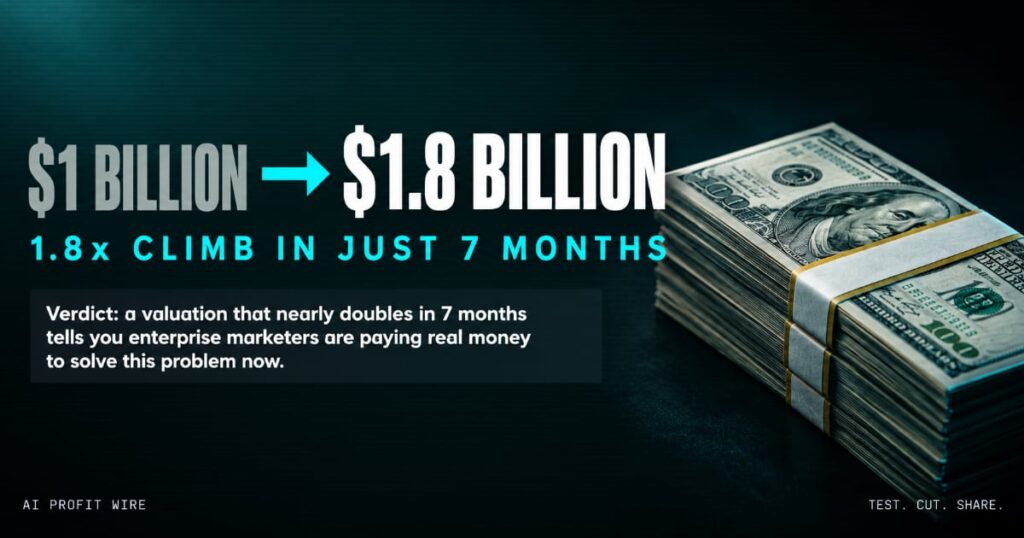
Signals growing investor confidence and capital influx into AI-driven search engine marketing tools for brands.
Who invested in Profound and how much?
Profound raised $180 million in a Series D round at a $1.8 billion valuation, co-led by Sequoia Capital and Kleiner Perkins, and the company planned to announce the round Tuesday.
Bloomberg counts more than $335 million raised to date by a startup founded in 2024 that now competes for AI talent with OpenAI and Anthropic.
James Cadwallader and Dylan Babbs founded the New York company, which tracks how AI models mention, describe, and recommend brands in generated answers.
Two of Silicon Valley’s oldest firms paid 1.8x for a $1 billion valuation set 7 months ago.
What are Profound’s actual customer numbers?
More than 700 enterprise customers pay for the platform, including 10% of the Fortune 500, with Target, Walmart, Ramp, MongoDB, U.S. Bank, and Figma named by Fortune.
The company runs on fewer than 120 employees, and its February Series C of $96 million at a $1 billion valuation brought total funding to $155 million before this round.
The climb came in 3 steps: a $35 million round in August 2025, the $96 million Series C in February, and this week’s $180 million. Lightspeed partner Sachin Patel frames the buy in Fortune as “the system of record for marketers” in a world where attention moves from search engines into answer engines.
Profound’s internal research found that up to 90% of the sources cited in AI answers can change over time, and different models lean on different source sets, which is the number that keeps enterprise marketers paying.
Adoption came before the markup: 700 customers and a 10% Fortune 500 footprint already existed when Sequoia and Kleiner Perkins re-priced the company.
How is AI search different from Google search for brands?
Google search hands a buyer a page of links to click, and you fight for position 1. An AI answer hands the buyer a shortlist with the choosing already done, and you either appear in those sentences or you don’t.
Profound monitors how ChatGPT, Perplexity, Microsoft Copilot, and Google AI Overviews describe brands, and its platform spans answer engine insights, prompt volumes, and an AI Marketer product line.
The category carries its own name now: answer engine optimization, built on the shoulders of SEO, as Cadwallader frames it.
He told Fortune the shift is an expansion of SEO rather than its extinction: “Our business is built on the shoulders of SEO, but this is way bigger.” His wider claim lands on every business with a brand: “In the future, every company on the planet will care deeply about how AI talks about and surfaces, and at some point interacts with, their brand.”
The fight moved from page 1 of results to the 3 sentences an AI tool says about your category.
What does the Profound funding mean if you already do SEO?
Your rankings dashboard measures a channel that fewer buyers open each quarter, and nothing in it records the moment an AI answer recommends a competitor instead of you.
Fortune reported that the February round chased the same fear, and the customer list confirms who buys first: retail, banking, and software brands with real search revenue at stake.
The role shift is already visible in those teams, because traditional SEO specialists are becoming what Cadwallader calls marketing engineers, operators who pair analytics and automation to influence what models recommend.
The content side of the shift still runs through SEO craft, and an AI content optimization tool like NeuronWriter is where most small teams start when they retool what they publish for how models read it.
If SEO is your channel, your next audit covers what the machines say about you, not where you rank.
An arborist is 40 feet up a red oak with a chainsaw running, dropping limbs toward a ground crew sorting brush from logs. Down on the driveway, the homeowner asks her phone which tree service in town handles storm damage, and the assistant names 2 companies. Hers is not 1 of them, even though her crew worked that street 3 times this year.
The job wraps, the invoice goes out, the review lands, and none of it touches the answer that sent the neighbor across the street to a competitor. That is the pitch behind $180 million in venture money: the businesses losing those calls have no report that shows the loss.
The check itself is free. Ask the tools your customers use what they say about your trade, then read every answer before the next ad dollar goes out.
What should you do about AI search visibility now?
Open ChatGPT, Gemini, and Perplexity this week and ask them the questions a buyer asks before shortlisting a vendor in your category. Save every answer, because up to 90% of the sources behind them will rotate over time.
Repeat the check every month and diff the answers, because that cadence catches the drift before it costs you a quarter of leads.
If the answers name competitors, the content you publish is the lever, and the same discipline that won you rankings applies to what the models cite.
Read what the machines say about you before your competitors learn to shape it first.
Source: Bloomberg Tech
