Expands global communication capabilities for businesses dealing with international customers or diverse local markets.
What did Google change in its AI translation tools?
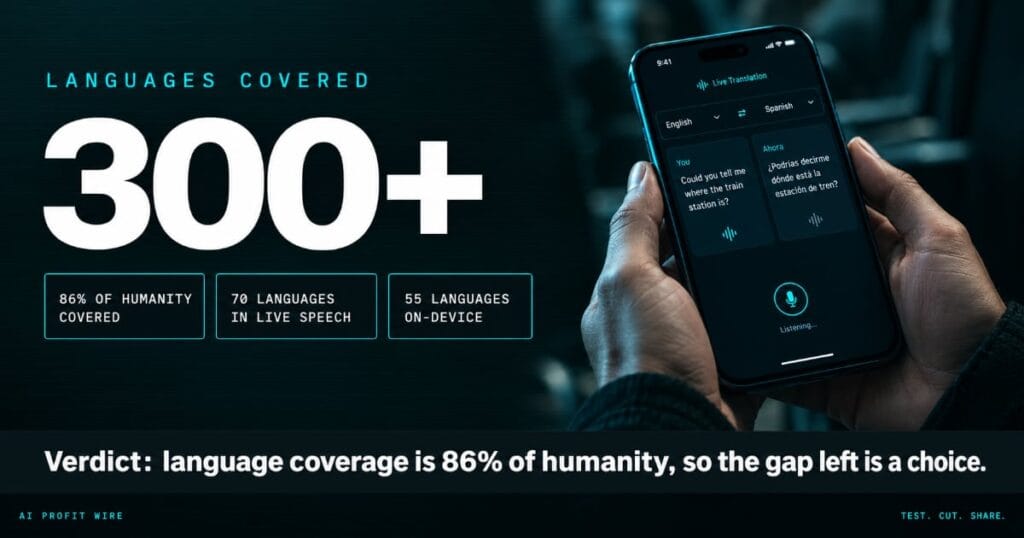
Google’s language technologies now power everyday interactions in more than 300 languages, spoken by more than 7 billion people, or 86% of the global population.
The core shift is architectural. Older systems transcribed audio to text, translated the text, and converted it back to speech, which stripped tone, pacing, and emotion from every exchange.
Google’s models, including Gemini, now work from the audio signal itself, per the announcement, and Gemini 3.5 Live Translate runs real-time spoken translation across 70 languages and more than 2,000 language pairs, capturing code-switching where a speaker blends 2 languages mid-sentence.
The speech-to-text sibling, Gemini 3.5 Transcribe, turns raw audio into polished text even in noisy environments, and it powers Rambler on Android Gboard, which strips filler words, fixes grammar, and switches languages mid-dictation.
Google moved translation from a text pipeline to native audio intelligence, and that changes what the output sounds like.
How accurate is Google’s 300-language translation?
The evidence Google provides is scale of training data and deployed usage, not independent benchmarks.
The Universal Speech Model trained on 12 million hours of audio, and the research effort behind it spans 25 years of open research and more than 400 peer-reviewed speech papers.
The VAANI paper documents the India effort alone: more than 30,000 hours of speech across 109 languages from more than 155,000 speakers, gathered region by region rather than language by language.
The dataset work runs as wide. WAXAL covers 27 Sub-Saharan African languages spoken by more than 100 million people across more than 26 countries, and the Amplify Initiative paired 1,600 local experts with 20 universities across 4 continents for 15,000 multimodal data points.
The scale is real, and no third-party accuracy benchmark appears anywhere in the announcement, so test your own language pair before trusting it with customers.
Should you use Google TranslateGemma instead of paying for translation?
TranslateGemma targets a different problem than cloud translation APIs: it runs on-device with no internet connection.
The open model family is built from Gemini and trained across 55 languages, and Google’s developer post plus the model card on Hugging Face cover the full lineup.
Because it runs on the device, translation quality no longer depends on a connection or a per-call cloud fee, which matters for field operations, travel-heavy roles, and customers in regions where more than 3 billion people still lack reliable internet access.
For offline and cost-sensitive use cases, TranslateGemma removes the 2 biggest reasons small businesses skipped machine translation.
Who is Google’s 300-language expansion for?
Any business selling to, supporting, or hiring from non-English-speaking markets, which describes most businesses with an online presence.
Support teams handling multilingual tickets are the clearest fit, and if your multilingual volume runs through chat, AI support chat tools like Tidio are the adjacent move worth pricing on the chat side.
Google’s accessibility work widens the audience further: a sign-to-text model trained across more than 50 sign languages serves the 70 million people worldwide who communicate through sign language, starting with ASL-to-English dictation.
A new Language Explorer tool visualizes LinguaMeta, the largest open-source language data repository, mapping more than 7,000 spoken, written, and signed languages. Google’s language technologies already connect more than 5 billion people across 9 platforms, including Search, Android, Chrome, and YouTube, and in New Zealand the team worked with Māori language experts to fix place-name pronunciation in Maps.
If any share of your revenue touches a second language, this expansion touches your cost structure.
A business owner at a service counter is halfway through a transaction when a group starts speaking a language they don’t know, and the owner smiles and continues with no way to understand whether the customers have a specific need. The question walks out the door unanswered, and nobody logged it, because the room looked fine on the surface.
That is what a language gap costs in practice: a service that reports success while a revenue moment slips through. Google now covers 86% of the global population with its language tools, which removes the coverage excuse and leaves the gap as a staffing and tooling decision.
For most small teams, the answer is to test 1 or 2 high-volume touchpoints first, not to rip out existing tooling.
What should you do about Google’s language expansion now?
Start with inbound support or FAQ handling, where a translation error costs a reply and not a contract.
Run a 2-week test on your busiest non-English channel, and let your own error rate make the decision.
The Viamo pilot in Rwanda already answered more than 2 million questions through Gemini on standard feature phones, which is proof the tools reach your customers on the devices they already own.
Test on your own traffic this month, because coverage stopped being the constraint.
Source: Google AI Blog
