Signals a tightening integration of meeting notes into core communication tools, potentially streamlining follow-up workflows for small teams.
Why did Superhuman acquire Fathom?
Superhuman has acquired Fathom, a Y Combinator-backed AI meeting notetaker founded in 2020, and the point is to fold real-time meeting context into its productivity platform.
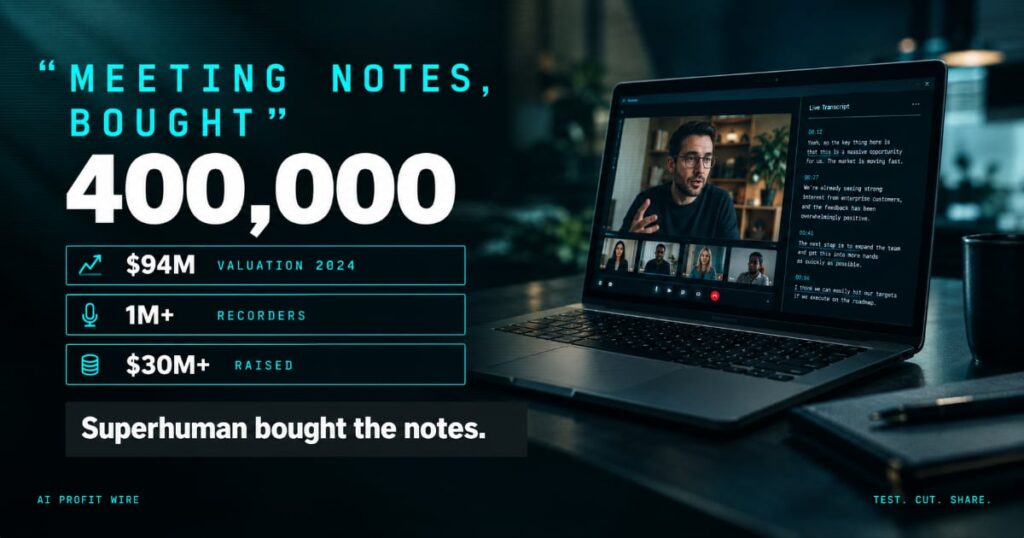
The deal, announced September 14, puts a notetaker with over 400,000 monthly active users inside a suite that already spans email, docs, calendar, databases, and a new AI agent builder, according to TechCrunch.
Fathom came out of Y Combinator’s Winter 2021 batch and still runs as an active San Francisco company, per Y Combinator’s directory.
The company has raised over $30 million and was valued at $94 million in 2024, per PitchBook data, with Zoom Apps Fund, Telescope Partners, BoxOne Ventures, and Maven Ventures on the cap table alongside Reddit CEO Steve Huffman, former Twitch CEO Emmett Shear, and Cruise co-founder Kyle Vogt.
Superhuman bought Fathom because building a reliable meeting recorder in-house proved harder than buying 1.
How many people actually use Fathom?
The adoption numbers are the strongest evidence in this signal, and they come from the company and the deal coverage instead of a marketing deck.
Fathom runs a free plan with unlimited recordings, transcripts, and instant call summaries, which the vendor’s pricing page documents in full, and that free entry point scaled the product to over 400,000 monthly active users.
The company says over 1 million people have recorded meetings on Fathom to date, which is the installed base Superhuman is buying.
The official acquisition release describes Fathom as an AI meeting partner trusted by hundreds of thousands of companies, and Fathom CEO Richard White called Superhuman’s 40 million user base the distribution opportunity that made the deal worthwhile, per the Business Wire announcement.
Mehrotra also teased what the notetaker unlocks: surfacing meeting context in real time inside the suite, which is where the agentic push stops being a demo.
Fathom brings proven adoption, and the 40 million figure is the seller’s estimate of the buyer’s reach, not an audited number.
How does buying Fathom compare to building a notetaker in-house?
Superhuman ran the experiment most platforms skip and tested a native notetaker with select users earlier this year, so the acquisition came from experience rather than guesswork.
CEO Shishir Mehrotra told TechCrunch the internal work increased the company’s confidence in demand while showing how deep these products run, because a product that feels easy on the surface is tricky to build well across all parts of meeting capture.
Competition sharpened the timeline, because rivals like Granola, Read AI, and Wispr have raised millions in the same category, and venture-backed notetakers face market pressure to move past transcription into proactive work.
White framed the same math from the seller’s side, saying that operating standalone would mean building things the Superhuman platform already has, which is the M&A case for speed over control.
Buying beat building because the category’s technical depth outran Superhuman’s internal timeline.
What does the Fathom acquisition mean if you already use Superhuman?
Meeting notes stop being a separate app and become an input the platform can act on, which means drafted follow-up emails, updated database entries, and scheduled follow-up meetings without leaving the inbox.
Superhuman Go, the company’s proactive assistant, works across 1 million apps and websites, and meeting context gives that assistant something concrete to act on.
Teams already use Fathom to search across conversations and spot patterns in sales calls and customer feedback, so the same dataset now feeds agents with greater context.
For Fathom’s existing base, the freemium product now sits inside a paid suite, and the free plan’s limits are the detail to read when the integration ships.
If you’re weighing meeting tools for your own team, our Krisp AI intelligence report breaks down how AI meeting assistants handle calls, which pairs with what a notetaker inside email changes.
Existing users gain a tighter workflow, and Fathom’s free plan is the 1 thing to watch as the integration deepens.
The whiteboard in your agency’s conference room still holds Tuesday’s client commitments, and the meeting recording that captured them sits unopened on a laptop in the corner. At 6pm someone re-types the decisions by hand, which is how the follow-up for your biggest account goes out a day late with 2 action items missing.
Superhuman paid for Fathom because 400,000 people already record meetings there, and purchase beat construction. Your version of that math is smaller and sharper: each decision re-entered by hand costs billable time you don’t invoice.
Meeting notes that don’t reach your task list are work you pay for twice.
What should you do about AI meeting notes this quarter?
Map which meetings produce decisions your team re-enters by hand, because that list is your real requirements document for any notetaker.
If you already pay for a suite that’s absorbing AI features, test the native workflow before adding another seat, because the acquisition brings the notetaker to Superhuman users without a new purchase decision.
Fathom’s free plan stays the zero-cost way to test the capture workflow, and paid plans start at $15 per user per month when you need advanced summaries and action items.
The 90-day money-back guarantee on paid tiers lowers the trial cost further, which makes this a cheap experiment by software standards.
Run the free workflow against your messiest recurring meeting this week, and judge it on the follow-ups it produces.
Test the free workflow this quarter, and let 400,000 existing users lower your research cost.
Source: TechCrunch AI
