Helps small business owners realistically evaluate AI projects and avoid wasting capital on tools without clear operational value.
What Does AI ROI Look Like For Small Businesses?
AI ROI for small businesses looks like one tool tied to one measurable bottleneck, and it looks nothing like the enterprise version. While large organizations struggle to articulate clear business value from AI, small firms are tracking monetary gains because they never had the budget to be vague.
AI Business’s reporting frames the split through two very different organizations: a benefits administrator that beta-tested a fraud-detection recruiting agent, and a 25-year-old Omaha advertising agency that built its own agentic tools. Both found returns by refusing to measure productivity in the abstract.
Gartner analyst Arun Chandrasekaran puts the enterprise side plainly: a lot of customers are still struggling to articulate clear business value from AI, and the alignment between productivity gains and value-driven metrics is still a work in progress across most organizations.
Small businesses see AI ROI because they measure the work, not the adoption.
Do Small Businesses Actually See Returns From AI Tools?
Yes, and the evidence is specific. Alight Solutions became a beta user of a fraud-detection recruiting agent from Phenom in September 2025, and on its first test the agent identified a candidate who applied twice for the same position using a different name and email address each time.
That single catch was enough for the talent acquisition operations manager to call the pilot a success, and it prevented paying for an unnecessary background check. The greater value, in her words, is time savings across screening.
OBI Creative, an advertising agency with fewer than 50 employees, built agentic tools on models including Gemma, Qwen, OpenAI GPT, and Claude. One monitors the health of client websites, another checks whether campaign work aligns with the client brief, and that second tool became a product the agency now licenses to clients.
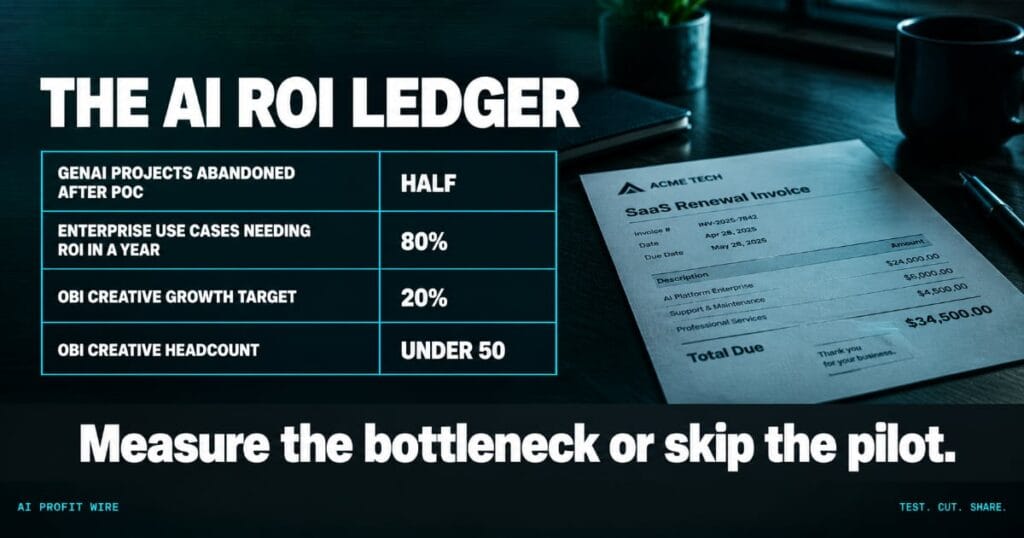
The CEO ties the result to margin: her team doesn’t go back to the client five times for changes, and the agency projects at least 20% year-over-year growth on the back of it.
Returns show up where the tool answers a question someone was already paying to answer.
How Is This Different From Enterprise AI Spending?
Enterprise AI spending buys breadth, and breadth is where the losses live. According to a 2026 report from Gartner cited in the article, around half of generative AI projects are abandoned after the proof of concept for reasons including poor data quality, escalating costs, and unclear business value.
Gartner’s own published prediction from 2024 set the floor at least 30% of GenAI projects abandoned by the end of 2025, which makes the 2026 reading a deterioration, not a surprise. The article adds the cautionary tale of a Pizza Hut franchisee suing the franchise in May over an AI delivery management platform it says cost millions rather than saving anything.
Cornell University runs the counter-pattern: it gave faculty frontier models in a secure environment early, never mandated usage, and measures value by students served and scientific discoveries made rather than by tokens consumed. Cornell’s AI lead is explicit that the university does not track tokenmaxxing, the trend of measuring employees by model token consumption.
Enterprises scale the pilot and hope value shows up, small teams name the value and then buy the tool.
The AI subscription renewed again, and the login had been idle since demo week. The line item was small enough to skip approval and steady enough to survive every budget review, which is exactly how unmeasured software spend compounds.
That quiet invoice is where about half of enterprise GenAI projects end up, dead after the proof of concept with poor data quality, escalating costs, and unclear value sharing the blame. The failure rarely announces itself, it just stops being discussed in meetings.
OBI Creative’s counter-move costs nothing to copy: name the bottleneck before the renewal date. Its agents answer two questions, is the site healthy and is the campaign on brief, and every tool the agency keeps has to pass the same test.
What Does Measuring AI ROI Require You To Track?
Track operational metrics that map to value, not activity metrics that map to nothing. Chandrasekaran’s example: in software engineering, the metric should be velocity, the new features actually delivered, and never lines of code.
Set the measurement before the use case, not after. His rule is blunt: if you can’t see a very clear line of sight to value, you don’t even pursue the use case, and for roughly 80% of enterprise use cases the ROI needs to arrive within a year.
OBI Creative’s cost control is the small-business version of the same discipline: the agency started with fixed-cost subscription models so employees worked inside a set budget, and overhead increases were balanced out by the efficiencies the tools produced.
Track the decision the number changes, because a metric that changes no decision is decoration.
What Should You Do About AI Tool Spending This Quarter?
Run the Gartner sequence in miniature: define the return first, then pick the use case, then buy. Write the bottleneck and its monthly cost on one line before the next renewal, and if the line stays blank, cancel the tool and keep the budget.
Cap the variable spend with fixed-cost subscriptions while you test, which is how OBI Creative kept its experiments inside a set budget. One measurable win, like a caught duplicate applicant or a monitoring agent that prevents client churn, justifies the next tool.
We run the same line-of-sight test when we score AI platforms, and our EngageBay intelligence report shows what that discipline looks like applied to a full marketing stack.
Name the bottleneck, cap the spend, and let the number decide the renewal.
Source: AI Business
