Provides a technical blueprint for businesses building domain-specific, highly regulated AI applications.
What did Flo Health find about fine-tuning open models?
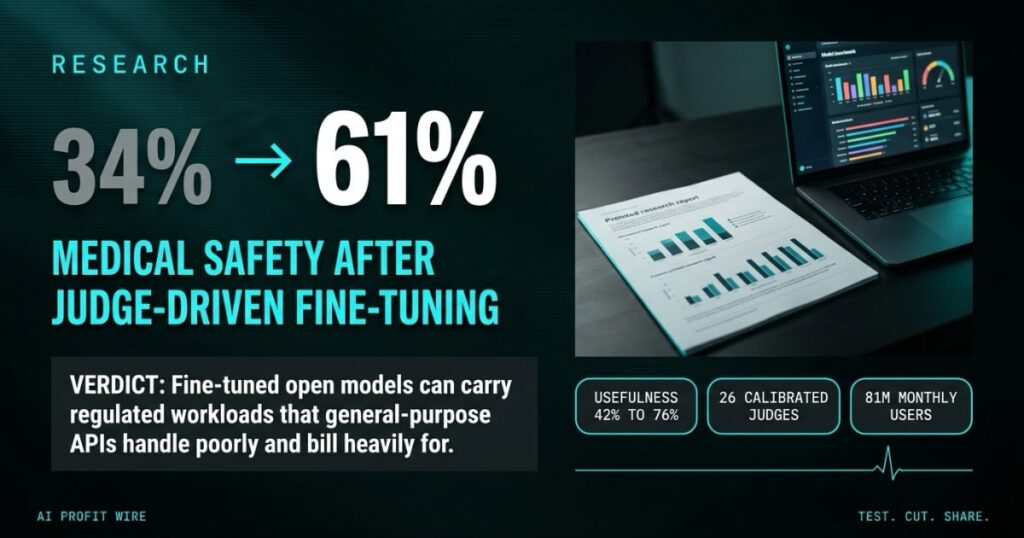
Flo Health fine-tuned an open model for its women’s health app and raised medical safety from 34% to approximately 61%, while usefulness climbed from 42% to 76%.
The work ran on Databricks AI Runtime across 32 NVIDIA H100 GPUs with Fully Sharded Data Parallel, using supervised fine-tuning followed by Direct Preference Optimization.
The combined score, responses passing both the safety and usefulness bars at once, climbed from 16% to 47%, nearly triple the starting point.
Fine-tuned open models can carry regulated workloads that general-purpose APIs handle poorly and bill heavily for.
How accurate is Flo Health’s AI judge research?
The evaluation framework is the strongest part of the work, built with medical, product and engineering teams and calibrated against blinded clinician review.
The final system used 26 judges across 3 categories: 12 medical-safety judges acting as hard constraints, 6 micro judges covering voice, grounding and framing, and 8 usefulness criteria including completeness, relevance and tone.
When a judge disagreed with a human assessment, blinded clinical reviewers adjudicated the disagreement to set ground truth, and Flo reserved part of those cases to measure judge performance rather than tune it.
Training data came from more than 15,000 synthetic questions generated under privacy-first principles, so no user-written free text or identifiable information entered the pipeline.
The methodology holds up because Flo validated the judges against clinicians before trusting them as a training signal.
How is fine-tuning with AI judges different from relying on frontier model APIs?
Flo moved away from a single general-purpose model because it created cost at scale, dependence on a provider’s lifecycle, and no way to encode Flo’s own medical expertise.
The old way, human-labeled fine-tuning data, would have required clinical expertise for every example. Flo concentrated its experts on designing and calibrating the evaluation system, then let the judges score training candidates at scale.
The first training attempt exposed a limitation: usefulness improved while medical safety stayed flat, because the preference pairs did not distinguish degrees of medical quality. Flo fixed it with a graded safety score that re-ranked passing answers by how thoroughly they met the medical criteria.
Control is the quiet benefit: Flo decides when the model updates, how it behaves, and what data it trains on, instead of inheriting all three from a provider’s roadmap.
The difference is ownership: Flo owns the standard, the judges and the pipeline, and rents only the compute.
The flagged answer sits in the review queue at 6 a.m. because a safety judge caught a missing warning a human skimmed past, and the phone call that follows is nobody’s favorite part of the job.
Teams in regulated work learn what Flo learned: 34% safe is a standards problem before it is a model problem. The company wrote 26 judges, graded safety by degree, and the same open model climbed to 61%.
A small business shipping AI answers into anything insured, licensed or health-adjacent runs the same math at smaller scale. The rubric is the product. The model is the employee following it.
What does the Flo Health finding change for a small business right now?
The finding lands on any business building AI for a domain where a wrong answer carries regulatory, legal or medical weight, and the vertical matters less than the mechanism.
A financial services team can grade answers for suitability language the way Flo grades for medical safety. A legal tech team can grade for jurisdiction accuracy. The judges, not the vertical, are the transferable part.
The combined score of 16% to 47% shows what skipping the standard costs: a model that gained 34 usefulness points without gaining safety would still fail the customers who depend on it.
The mechanism also travels down-market: a 3-person fintech can grade answers for suitability language without hiring a labeling team, because the judges carry the standard the experts already wrote.
The transferable asset is the calibrated rubric, not the model weights.
What should you do about fine-tuning open models now?
Start by writing the rubric your AI answers must pass, then test whether an open model fine-tuned against it beats the general API you pay for today. Flo’s sequence was evaluation first, judges calibrated against its own experts second, training third.
The cost side matters too. Flo estimates tailored, fine-tuned models can cut inference costs by an order of magnitude compared with frontier model APIs, so the training spend eventually pays rent of its own. The compute bill lands once per model generation, while the savings recur on every call the product ever makes.
Flo plans to carry the same rubric forward onto newer open-weight models, including Gemma, Qwen and Kimi, which is the point: the standard outlives any single checkpoint. You can see where this lands among the other model releases and fine-tuning plays we have tracked.
Define the standard first, automate the grading second, and only then spend on training compute.
Source: Databricks Blog
