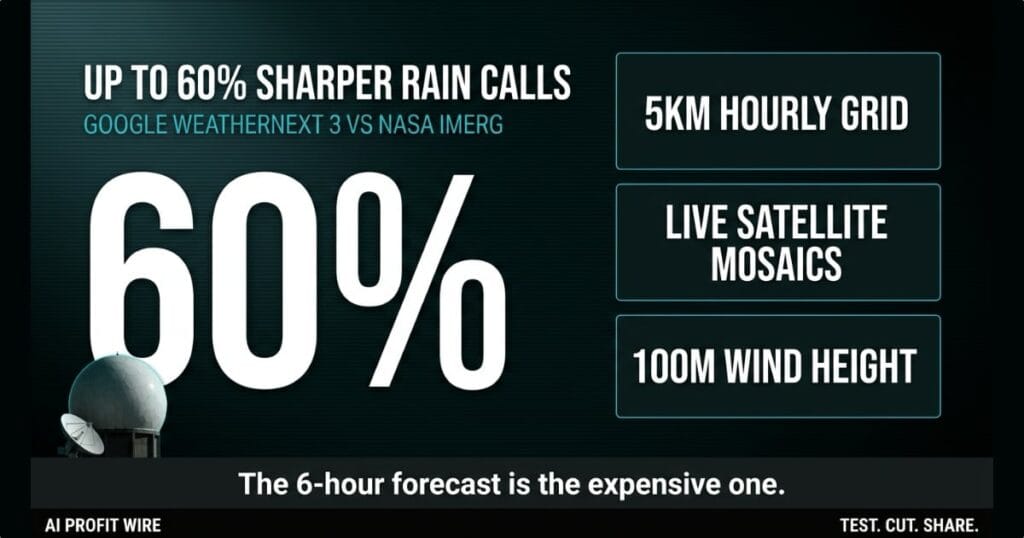
Significant impact on agriculture, renewable energy, and logistics through precise precipitation and turbine-height wind speed forecasting.
How does Google WeatherNext 3 work?
Google WeatherNext 3 is an AI weather forecasting model that replaces traditional physics simulations with live satellite observations. It provides hourly updates at a high spatial resolution, and it is now integrated across Google Search, Maps, Gemini, Google Maps Platform, and Cloud.
The model generates surface variable forecasts, such as temperature and moisture, at a 5-kilometer resolution. Other surface variables are tracked at 10 kilometers, while atmospheric variables like wind speed use a 25-kilometer grid.
The model launched September 3, 2026, and it begins powering weather experiences across Google products the same day.
That makes global forecasts roughly 5 times sharper than WeatherNext 2, which produced forecasts on a 25-kilometer grid in 6-hour increments. The engine behind it is a Functional Generative Network mesh transformer, described in DeepMind’s WeatherNext 3 technical paper.
WeatherNext 3 moves forecasting from static simulations to live satellite observations.
How accurate is Google WeatherNext 3’s precipitation forecasting?
The DeepMind announcement shows a significant leap in predicting rain and snow, built on two high-quality precipitation sources instead of one. Those sources are NASA’s IMERG satellite dataset and Google’s own global precipitation reanalysis based on satellite radar.
In medium-range global forecasts, the model shows a Continuous Ranked Probability Score improvement of up to 60% against IMERG. It also improves 30% against MRMS ground radar and 10% against rain gauge measurements at early lead times.
Independent verification backs the vendor’s numbers. DeepMind points to live evaluations by Brightband’s open weather benchmark, which ranks global AI weather models against each other in real time.
Users of Google apps will see up to 50% more accurate precipitation forecasts when planning a day or more ahead. The greatest gains land in regions where forecasts have historically been least reliable.
The model solves the blurriness of previous AI forecasts to capture sharp convective storm bands.
Is WeatherNext 3 good enough to replace traditional weather models?
WeatherNext 3 eliminates the 6-hour data lag inherent in numerical weather prediction (NWP) models. Traditional models rely on supercomputer-driven physics simulations that can’t update fast enough for rapid weather shifts.
By ingesting a mosaic of live geostationary satellite data, the AI generates a new forecast every hour. Each forecast is grounded in the most recent satellite observations available.
The model also trains directly on sparse weather station observation data to account for regional details like topography. That removes the over-smoothed, pixelated temperature representations older models produced near coastlines, valleys, and mountain ranges.
The shift to hourly satellite-driven updates makes the 6-hour physics-model lag a planning liability.
12 is written in red marker on the appointment board. It’s the number of high-ticket color treatments cancelled in one hour because a sudden storm hit the north side of the city.
The salon owner watches the rain stop two blocks away, but the clients are already gone. They relied on a generic county-wide forecast that couldn’t distinguish between a 5-kilometer pocket of rain and a clear sky.
This is what low-resolution data costs a service business. When your revenue depends on people showing up to a physical chair, a 5km resolution gap is the difference between a full book and a dead morning.
Who is Google WeatherNext 3 actually for?
The model is built for industries where hyper-local weather shifts hit revenue directly: agriculture, renewable energy, and logistics. Google calls out daily planning improvements across exactly those use cases.
Energy developers get 100-meter wind speed forecasts at roughly turbine height to predict output. Solar farms get high-resolution cloud cover and sun radiation data to estimate ground-level light, and grid operators get to match clean power generation against consumer demand.
Logistics founders can pipe the same hourly feed into routing and customer messaging, and a dispatch board that reacts to an hourly update beats one that reacts to a morning forecast. The daily AI signal briefings we publish track tools like this as they ship.
This tool is for any business where a 5-kilometer weather shift creates an operational bottleneck.
Should you use WeatherNext 3 instead of paying for specialized weather data?
For most small business owners, the integrated forecasts inside Google Search, Maps, and Gemini are enough for daily planning. That’s the free layer, and it rolls out inside products you already open.
Developers and larger firms can query the same forecasts in BigQuery and Earth Engine, or bulk-download from Google Cloud Storage. Google’s WeatherNext developer documentation covers the integration paths with no model setup required.
The accessibility matters most in underserved regions across Latin America, Africa, and Asia-Pacific. Those markets historically couldn’t absorb the supercomputing costs of traditional high-resolution regional models.
Use the free Google apps layer for planning and the Cloud API for automating workflows, and skip the proprietary data contract until you outgrow both.
Source: Google DeepMind
