Reduces friction in international customer interactions and travel, improving communication efficiency for global SMBs.
What did Google Translate change about live translations?
Google Translate shipped 2 updates to live translate on September 4, announced by product manager Sasha Kapur on Google’s official blog, and both target the way the audio reaches you. The announcement frames the pair as fixes for how sessions behave after they start.
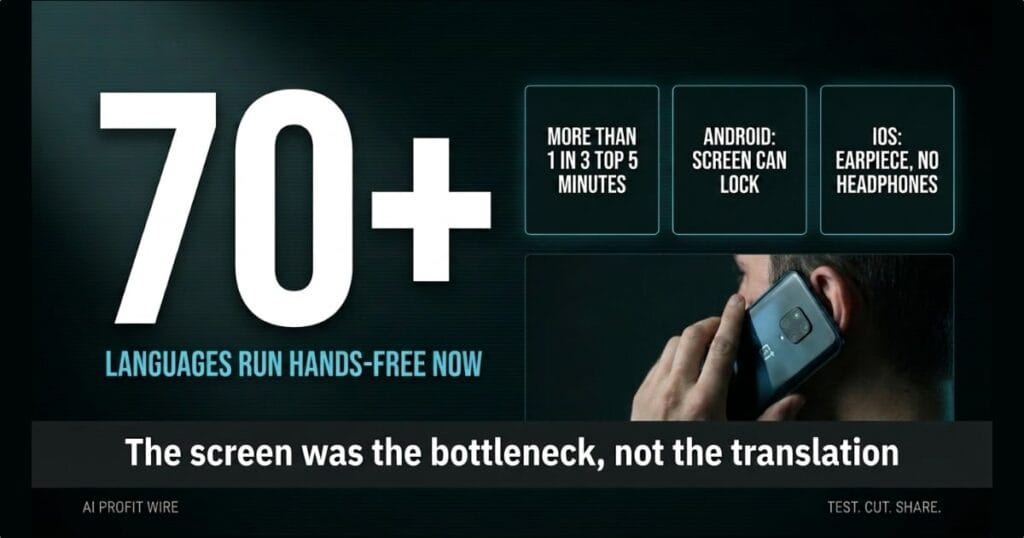
The first change lets Android users keep live translations running in the background while they multitask or lock the phone screen, with iOS support listed as coming soon. The second brings live translations through the phone’s earpiece to iOS users worldwide, a capability Google says already existed on Android.
Live translate carries natural, near-real-time audio translation across 70+ languages, and the “near-real-time” part traces back to the Gemini 3.5 Live Translate model Google introduced in June for Translate, Meet, and AI Studio.
Google removed 2 physical constraints from the same feature: the awake screen and the headphones.
Does Google Translate actually work in the background?
Yes, on Android, and Google’s own usage data explains why that platform went first. The company reports that more than 1 in 3 live translation sessions now run longer than 5 minutes, which is exactly the stretch where holding a screen awake stops making sense.
The behavior is documented, not just announced. Google’s Translate Help documentation tells users they can continue to use live translate in the background, and to connect headphones or hold the phone to their ear to hear real-time translations.
The iOS side of the trade is narrower today, because iPhone users worldwide get the earpiece mode now while the background half of the update remains “coming soon.” The screen-stays-on rule still holds on iPhones until that ships.
Background mode is a working reality on Android and a dated promise on iOS.
Can Google Translate replace a human interpreter?
For workflow audio, the gap keeps narrowing. TechCrunch reported in March that Google turned any pair of headphones into a real-time one-way translator across 12 countries, powered by Gemini and built to keep each speaker’s tone, emphasis, and cadence intact.
The rollout math is measurable. March took the headphone mode from Android in 3 countries to iOS and 12 total, and September’s earpiece update removes the headphone requirement entirely, leaving the hardware list at the phone already in your hand.
A human interpreter still owns the room where a single mistranslated clause moves money, contract signings, payment terms, and regulatory answers. What changed is everything around that room, because site walks, logistics calls, and supplier check-ins now run on a free tool instead of a day rate.
The interpreter keeps the contract negotiation, and the earpiece takes the warehouse floor.
Who is Google Translate’s earpiece mode actually for?
The app turned 20 in April 2026 and now spans 249 languages and varieties, with live audio in 70+ of them, so the installed base reaches effectively every importer, expat, and travel-heavy founder on the planet.
Google’s own examples lean consumer travel, catching announcements at noisy airports and following along on crowded tours. The business overlap is direct, because anyone who takes supplier calls, walks a production floor, or meets clients across a language line gets the same hands-free upgrade at no cost.
The scale behind the habit is not small either: Wikipedia’s running tally credits Google Translate with more than 100 billion words translated daily, and hands-free audio is where the next chunk of that volume lands.
This is for anyone whose workday includes a conversation they can’t hold in the other person’s language.
The mill foreman in Ningbo props his phone against a fabric roll and starts walking the production floor on a video call, and the buyer in Chicago listens to the English translation come through the earpiece while she checks the dye lot photos from that morning.
This is the kind of call that runs past 5 minutes, the length more than 1 in 3 live translation sessions now hit, and nobody holds a screen that long with a clipboard in the other hand. The background mode is what lets her lock the phone and keep listening while the container gets tallied.
Is Google Translate ready for real business conversations?
Update the app today and the path differs by platform: Android users get the background win immediately, and iPhone users can test earpiece mode on the next call before the background half lands.
Run the first test on a low-stakes call, a supplier check-in rather than a contract negotiation, and keep a human interpreter on retainer for anything where a mistranslated clause costs real money. The hands-free shift is the same pattern we track in the signals archive, AI features moving off the screen and into the room.
Adopt it for the workflow calls now, and keep the human for the ones that move money.
Source: Google AI Blog
