Using an integrated full-stack platform can reduce your AI infrastructure costs and simplify development by eliminating the need to stitch together multiple vendor tools.
What is Google’s full-stack AI approach and what changed?
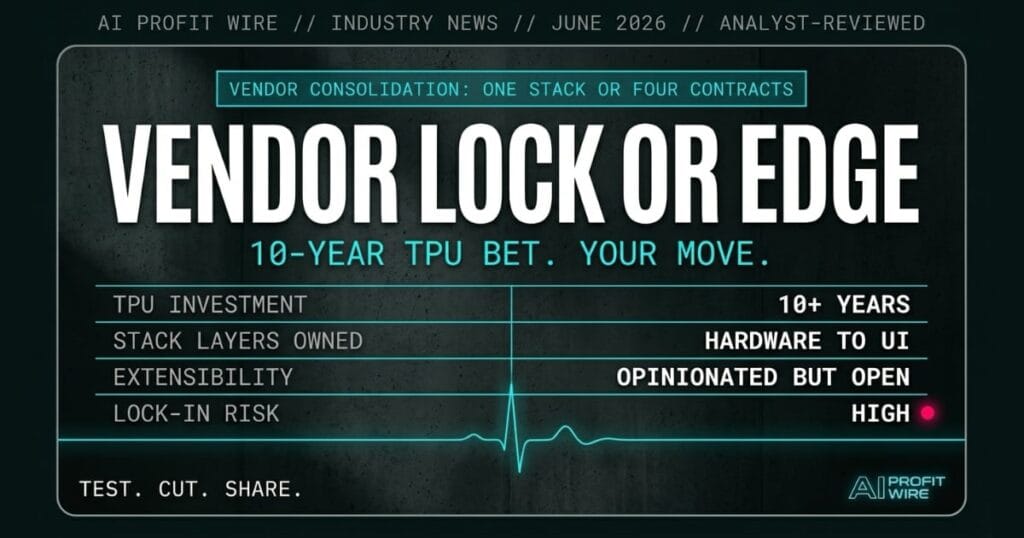
Google’s full-stack AI approach integrates every layer of technology from hardware and models to user interfaces into one cohesive system. Richard Seroter, who leads developer experience at Google Cloud, explained that this strategy has been foundational to Google’s AI work for over a decade. The company’s bet on custom TPUs is already more than 10 years old, and the approach is designed to improve reliability, lower costs, and simplify development by removing the need to stitch together disparate parts from multiple vendors.
The 2026 update is that the stack is now visibly assembled. Antigravity, the agentic coding agent unveiled at Google I/O 2026, is now integrated inside the Gemini Enterprise Agent Platform (formerly Vertex AI). Google’s own Antigravity blog confirms that “Google Antigravity brings agentic coding and agent orchestration to all builders, built on the agent harness co-optimized with the Gemini family.” For small business owners, that means the three entry points Seroter describes are no longer hypothetical. Google AI Studio, Gemini Enterprise Agent Platform, and Antigravity are all live and shipped.
This vertical integration play reduces friction, but evaluate your vendor dependence before committing the full stack.
What’s the evidence behind Google’s full-stack AI approach?
Google provides the hardware through TPUs, frontier models through Google DeepMind like Gemini, and the interfaces people use daily like Maps and Gmail. Seroter stated that owning the entire stack allows Google to catch technical failures at one layer and handle them at another, rather than waiting for external providers. He also noted that because Google isn’t paying third-party vendors, customers don’t absorb those fees, which enables competitive pricing.
The interview also makes the architectural argument concrete. Seroter describes an intentional AI stack as needing “a cohesive combination of layers to get a job done: compute infrastructure, an AI model, an orchestration platform and the user interfaces.” Google owns every one of those layers. The TPU investment is 10 years old. The DeepMind model lineage runs through Gemini. The orchestration layer is Gemini Enterprise Agent Platform. The interface layer is Maps, Gmail, and the rest of the Workspace surface.
The extensibility claim is also confirmed in the interview. Seroter says: “if you want to use another company’s AI model instead of Gemini, or hook up different software instead of Google Workspace, you can plug those right in.” That is the “opinionated but extensible” framing. The pricing advantage, however, only holds if you stay inside Google’s stack.
The economic advantage is real, but only if you stay inside Google’s stack.
How does Google’s full-stack AI affect day-to-day operations for small businesses?
Small business owners can choose from three entry points depending on their technical skill level and needs. Google AI Studio allows rapid prototyping of web applications with deployment to Cloud Run in minutes, with Seroter describing it as a way to “take a creative idea and quickly build a prototype web application” and deploy with “the click of a single button.” The Gemini Enterprise Agent Platform offers a low-code option to automate day-to-day work like inbox management and spreadsheet parsing without writing code. For more complex needs, the Antigravity platform enables sophisticated agent builds without advanced programming knowledge.
The decision matrix for a small business owner is straightforward. If the need is a one-off prototype or a quick internal tool, Google AI Studio is the entry point. If the need is automating recurring work like inbox triage or spreadsheet parsing, Gemini Enterprise Agent Platform is the entry point. If the need is a multi-step agent that orchestrates across systems, Antigravity is the entry point. None of these require an engineering degree, which is the explicit design intent.
The trade-off to flag during your vendor review: the pricing advantage only holds if you stay inside Google’s integrated stack. Plug in rival models or alternative software and you lose the cost stack that makes the pitch work. For more context on how vendor consolidation signals affect small business AI stacks, see our live archive of pipeline-filtered AI signals and operational trends.
A stack of 14 separate software invoices sits on a freight dispatcher’s desk at the end of the month, proving that tracking a single pallet requires paying a routing vendor, a telematics vendor, and a customer portal vendor. When a tracking API breaks at 11 PM on a Saturday, 3 different support reps point fingers at each other while the client demands an update. The pitch for full-stack AI focuses on having exactly one entity to hold accountable when the system fails. Google’s 10-year TPU investment means the hardware, the model, and the interface share one billing cycle and one support tier. The danger is that the pricing advantage only holds if the business stays inside that ecosystem entirely, forcing a company to pay for the whole stack even when they only need a fraction of it.
What’s the final verdict on Google’s full-stack AI approach?
The full-stack approach reduces integration friction and potential blame-shifting between vendors, but it also increases dependence on a single provider. Seroter emphasized that the platform is “opinionated but extensible,” meaning rival models and software can be plugged in. However, the primary value proposition, competitive pricing, derives from staying within Google’s integrated stack.
For small business owners, the actionable read is this: if your current AI stack involves more than 2 separate vendor contracts, the full-stack pitch is worth a serious vendor review. If your stack is one API call to a model provider, the consolidation argument is weaker because you are not actually paying integration overhead in the first place.
Evaluate this during your next vendor review if your current AI stack involves more than 2 separate contracts.
Source: Google AI Blog (cross-referenced with antigravity.google/blog/google-antigravity-for-enterprises and the Google I/O 2026 developer highlights)
