Directly impacts revenue by revealing blind spots in AI-driven search where competitors are capturing your potential buyers before they ever reach your site.
What is competitive AI visibility analysis and what changed?
ATAK Interactive published a detailed framework on June 29, 2026 for running competitive AI visibility analysis: the process of measuring how your brand appears in AI-generated answers from ChatGPT, Gemini, Perplexity, and Google AI Overviews relative to your competitors. The article argues that your AI visibility score is meaningless in a vacuum, and that the real strategic value comes from mapping the entire competitive landscape inside AI answer engines.
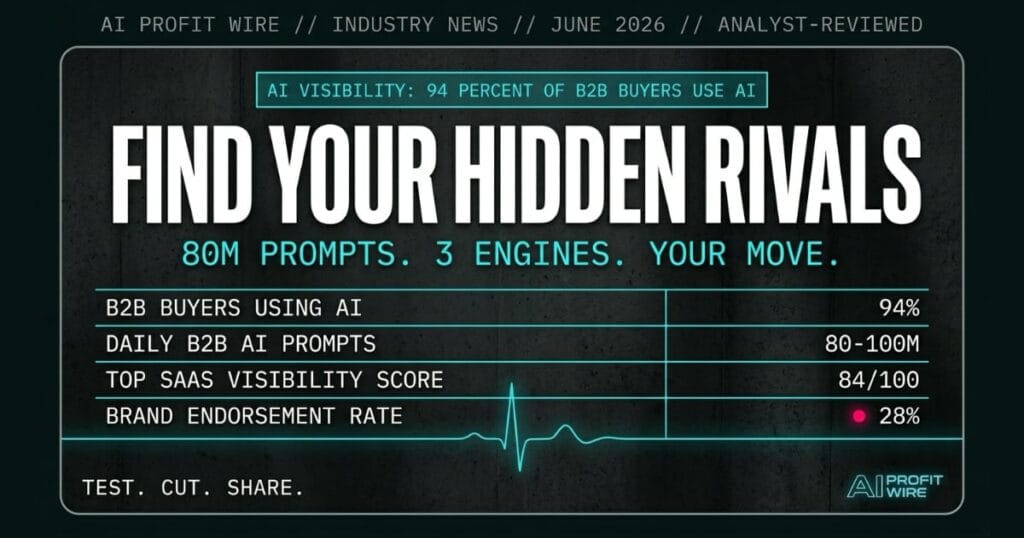
The article cites Forrester’s 2026 Buyers’ Journey Survey of nearly 18,000 global business buyers, which found that 2x more buyers named generative AI or conversational search as their most meaningful research source than any other source, outranking vendor websites, product experts, and sales reps. The proportion of B2B buyers using AI in their purchase process grew from 89% in 2025 to 94% in 2026.
The core argument: roughly 70 to 80% of B2B buying research happens before a buyer ever contacts a vendor’s sales team. By the time someone fills out your form, the shortlist is mostly built. And increasingly, that shortlist is getting assembled inside an AI answer you never see.
Your buyers are forming opinions about your brand inside AI answers you’ve never read, comparing you to competitors you may not know exist, before they ever land on your site.
What’s the evidence behind competitive AI visibility analysis?
The article is rich with quantified data from multiple sources. Forrester’s 2026 survey of 18,000 buyers confirms the AI research shift. Spotlight and Profound estimated daily B2B-related prompts across ChatGPT alone at more than 20 million per day. Add Claude, Copilot, Perplexity, and Gemini, and that balloons to 80 to 100 million B2B research prompts every single day.
The article defines specific metrics: AI Visibility Score (top SaaS brands score around 84/100, median sits at 62), Share of Voice (market leaders typically hit 35 to 50% in concentrated categories, 15% or above is strong in fragmented markets), Mentions vs Citations (a mention is the AI recommending you, a citation is the AI pulling your content as a source), Prompt Coverage, Sentiment (average brand receives genuine endorsement on only 28% of category prompts, with 41% neutral, 19% cautious, and 12% outright hallucinations), and Platform Distribution (Perplexity and Copilot include external links in over 77% of responses, ChatGPT in roughly 31%).
The article includes a detailed case study of a brand called QZ that scored 16/100 on AI visibility despite 20 years of market presence and enterprise clients. A smaller challenger scored 20/100 and was growing, but QZ had 251 citations to the challenger’s 41. 6x more citations, but fewer recommendations. 2 competitors, nearly identical visibility scores, completely opposite problems.
The evidence combines Forrester survey data, platform analysis from Spotlight across 2.4 million AI responses, and a real case study with quantified metrics.
How does competitive AI visibility analysis affect day-to-day operations for small businesses?
For small business owners, the operational impact is direct: your buyers are asking AI engines to compare you to competitors, and you have no visibility into what those engines are saying. The article’s lamp shade example is striking: a customer who thought there were only 2 players in their space discovered 3 competitors they had never heard of, 2 of which had more AI market share than the established competitor they had been benchmarking against for years.
The article recommends a manual sweep you can do in an afternoon. Open ChatGPT, Gemini, and Perplexity. Ask the buyer-intent questions your customers ask: “best tools for X,” “alternatives to Y,” “who should I hire for Z.” Note every brand that appears, every brand that gets cited, and the tone the model uses for each. Run each prompt 3 times because LLM responses vary across runs. Then ask the models directly how they would describe each competitor, and you get a rough sentiment read for free.
For small business owners who want to close the content gap that AI visibility analysis reveals, tools like NeuronWriter, reviewed in our Intelligence Report, can help produce the research-backed, long-form content that AI engines pull as citation sources. The article’s case study shows that the citation gap is where niche companies can win against larger incumbents.
A $50,000 RFP bypasses your sales team completely because a prospect asked ChatGPT for category recommendations, received 3 names they have never heard of, and closed the tab. You do not lose that deal to a competitor you know. You lose it to an invisible rival inside an AI answer you never read. A visibility score of 20/100 looks disastrous until you check the category leader and find them sitting at 16 and dropping. The fix starts with a manual sweep that takes an afternoon and costs $0. The ROI is measured in recovering the deals leaking out through discovery blind spots.
What’s the final verdict on competitive AI visibility analysis?
Small business owners must treat AI visibility as a distinct operational requirement, not an SEO add-on. The businesses that restructure content for AI citation now will capture inbound leads that competitors lose to invisible discovery gaps. The tactical playbook is clear: add FAQPage and HowTo schema to your highest-value pages, write answer-first content with 50 to 150 words per FAQ, get cited on authoritative third-party sites that AI engines trust, and monitor your brand’s appearance in ChatGPT, Perplexity, and Google AI Overviews manually.
The 73% B2B buyer adoption rate means this isn’t a future prediction. It’s a present condition. Every month of delay compounds the discovery gap. The businesses that win this shift aren’t the ones with the biggest content budgets. They’re the ones who restructured first.
Delaying this shift means funding a marketing strategy optimized for a search behavior that’s actively disappearing.
Source: ATAK Interactive Blog (by Austin LaRoche, citing Forrester 2026 Buyers’ Journey Survey and Spotlight analysis of 2.4 million AI responses)
