Cuts API costs for running AI agents and automations while delivering near-top-tier performance, directly saving money on daily workflows like CRM updates and email outreach.
What’s Claude Sonnet 5 and what changed?
Claude Sonnet 5 is Anthropic’s newest midsize AI model, launched June 30, 2026, with enhanced agentic capabilities and significantly lower API pricing than premium competitors. It is priced at $2 per 1 million input tokens and $10 per 1 million output tokens through August 31, 2026, after which it rises to $3 and $15. This makes it cheaper than Opus 4.8 ($5/$25), GPT-5.5, and Gemini 3.1 Pro, although still more expensive than Gemini 3.5 Flash. The context window supports up to 1 million tokens.
The model self-checks output without explicit prompting, reducing the need for human oversight on routine multi-step tasks. Anthropic reports lower hallucination and sycophancy rates than Sonnet 4.6, plus better refusal of malicious requests and improved resistance to prompt-injection hijack attempts. Cyber safeguards are enabled by default. Anthropic’s System Card confirms an overall lower rate of undesirable behaviors than Sonnet 4.6, making it generally safer in agentic contexts.
Sonnet 5 establishes agentic capability as the baseline expectation at every price tier, not a premium feature. The August 31 price jump is the billing warning.
What’s the evidence behind Claude Sonnet 5?
Anthropic cites benchmark scores and real-world tester feedback as the core evidence. On SWE-bench Verified, Sonnet 5 scores 85.2%. On SWE-bench Pro, it scores 63.2% versus Sonnet 4.6’s 58.1% and Opus 4.8’s 69.2%. On Terminal-Bench 2.1, it jumps to 80.4% from Sonnet 4.6’s 67.0%. On FrontierCode v1, it leaps from 15.1% to 38.8%. On GDPval-AA v2, which compares AI to human experts using professional judges, Sonnet 5 scores 1609 Elo versus Sonnet 4.6’s 1381 Elo.
Real-world validation comes from production deployments. Daniel Shepard, Senior Engineer at Zapier, stated Sonnet 5 completed a 2-part Salesforce update and enterprise email task end-to-end where previous models stalled halfway. Fabian Hedin, Co-founder of Lovable, praised its consistent refusal of unsafe requests. Neel Chotai, a Rust engineer, reported Sonnet 5 unprompted wrote a reproducing test, implemented a bug fix, then stashed it to confirm the bug recurred without the change, all in a single pass. TechCrunch framed the launch as confirmation that agentic capability is the new baseline expectation at every price tier, with the differentiator being how cheaply and reliably models can do it without human oversight.
The evidence shows near-premium performance at a deliberately reduced cost point, validated by production automation workflows and independent benchmark gains.
How does Claude Sonnet 5 affect day-to-day operations for small businesses?
Small businesses running API-based automations, CRM updates, or email outreach can now access agentic AI at roughly half the operational cost of top-tier models. The self-checking behavior reduces error correction overhead. Lower hallucination and sycophancy rates mean fewer manual corrections. Better refusal of malicious requests reduces security risk in automated workflows. For teams without dedicated ML engineers, this lowers the barrier to deploying reliable automation.
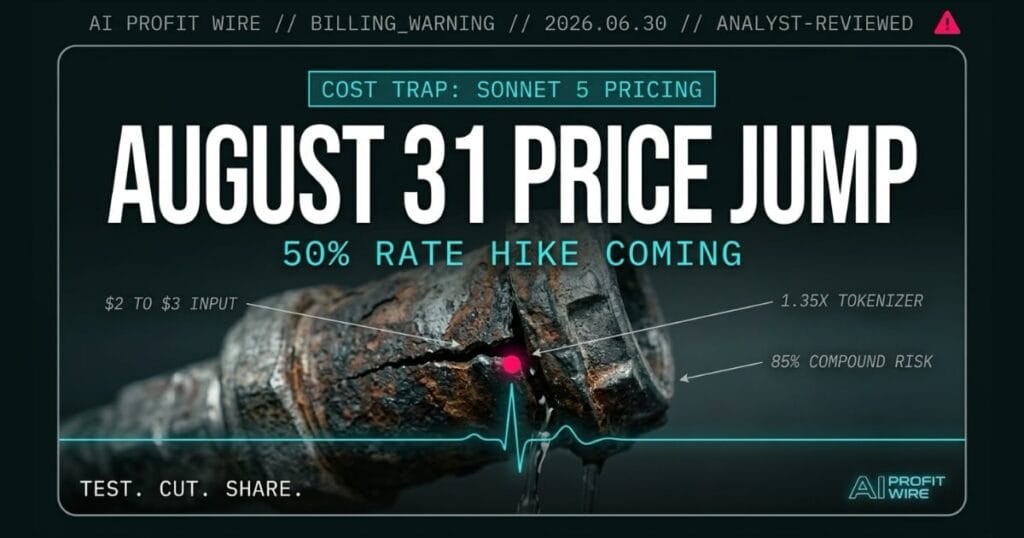
The billing warning is the August 31, 2026 price jump. Introductory pricing of $2 per 1 million input and $10 per 1 million output rises to $3 and $15. That is a 50% increase on input and 50% on output. Teams that build workflows on the introductory pricing without metering will see their API costs jump overnight. The tokenizer change compounds the risk: Sonnet 5’s updated tokenizer can produce 1.0 to 1.35 times more tokens for the same input, so the actual cost increase from the price jump may exceed 50% on some workloads. For teams tracking cost and performance shifts, our live archive of operational AI signals monitors how pricing changes reshape small business AI adoption.
Day-to-day operations gain a cheaper, more autonomous automation layer, but the August 31 price jump requires proactive cost planning.
A monthly API invoice for $2,400 lands on an accounting firm’s desk purely for running compliance checks through Opus 4.8. Dropping to a cheaper model historically meant paying human reviewers to catch the newly introduced hallucinations, wiping out the API savings in payroll costs. Sonnet 5 deployed directly on AWS changes that calculus by delivering near-premium agentic performance at $2 per 1 million input tokens. The model self-checks its output before returning the result, dropping the error rate to a level where human review is no longer a bottleneck. The firm cuts its monthly API spend by 60% and inherits Amazon’s regional data residency automatically, but the August 31 price jump to $3 per 1 million tokens means the window to lock in the migration math is closing fast.
What’s the final verdict on Claude Sonnet 5?
Claude Sonnet 5 is a cost-optimized agentic model that trades marginal top-end performance for substantial operational savings. It isn’t Opus 4.8 for the hardest judgment calls, but it is superior to Sonnet 4.6 and competitive with more expensive alternatives for the majority of business automation tasks. The SWE-bench Pro gap between Sonnet 5 (63.2%) and Opus 4.8 (69.2%) is 6 percentage points. The price gap is 60%. For most workflows, that trade is obvious.
The launch pricing creates a window for small businesses to test or migrate agentic workflows before the August 31 price increase. The billing warning is specific: $2/$10 becomes $3/$15, a 50% increase. The tokenizer change may add another 35% to actual token consumption. Teams that don’t meter their stack before August will face a compound cost surprise. The tactical move is to deploy now, measure actual token usage on production prompts, model the post-August cost, and decide whether to stay on Sonnet 5, downgrade to Gemini 3.5 Flash for high-volume low-complexity tasks, or reserve Opus 4.8 for the hardest judgment calls.
Cut your API spend now and meter the stack monthly before the August price jump. The 50% rate increase compounds with the tokenizer change.
Source: TechCrunch AI
