Deploying AI agents correctly in your onboarding flow can significantly reduce customer churn and support costs while accelerating time-to-value.
What’s AI agent SaaS onboarding and what changed?
AI agent SaaS onboarding deploys autonomous agents to guide new users through setup, surface relevant features, and resolve repetitive questions during the critical first product experience. The shift moves from passive self-serve onboarding or human-led walkthroughs to always-on agent-assisted flows that operate without business hours.
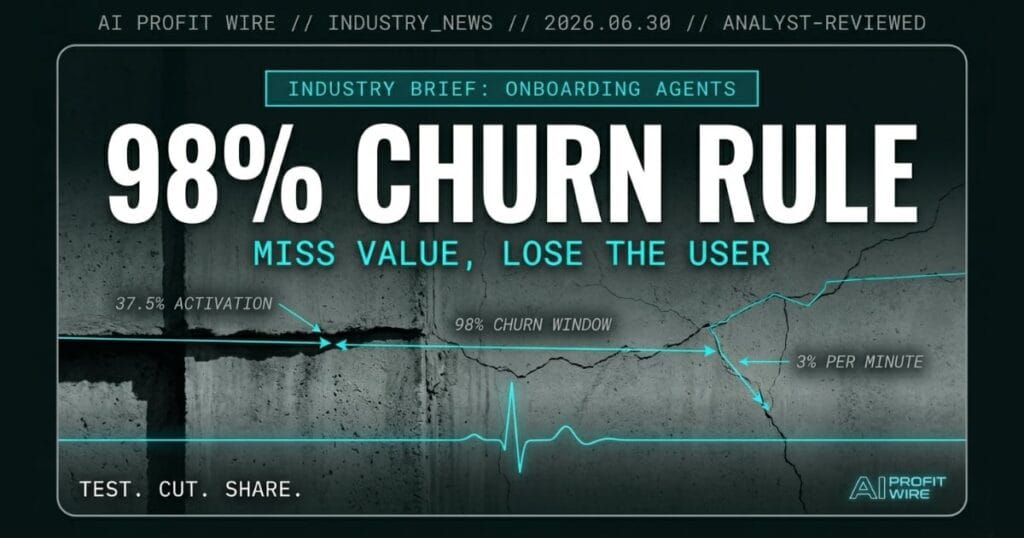
Userpilot’s 2024 benchmark across 62 B2B SaaS companies found average activation at 37.5%, meaning most signups never reach a meaningful product moment. Amplitude’s 2025 data sharpened the picture: over 98% of users who miss a value milestone within 2 weeks churn permanently. OnRamp’s 2026 survey of 150 customer success and revenue leaders found 89% reported AI reduced onboarding friction, 88% said it helps reduce early-stage churn, but only 36% have metrics in place to prove the connection.
Deploy agents with bounded scope and a defined human handoff, or risk automating your users straight to churn.
What’s the evidence behind AI agent SaaS onboarding?
The evidence spans three benchmark datasets and operational data from implementation teams. Userpilot’s 37.5% activation rate defines the ceiling most SaaS products hit. Amplitude’s 98% churn figure for non-activated users defines the time window. Research cited in onboarding analysis suggests every additional minute of setup time reduces conversion by roughly 3%, making time-to-first-value the single most critical lever.
OnRamp’s 2026 report adds the operational layer: 91% of leaders say AI improved customer-facing communication, 92% report improved satisfaction scores, and 70% say AI improves retention. But only 22% have deployed AI across all customer segments, only 25% have AI embedded end-to-end, and only 17% rate their AI maturity as advanced. The gap between perceived benefit and measured proof is where most onboarding AI fails silently.
The data supports agent deployment for speed, but only where the task is predictable and the user isn’t frustrated or strategic.
How does AI agent SaaS onboarding affect day-to-day operations for small businesses?
Small businesses running SaaS products or software services can cut support volume and accelerate user activation using scoped AI agents. The operational impact is measured in hours saved on repetitive queries and conversion lift from faster setup. Teams using agentic onboarding platforms like OnRamp report concrete gains: Qualia cut go-live time by 53% and scaled onboarding capacity 3x. AGS Health reduced onboarding time by 30% and recognized revenue 3 months sooner.
The trap is deploying agents without escalation paths. OnRamp’s analysis frames it directly: agentic doesn’t mean autonomous. The benefit is keeping a human in the loop for the moments that need one, while the agent handles the busywork around them. The 95% of teams whose AI is “mostly reactive rather than predictive” are the ones inflating churn through chatbot loops that frustrate confused users. Track agent-assisted activation as a standalone metric. If it drops, the intervention is broken, not the product. For founders monitoring operational AI trends, our archive of filtered activation and automation signals for small business owners provides ongoing reference points.
Deploy agents with bounded scope and a human handoff defined first, or risk automating your users straight to churn.
A new inventory management dashboard sits empty because the setup agent walked the user through 5 configuration steps but couldn’t explain why a SKU prefix mattered for their specific warehouse layout. The user clicks away at step 3, and 2 weeks later, they churn. The agent handled the technical flow correctly, but it missed the business context. A system designed for speed collides with a user who needed judgment first. The 98 percent churn figure isn’t about product quality. It is about the mismatch between what the user needed and what the system delivered. The fix isn’t more AI. It is scoped AI with a defined escalation path built before a single prompt is written.
What’s the final verdict on AI agent SaaS onboarding?
AI agents belong in onboarding for predictable, repeatable tasks with fixed answers and clear error patterns. They fail where judgment, emotional intelligence, or strategic alignment is required. The analysis recommends starting with a drop-off map, building escalation logic before any prompt engineering, and measuring agent-assisted activation as a standalone metric. Every minute of setup friction costs roughly 3% in conversion. The 3% rule compounds: a 10-minute reduction in time-to-first-value can lift activation by 30%.
The maturity gap is the opportunity. Only 17% of teams rate their AI onboarding as advanced. The 83% who don’t are either over-automating (chatbot traps) or under-measuring (no agent-assisted metric). Both fail. The teams winning at this standardize the onboarding system first, then embed AI deeply into it. They don’t add more AI tools. They add better infrastructure underneath the AI they already have.
Scope the agent tightly, hand off strategically, and measure what matters, or the automation becomes the leak.
Source: AutoGPT Blog
