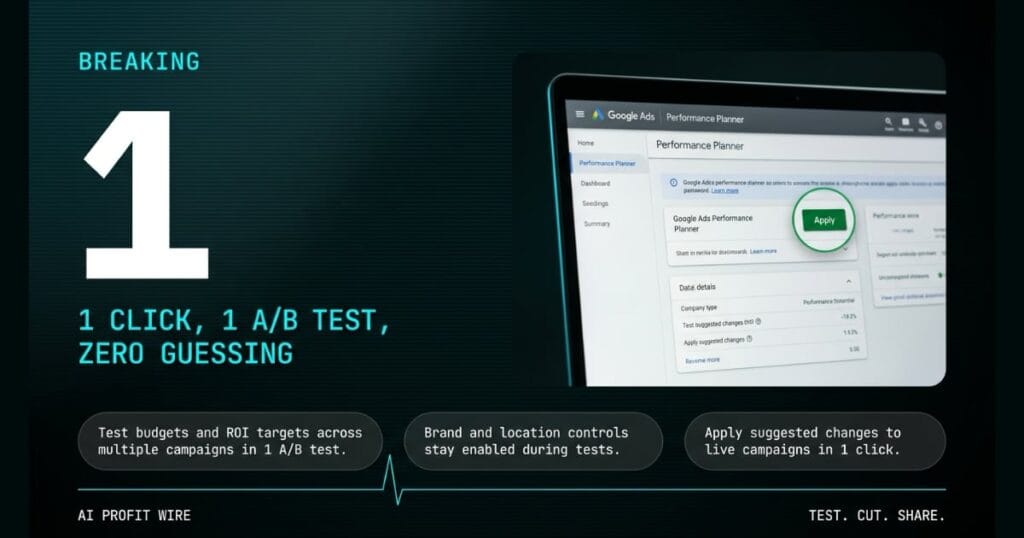
Reduces wasted ad spend and increases ROI through data-driven budget scaling.
What is Google AI Max testing and what changed?
Google is adding A/B testing and budget planning tools to AI Max Search campaigns, with the rollout scheduled for September 2026.
The update lets advertisers test different budgets and ROI targets across multiple Search campaigns in a single A/B test, replacing the previous one-click experiments with a more structured experiment layer.
Performance Planner now also shows how bidding or budget changes may impact existing campaign performance, with suggested changes applicable in one click directly to live campaigns.
Google is turning ad budget scaling into a data-driven experiment instead of a guess.
What is the evidence behind Google AI Max testing?
The announcement came directly from Brandon Ervin, Director of Product Management for Search Ads at Google, posted August 20, 2026 on the official Google Ads and Commerce blog.
The post specifically confirms the multi-campaign A/B testing capability covers brand and location controls, so advertisers can run tests without compromising the guardrails they have already configured.
The Performance Planner integration is the second evidence point. It previews bidding and budget target changes against existing campaign performance before any money is committed.
The blog post specifically calls out that the new AI Max experiments now let advertisers run tests with brand and location controls enabled, so the guardrails they have already configured stay intact during the test.
This is the operational unlock for any business running multi-location campaigns or brand-restricted ad groups, where previously any test risked compromising the controls that kept spend inside compliance boundaries.
The source is official product leadership at Google, not a third-party report.
How does Google AI Max testing compare to the alternatives, and what background do small business owners need?
The previous alternative was manual budget adjustments and guess-and-check bidding, where small business owners changed targets and waited to see if the ROI held.
Earlier AI Max setups lacked the ability to run a single A/B test across multiple campaigns at once, which forced founders to change targets blindly and react after the spend was already gone.
The new tools move the testing before the spend. ROI targets, bidding changes, and brand or location guardrails can all be validated in a controlled experiment before any change goes live.
Performance Planner previews how bidding or budget target changes will impact existing campaign performance, which means the experiment produces a forecast you can act on with the 1-click apply.
For small business owners, this collapses the timeline from a 2 week manual test cycle to a same-day decision backed by Google’s own historical performance data.
The same update also benefits advertisers who previously avoided AI Max experiments because changing ROI targets risked disabling brand or location controls mid-campaign.
Data-backed testing replaces the gamble of manual budget increases.
A 4 chair dental practice just spent $42,000 on a cone beam CT scanner. The settings are a confusing mess of exposure, rotation, and field-of-view dials, and the lead hygienist is terrified to touch any of them without the manufacturer’s rep on speakerphone.
Every patient scan becomes a gamble: too low and the image is unreadable, too high and the patient gets unnecessary radiation. The $42,000 machine sits underused for 6 months while the team waits for the rep to fly out.
Google’s AI Max testing is the preview mode that machine has been missing. You see exactly what the change will do, in a controlled experiment, before you commit a single dollar of additional spend. The 1 click apply is the moment you decide the experiment was worth it, not the moment you start gambling.
How does Google AI Max testing affect day-to-day operations for small businesses?
Small business owners can now scale their lead generation without the fear of an overnight budget collapse from an untested ROI target.
The 1 click application of suggested changes saves hours of manual campaign auditing, freeing the founder to focus on strategy instead of bid tweaking.
Founders running funnels on platforms like Systeme.io for centralized funnel management can now match their top-of-funnel ad spend to actual conversion capacity, scaling only when the experiment proves the ROI holds.
Operational efficiency increases when AI handles the testing layer and the owner handles the decision.
What is the final verdict on Google AI Max testing?
The AI Max testing tools remove the biggest barrier to scaling Google Ads for small businesses: the fear of wasted spend on an untested change.
Testing ROI targets across multiple campaigns in a single A/B test turns a high-risk gamble into a calculated move backed by Google’s own performance data.
For small business owners running 3 or more Search campaigns with brand or location controls turned on, the September rollout removes the last excuse for not scaling AI Max experiments inside the guardrails.
Stop guessing on your bids and start testing them in September.
Source: Google AI Blog
