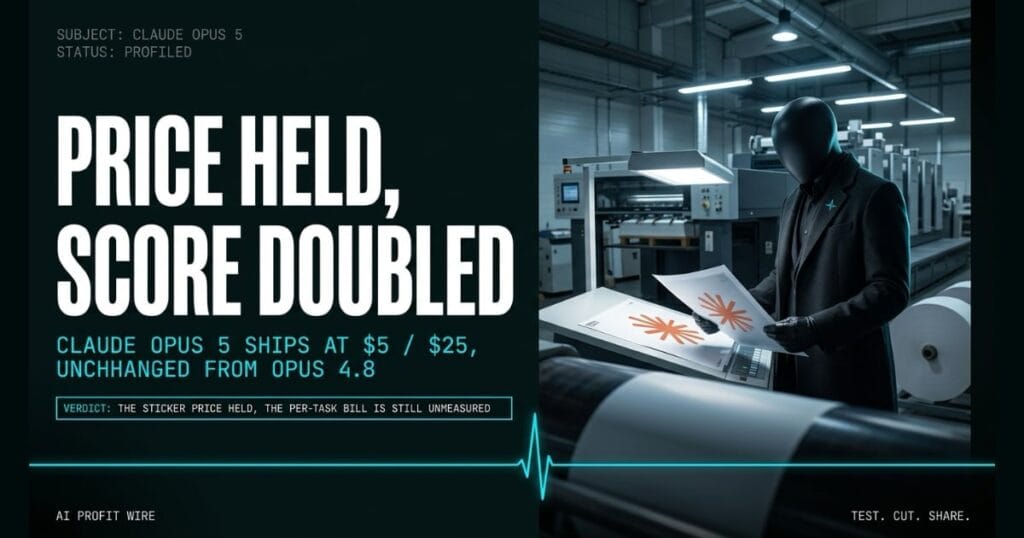
Small businesses don't buy frontier models directly, they inherit them through the AI tools already on the monthly invoice. Opus 5 holding at $5/$25 while more than doubling Opus 4.8's Frontier-Bench score gives every vendor routing to Opus-tier models more capability headroom at zero input-cost increase, which historically surfaces as feature upgrades inside existing subscriptions over the following 30 to 60 days rather than price hikes. The open risk is per-task token burn, which is the number that actually sets an agentic tool's bill, and it stays unmeasured independently on day one.
Analysis assisted by Claude Opus 5, the model reviewed in this signal. All figures are sourced to Anthropic’s launch documentation and independent trackers, linked throughout.
What is Claude Opus 5 and what changed?
Anthropic released Claude Opus 5 on July 24, 2026, priced at $5 per million input tokens and $25 per million output tokens, identical to Opus 4.8.
The model is generally available today across Claude.ai, Claude Code, Claude Cowork, and the Claude API under the model ID claude-opus-5. It becomes the default model on Claude Max and the strongest model available on Claude Pro.
Anthropic positions it as approaching the intelligence of Claude Fable 5 at half the price, although it notes the model stays behind Mythos 5 on cybersecurity tasks and on long-running autonomous biology research.
The headline for anyone running a budget is that the per-token price didn’t move while the benchmark performance did.
What is the evidence behind Claude Opus 5’s benchmark claims?
Anthropic published results across nine named evaluations, and the most business-relevant result comes from Zapier’s AutomationBench.
On AutomationBench, which scores whether a model can complete a business task from start to finish, Opus 5’s pass rate runs around 1.5 times the next-best model at the same cost per task, and even at its lowest effort setting it clears more tasks than any other model tested.
On Frontier-Bench v0.1 it more than doubles Opus 4.8’s score at a lower cost per task, and on ARC-AGI 3, which tests novel problem solving, its score is three times the next-best model. On OSWorld 2.0, a computer-use benchmark, it passes Fable 5’s best result at a little over a third of the cost.
Zapier’s CEO reports the model took a raw account-health workbook and ran a complete churn-prevention sequence, flagging at-risk accounts and routing each one to the right owner, hitting a 100% pass rate where earlier models failed the task outright.
Every number above comes from Anthropic or from partners Anthropic selected for early access, which is why the Hype Check lands at 7.8/10 rather than higher.
How does Claude Opus 5 compare to Opus 4.8 and Sonnet 5, and what background do small business owners need?
Opus 5 holds the same $5 and $25 rate as Opus 4.8, which shipped May 28, 2026, while Sonnet 5 sits at $3 and $15 standard once its introductory rate ends August 31, 2026.
In the weeks before launch, multiple outlets tracked an unconfirmed rumor putting Opus 5 at $10 input and $50 output, double the Opus 4.8 rate. That rumor is now dead, and for once the correction runs in the buyer’s favor.
The background that matters more is that per-token price and per-task cost are two different numbers. Artificial Analysis measured Claude Fable 5 inside Claude Code at $11.80 per completed agentic task against $2.49 for Grok 4.5, a gap driven by tokens burned rather than by sticker rate.
Several early-access partners report Opus 5 moving the right way on that measure, including 26% fewer tokens on legal agent work at max reasoning and roughly a seventh of the reasoning tokens on one trading firm’s benchmark, with under half the latency of Opus 4.8.
A flat sticker price only helps if token burn per finished task stays flat with it, and that’s the number worth watching over the next two weeks.
How does Claude Opus 5 affect day-to-day operations for small businesses?
Almost no small business calls the Claude API directly, which makes this a supply-chain event rather than a purchase decision.
The real exposure runs through the tools already sitting on the monthly invoice, because the platforms that route to Opus-tier models inherit both the capability gain and whatever the true per-task token burn turns out to be.
There’s also a routing detail worth knowing, since requests flagged by Opus 5’s cyber safety classifiers fall back to Opus 4.8 by default inside Claude.ai, Claude Code, and Cowork. Anthropic expects those classifiers to fire around 85% less often than they do on Fable 5, though an automation touching security-adjacent work can still run quietly on the older model.
The models most small businesses actually touch are the ones already embedded in the software they pay for, which is why how your support agent handles a live customer conversation is a more useful question than which frontier model tops a leaderboard this week.
Watch your existing vendors’ release notes over the next 30 days, because that’s where this launch actually reaches your operation.
A 5,000-unit print run comes off the press with a color shift on every sheet, and the operator who signed the proof two hours earlier has already marked the job complete. The defect is there at proof stage. Nobody checks it twice.
The reprint isn’t the expensive part. The expensive part is the client call, the blown delivery date, and the second press run you’re now paying for on a job you already quoted at a fixed price.
That’s the exact gap between a model that reports a task finished and a model that verifies a task finished, and it’s why the self-checking behavior in Opus 5 matters more to a small operation than any single benchmark score on the announcement page.
What is the final verdict on Claude Opus 5?
Claude Opus 5 clears the bar for production use, held back on the scorecard by day-one evidence quality rather than by anything in the product.
Pricing and release maturity both score high, since the model is generally available on every platform at a published, unchanged rate, with a system card and a prompting guide out on launch day.
Community adoption and expert sentiment score lower for the obvious reason, which is that the model is hours old and every reported figure traces back to Anthropic or to the 22 early-access partners it chose to publish.
Treat the capability claims as credible and the cost claims as unverified until an independent per-task measurement lands.
Source: Anthropic
