Reduces infrastructure costs and technical barriers, allowing small businesses to deploy advanced AI automations faster and cheaper.
What is Amazon Bedrock AgentCore harness and what changed?
Amazon Bedrock AgentCore harness now has a verified open-source community node for n8n workflows under the MIT license. You add it as an agent step directly in the n8n editor.
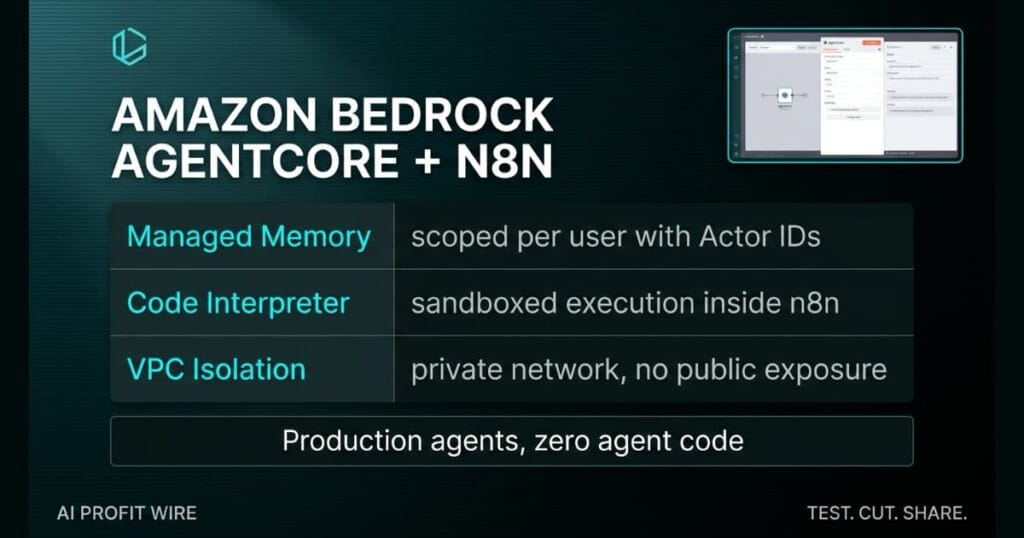
The node exposes the full harness capabilities: managed memory, a code interpreter, skills from the AWS curated catalog, and VPC isolation. You define the agent in configuration, and AgentCore runs the orchestration loop for you.
Each session runs in its own isolated environment with a filesystem, shell, memory across sessions, and web browsing. The first run takes 30-60 seconds to provision, then reuses the agent on later runs. When configuration isn’t enough, you can export the harness to Strands code and keep running on the same system.
Small business owners can deploy production AI agents in n8n without writing agent code or managing infrastructure.
What is the evidence behind Amazon Bedrock AgentCore harness?
The source is an official AWS Machine Learning Blog post providing a full walkthrough of the node. The node package is @aws/n8n-nodes-agentcore, version 0.3, and it is a verified community node in the n8n ecosystem.
AgentCore harness is powered by Strands Agents, the open-source agent framework from AWS. The harness runs the orchestration loop, calls tools, manages the context window, keeps state across turns, recovers from failures, and isolates each session.
When configuration isn’t enough, you can export the harness to Strands code and keep running on the same system. The node uses the same AWS credential pattern as existing n8n AWS Lambda and Amazon S3 nodes.
The integration is production-ready, open-source, and documented with step-by-step examples from AWS.
How does Amazon Bedrock AgentCore harness compare to the alternatives, and what background do small business owners need?
n8n’s built-in AI Agent node handles a single model call in a workflow. The community node goes further by exposing the full harness: managed memory, tool execution, VPC networking, and per-user memory scoping.
Alternatives like LangChain or AutoGen require you to write and host agent code. AgentCore harness gives you the orchestration layer as a managed capability, configured through the n8n editor with no code. The harness handles tool calls, context window management, failure recovery, and session isolation that you’d otherwise have to build yourself.
You can switch model providers mid-session between Amazon Bedrock, OpenAI, Google Gemini, or LiteLLM-supported providers without losing context. Non-Bedrock providers use an API key stored in AgentCore Identity.
The AgentCore node replaces custom agent hosting with a managed, configurable harness inside your existing n8n workflows.
How does Amazon Bedrock AgentCore harness affect day-to-day operations for small businesses?
Founders already using n8n can install the community node from the nodes panel and connect it with their AWS credentials. No new infrastructure, no agent code to maintain.
Memory is scoped by actor and session, so one agent can serve many users with isolated histories. This matters for customer support, onboarding, and any workflow where context carries across turns. You can explore how other AI automation signals affect your operations in the archive.
VPC isolation lets agents access private databases and internal APIs without exposing them to the public internet. The harness pulls its container image from a private Amazon ECR repository in the same Region.
Small business owners get persistent, isolated, tooled agents inside the workflows they already run, with zero additional hosting.
You’re looking at a customer support queue where every conversation starts from zero. The same person asks about their order status 3 times in a week, and each time your agent treats them like a stranger. That’s 3 wasted interactions and a frustrated customer.
AgentCore’s managed memory fixes this. Set an Actor ID per customer and a Session ID per conversation, and the harness scopes memory so the agent remembers what it learned. The first run provisions the memory store in 30-60 seconds. After that, every follow-up loads the prior context before the agent reasons.
You didn’t build a memory layer. You didn’t write agent code. You configured a node in n8n and the harness handled the rest. That’s the operational shift: context persistence without engineering overhead.
What is the final verdict on Amazon Bedrock AgentCore harness?
Amazon Bedrock AgentCore harness gives n8n users a managed agent layer with persistent memory, code execution, skills, and VPC isolation. The community node is open-source under the MIT license.
The harness runs the orchestration loop, manages context windows, and keeps state across turns. You define agents in configuration, not code. First-run provisioning takes 30-60 seconds.
For small business owners already on n8n, this turns existing workflows into stateful, isolated agents without new infrastructure. Memory scoping per user means one agent can serve your entire customer base with individual context.
Install the node, point it at a harness, and deploy production agents from the n8n editor with zero agent code.
Source: AWS Machine Learning Blog
