Implementing AI agents for pre-call research and CRM hygiene can save significant administrative time, allowing human reps to focus on closing deals and relationship building.
What are B2B sales AI agents and what changed?
B2B sales AI agents are software systems that autonomously plan and execute multi-step tasks, like researching accounts and updating CRM records, with limited human intervention.
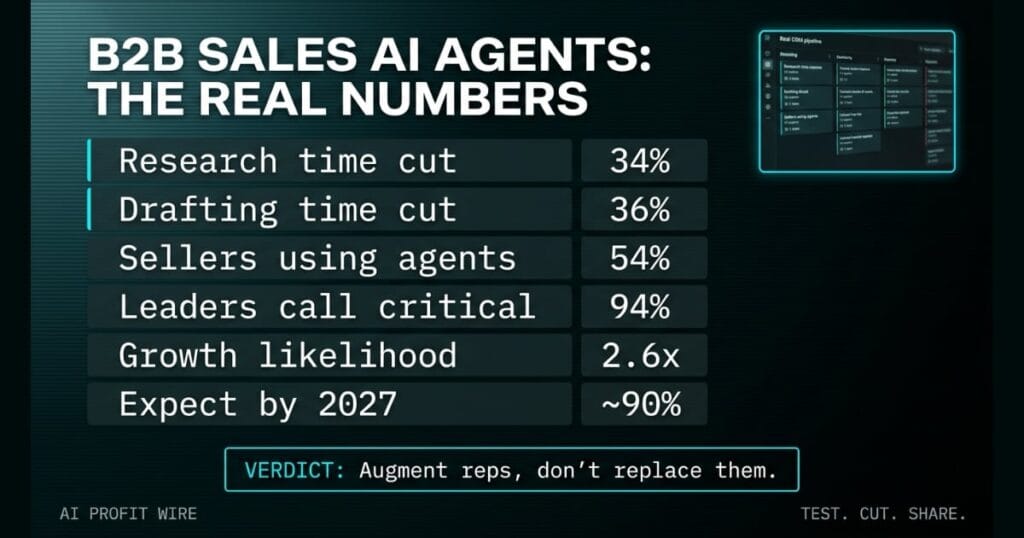
The shift in 2026 is that 54% of sellers have already used AI agents, and 94% of sales leaders who deployed them describe the tools as critical infrastructure. This is no longer an experiment, it is a core workflow component.
These systems differ from basic chat assistants because they monitor pipelines, pull firmographic data, and queue personalized outreach sequences for human approval. The agent possesses initiative and orchestration capabilities.
B2B sales AI agents moved from experimental tech to critical pipeline infrastructure.
What is the evidence behind B2B sales AI agents?
The evidence shows AI agents deliver measurable time savings in specific administrative workflows rather than end-to-end deal execution.
Salesforce State of Sales data from 4,000 professionals reveals fully deployed agents reduce prospect research time by 34% and email drafting time by 36%. Gartner data also shows organizations using AI-enabled next best actions are 2.6 times more likely to achieve commercial growth.
Adoption metrics confirm the trend, with 87% of sales organizations using some form of AI and nearly 90% of sellers expecting to use agents by 2027. The numbers prove AI recommends and humans decide.
The data proves B2B sales AI agents drive growth through augmentation, not autonomous selling.
How do B2B sales AI agents compare to the alternatives, and what background do small business owners need?
B2B sales AI agents outperform static lead lists and manual CRM updates by monitoring thousands of buying signals like hiring spikes and technology changes automatically.
Unlike human SDRs who manage 50 accounts a week, agents compile account briefs, summarize earnings calls, and map buying committees in minutes. This capacity increase happens without a single new hire.
Vendors selling 5-minute setups are selling the sizzle, because successful deployments require weeks of workflow design and permission scoping. Teams that deploy agents on messy CRM data get confidently wrong outputs at scale.
B2B sales AI agents beat manual prospecting but require clean data and explicit human handoff rules.
How do B2B sales AI agents affect day-to-day operations for small businesses?
Small businesses use AI agents to compress roles, allowing fewer people to manage more pipeline by automating repetitive tasks like logging calls and chasing missing data.
Founders must reinvest the 34% research time savings into higher-quality discovery and account expansion instead of simply raising activity quotas.
The operational rule is that agents handle the repetitive layer while humans manage pricing, complex objections, and relationship risk. Defining these handoff points explicitly prevents automated errors.
For a practical starting point, consider pairing agents with an AI customer support tool to handle inbound qualification while agents work outbound research, keeping humans on both handoff points.
Day-to-day operations shift from manual data entry to augmented deal qualification and closing.
The Founder Lens
A shipment of 200 custom-branded parts arrives at your warehouse, and the supplier’s packing slip says all 200 passed inspection. Your receiving clerk logs it as complete without opening a single box, because the paperwork looks perfect and the delivery window is tight.
Three weeks later, your production line stops. 34% of the parts are the wrong spec. The automated inventory system reported success, but nobody verified the physical contents against the actual order. The error scaled silently because the system trusted stale data.
Deploying an AI agent on stale CRM data works the same way. The agent will research, draft, and queue outreach with confidence, but 34% of its inputs are wrong, and every output compounds the error. You must fix your records before you automate a single workflow.
What is the final verdict on B2B sales AI agents?
The verdict is that B2B sales AI agents are mandatory infrastructure for research and CRM hygiene, but fully autonomous selling remains hype.
Small business owners who treat agents as workflow infrastructure with clear guardrails will see a 2.6x higher likelihood of commercial growth. Those who chase demos and cut human headcount will scale their data problems.
The winning pattern in 2026 is AI recommending and humans deciding, which means you must define human-only actions before deployment. The gap between teams that treat agents as infrastructure and teams that chase demos will show up in pipeline numbers.
Founders must deploy B2B sales AI agents to augment reps, not replace them.
Source: AutoGPT Blog
