Warns SMBs that AI software recommendations may be manipulated, preventing costly mistakes in tool selection.
What did Trellner find about Perplexity’s software recommendations?
Trellner Research put 380 buyer-intent software categories, from “CRM software” down to niche verticals, through two Perplexity models and kept every URL the models retrieved while answering. The run produced 3,800 recommendation slots naming 1,807 distinct products, backed by 7,534 citations across 2,055 distinct domains.
The methodology gives the numbers weight: 760 calls in all, one prompt per category per model, with the categories written before any results were seen and never revised.
Grounding is the retrieval step these models perform before they answer, and the documents it pulls are doing more of the deciding than buyers realize.
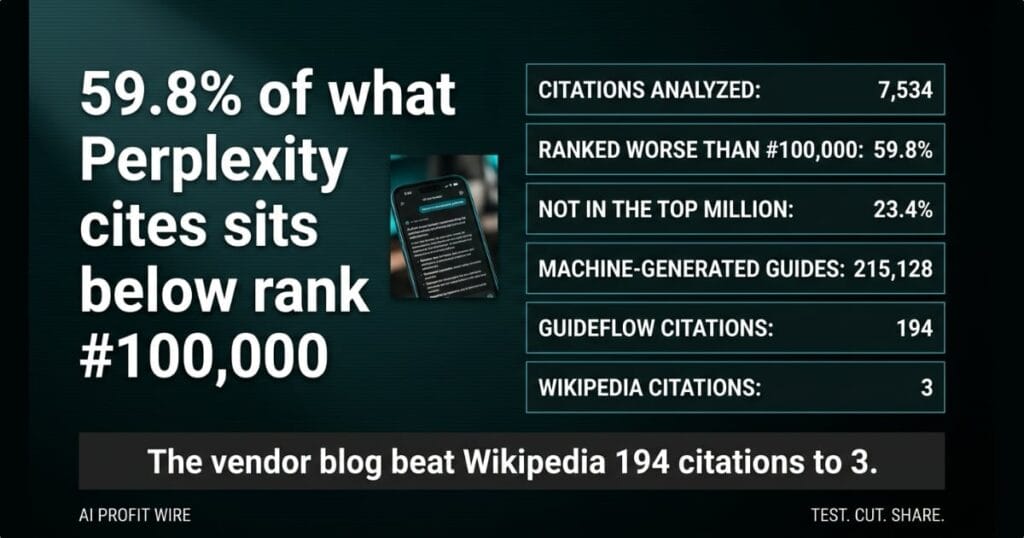
The headline finding is where those documents live: 59.8% of the 7,534 citations point to domains ranked worse than #100,000 in the Tranco ranking, and 23.4% aren’t in the top million at all.
The evidence base behind AI software recommendations sits mostly at the bottom of the web.
How reliable are Perplexity’s software recommendations?
Three related domains published 215,128 machine-generated “best software” guides between them, and none of the 3 existed before December 2023. Two of them label their own homepages “Facts & Grounding Page,” a title addressed to the retrieval software rather than to a human reader.
The guide counts are the tell: 70,731, 71,684, and 72,713 generated buying guides per site, against exactly 6 blog posts each. There are not 215,128 software categories.
A vendor blog called Guideflow, which sells interactive product demos, was cited 194 times across 96 categories it doesn’t compete in, placing it 3rd overall and ahead of Gartner. Each of its 96 citations was a different URL feeding a category question.
The sites winning the citations were built to be read by models, not by people.
How is Perplexity’s grounding different from traditional search?
Traditional search ranks pages for a human who clicks. Grounding fetches documents to condition an answer, which lets machine-readable records bypass the authority signals old SEO demanded.
The concentration data shows it plainly. The median Tranco rank of the ranked citations was 71,611, and Wikipedia was cited 3 times in 7,534 while review site G2 pulled 291 citations.
The ten most-cited domains take 17.3% of citations, so the story isn’t a cartel of famous sites supplying the answers. It’s what fills the other four-fifths: 751 of the 2,055 cited domains, 36.5% of them, don’t appear in the top million.
The two Perplexity tiers also returned byte-identical citation lists in 289 of the 380 categories, which means they share one retrieval layer. You’re sampling the same stack twice, not getting independent opinions.
AI grounding creates a shortcut past the quality filters search spent 20 years building.
The purchase order for a new CRM is sitting in the approvals queue, chosen because an AI shortlist ranked it first. Nobody on the team opened the citations behind that ranking, and the contract is 3 years.
The evidence underneath came from a site with 6 blog posts and 71,684 generated buying guides, credited to 3 reviewers whose page template is shared with 2 sister brands. The “editorial process” line still carries an unrendered placeholder reading “Within the next 26 days.”
A consultant who only reads brochures written by the vendors they recommend gets fired. The AI version of that consultant is free, so nobody fires it, and the bill shows up later as a tool the team quietly stops using.
Does Perplexity’s citation bias affect small business owners?
The founders most exposed are the ones using AI to save time on vendor research. They receive a ranked shortlist that looks objective but was assembled from manufactured listicles and vendor content marketing.
The retrieval errors go past spam into wrong answers. Asked for research data management platforms, one model served dryad.co, which redirects to an Indonesian online gambling portal, and a data quality query returned the Monte Carlo casino instead of the data company.
Trellner is careful about the boundary: the study did not test whether removing these sources would change the answers. The measured fact is what the evidence layer is made of, and 1.1% of the recommended vendor homepages were already gone or unreachable.
If you’re fixing your own corner of the web in response, write for the human buyer first, and a content optimization platform like NeuronWriter keeps that intent focus instead of chasing the bot.
The risk is buying on evidence nobody human ever vetted.
Should you trust Perplexity’s software recommendations?
Treat every AI shortlist as a starting point, not a verdict. Use it to generate names, then verify each one against sources a machine didn’t write.
Open the citations before you open your wallet. A domain you’ve never heard of, running generic “best of” lists, is not evidence of quality.
Demand a live demo and check forums where real users discuss failures, because a peer who pays the monthly bill beats a machine-generated ranking every time.
Verify every AI software pick with a live demo and a human peer.
Source: trellner.com
