Understanding this transition prevents wasted spend on disconnected AI tools and focuses investment on integration that drives actual business outcomes.
What’s the AI orchestration chasm and what changed?
The orchestration chasm is the structural barrier that prevents businesses from scaling AI beyond isolated departmental pilots. It represents the difficult leap from Level 2 operational tools to Level 3 systemic automation.
At Level 2, marketing teams use AI for content generation and support teams use it for ticket triage. These standalone systems deliver measurable value, but they don’t connect to core business infrastructure like CRMs or billing platforms.
Breaking through this plateau requires an orchestration layer that acts as middleware between AI models and enterprise systems. This layer allows agents to read from and write to the actual databases that run the business.
The orchestration chasm is the exact bottleneck where AI pilot purgatory begins.
What’s the evidence behind the AI orchestration chasm?
Gartner predicts that over 40% of agentic AI projects will be canceled by the end of 2027 because of escalating costs, unclear business value, and inadequate risk controls. This high failure rate stems directly from the complexity of integrating agents into legacy systems.
KPMG’s Q4 2025 AI Pulse Survey found that 65% of leaders cite agentic system complexity as the top barrier to deployment, a figure that held steady for two consecutive quarters. Department-level success doesn’t automatically translate to enterprise-level scale without a unified integration strategy.
Deloitte’s 2026 State of AI in the Enterprise report found that only 21% of organizations have a mature model for governing autonomous agents, while 84% have not redesigned jobs around AI capabilities. This lack of organizational coordination compounds the technical integration barrier.
The evidence shows that technical isolation and a lack of governance infrastructure are killing AI scalability.
How does the AI orchestration layer compare to the alternatives, and what background do small business owners need?
Many executives treat AI adoption as a model-selection problem, asking which AI they should buy. This is the wrong first question, because the AI model is merely an interchangeable reasoning engine.
The correct approach is asking how AI will connect to existing systems, data, and workflows. The orchestration layer provides this connection, giving the reasoning engine the ability to perform actual write operations like updating CRM records or processing refunds.
Without this middleware, even the most capable model is limited to answering questions based on text manually pasted into a chat window. The orchestration layer keeps business logic within your own infrastructure so you can swap underlying models without rebuilding entire systems.
Model selection is secondary, because the orchestration layer is the most critical architectural decision for scaling AI.
How does the AI orchestration chasm affect day-to-day operations for small businesses?
Small businesses face the exact same operational bottlenecks as Fortune 500 companies when trying to scale AI. When tools operate in isolation, founders waste spend on disconnected software that requires manual data transfer.
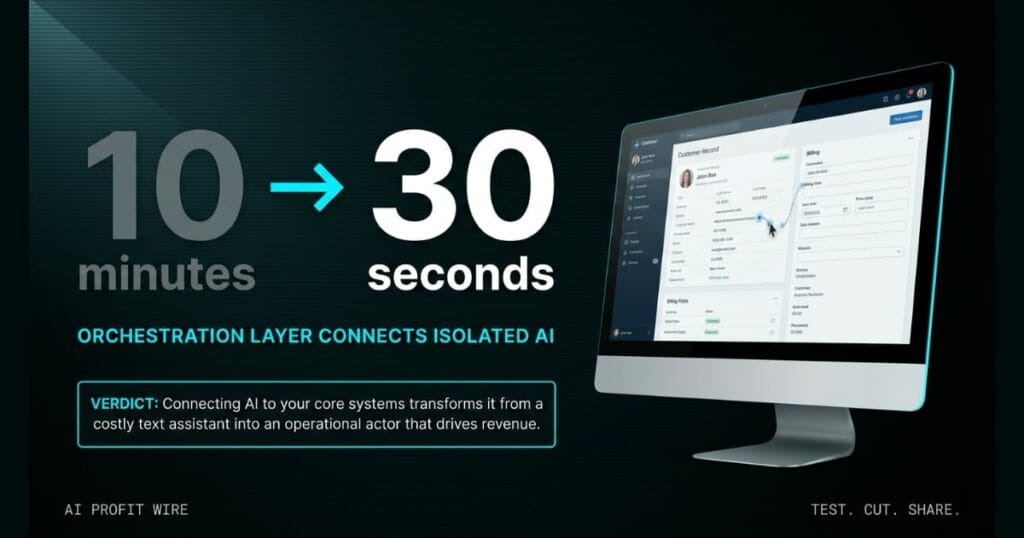
Wells Fargo deployed an AI assistant to 35,000 bankers across roughly 4,000 branches, connecting the agent to internal procedures and reference material. Bankers now retrieve information in about 30 seconds, down from up to 10 minutes of manual searching, and 75% of relevant searches run through the agent.
JPMorgan Chase built its LLM Suite platform, which reached 200,000 onboarded users within 8 months, while its Contract Intelligence system performs the equivalent of 360,000 hours of legal and loan-officer work annually. Connecting your AI-powered support tools to your core database is what makes that kind of operational lift possible.
Connecting AI to your core systems transforms it from a costly text assistant into an operational actor that drives revenue.
A dispatcher’s routing algorithm promises faster delivery times, but the software can’t pull live traffic data or write updated ETAs back into your customer notification system. The algorithm works perfectly in isolation, yet your drivers still arrive late and your clients remain in the dark because the tool operates as an island.
The 65% deployment complexity barrier hits your courier service the same way it stalls enterprise AI pilots. Wells Fargo collapsed a 10 minute search into 30 seconds by giving 35,000 bankers an agent that reads from actual internal systems, and that lift is impossible without an orchestration layer connecting your chatbot to your billing and fulfillment data.
To cross this chasm, you need middleware that authenticates into your dispatch software and performs the write operations that actually resolve the customer issue. Without that integration, you’re paying for a text generator while your operational backlog continues to pile up.
What’s the final verdict on the AI orchestration chasm?
The AI orchestration chasm is the definitive barrier between isolated departmental tools and systemic business automation. Bridging it requires a middleware layer that connects reasoning engines directly to your core operational data.
Gartner projects that over 40% of agentic AI projects will fail by 2027 due to escalating costs and inadequate risk controls. This failure is a direct consequence of ignoring the integration and governance barriers that an orchestration layer solves.
Small business owners must stop asking which AI model to buy and start asking how they will connect AI to their existing systems. The model is interchangeable, but the orchestration layer is the permanent architectural foundation that drives business outcomes.
Surviving the AI maturity transition requires investing in orchestration before upgrading models.
Source: blog.n8n.io
