Prevents loss of client trust and brand dilution caused by generic, obvious AI-generated communications.
What is AI email slop and what changed?
AI email slop is the act of copying raw chatbot output and pasting it into a professional communication without reading, editing, or adding any human judgment.
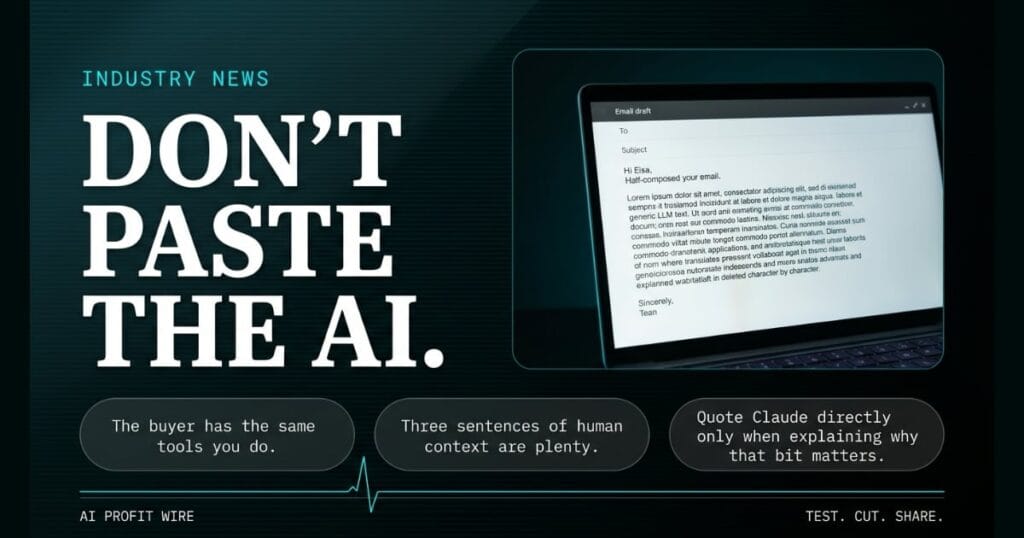
The person on the other side has the same tools you do. If they wanted the generic answer, they would have it in a couple of seconds. They asked you because they wanted your context, your taste, and your judgment.
The shift is from using AI as a final author to using it as a drafting partner, with the human remaining the primary source of value in every reply.
Stop acting as a proxy between a chatbot and the person who asked you a question.
What is the evidence behind AI email slop?
The team behind dontpastetheai.com built a public-facing resource specifically to call out the behavior of dumping raw LLM output into Slack DMs, code reviews, and client emails.
Their guidance is direct: use AI for drafting, but read what it gave you, then write your own version or polish the text. Take the part that actually answers the question and ignore the rest. Three sentences from you is plenty, and even if those three sentences are copied, at least you read them.
If a specific part of the model’s answer is genuinely useful, quote it and explain why. The site’s own example reads “I asked Claude and this bit here makes sense,” followed by the human’s reason for trusting that specific point.
The site also makes a fourth point that most businesses miss: silence is a valid response. If you have no strong opinion, say so explicitly rather than faking one with AI text.
This directly addresses the most common failure mode in B2B communication, which is the urge to seem responsive at the cost of being honest about what you actually think.
The professional consensus is clear: raw AI output in a business inbox is a brand liability.
How does AI email slop compare to the alternatives, and what background do small business owners need?
The alternative workflow is AI-drafts-and-humans-edit, which preserves the speed of AI while keeping the human authority over every word that ships.
Effective users pull out the single specific answer the model produced and drop the rest. They add 3 sentences of human context, which is usually enough to carry the judgment the model cannot.
When a model like Claude provides a genuinely useful technical point, the sender quotes it directly and explains why that specific point matters, instead of forwarding the entire response as if it were their own thinking.
The dontpastetheai.com resource frames this as a basic habit, not a sophisticated workflow. The default is to read what AI generated, then write your own version or polish the text, full stop.
This is also why the same tool that 10x’s your drafting speed can simultaneously erode your client trust, if you let the raw output ship without the human layer on top.
Human judgment is the only differentiator in an AI-saturated inbox.
A real estate agent drafts an offer letter to a listing agent using a chatbot at 9pm. The output is clean, structured, and reads like every other AI-written offer the listing agent has seen that week.
The listing agent has ChatGPT open in the next tab. They paste the offer in, ask the model to identify AI slop, and the model flags it instantly. The offer is dismissed without a counter, because the buyer’s agent did not add a single piece of context the model could not have generated on its own.
The 3 sentences the agent could have added, the comparable comps from the buyer’s last 2 wins, the reason this particular school district matters to the family, the willingness to flex on closing date for a 10 percent earnest money increase, are the only reason the listing agent picks up the phone. AI cannot supply that part.
How does AI email slop affect day-to-day operations for small businesses?
Over-reliance on AI for client communication dilutes brand trust and makes the founder look replaceable by a free tool.
Operational efficiency increases when AI is used to brainstorm and draft, but trust collapses when raw output is used to communicate, especially in high-ticket services where the buyer is paying for judgment.
Founders who want a deeper framework on this should read the latest AI signals for small business owners for adjacent plays on AI in client work.
Efficiency without judgment is just a faster way to lose clients.
What is the final verdict on AI email slop?
AI is a powerful drafting partner but a terrible spokesperson. It lacks the taste, the context, and the specific perspective that earns professional trust.
Small business owners must read every word the AI generates and rewrite the final take. If there is nothing to add, a short honest reply beats a long generic one every time.
Use AI to think, but never let it speak for you in a client inbox.
Source: dontpastetheai.com
