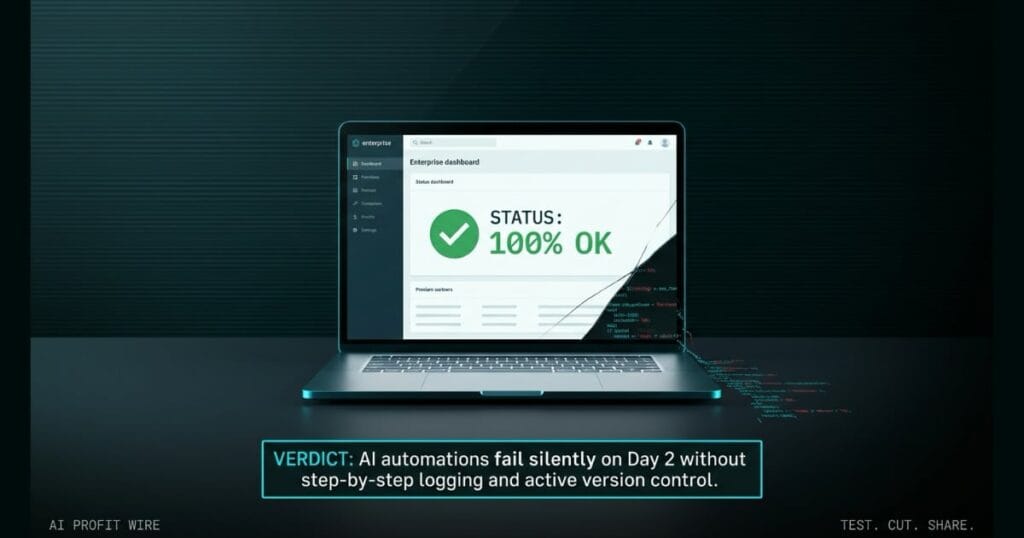
Prevents costly downtime and wasted resources by ensuring small business owners build AI automations that are maintainable and scalable from day one.
What is the AI Day 2 Problem and what changed?
The AI Day 2 Problem represents the long-term maintenance issues that surface after an automation is built and launched, catching non-technical builders off guard.
Building an AI workflow on Day 1 is pure bliss, but keeping it running on Day 2 is a classic software engineering challenge, and if you come from a non-technical background, this can be fatal for your momentum.
When an automation breaks, the lack of underlying infrastructure knowledge becomes fatal for momentum, as AI tools rarely teach how the actual system works.
The Day 2 Problem is a classic software engineering challenge that experienced engineers have been solving for decades.
What is the evidence behind the AI Day 2 Problem?
The evidence comes from a finance worker named Dave who built an invoice-scanning automation that posted 3 invoices with the wrong amounts on its second day.
Because his automation lacked traceability, he had no record of what the AI did at each step, meaning he could not tell if the AI misread the PDF or if the upload failed.
Dave edited his only version to fix the error, but with no version control, he couldn’t undo the change and spent hours rebuilding his original automation from scratch.
By Friday, the system silently skipped 11 invoices because it could not parse the formats, operating unnoticed while Dave spent the week fixing visible errors.
Without logging and version control, AI automations fail silently and operators can’t undo the damage.
How does the AI Day 2 Problem compare to the alternatives, and what background do small business owners need?
Traditional software gives the same output until someone changes the code, but AI model updates can adjust how a prompt is handled, meaning the same input gives a different result.
If your product depends on consistency, you need a way to test that it still behaves as it did last week, which software engineers call evals, essentially QA for AI.
On Wednesday of Dave’s week, a teammate named Marco tried to help when the system needed a reset, but the login credentials were tied to Dave’s email and there was no documentation.
On Thursday, Dave’s boss asked to roll the automation out to a second office, but everything was hardwired to one email inbox, one set of vendor formats, and one accounting system, requiring a full rebuild.
Experienced engineers rely on a comprehensive set of areas to review, known as the “ilities,” which include maintainability, portability, and scalability to prevent these exact failures.
When model updates can shift how a prompt is handled, you need active version control, shared access, and continuous testing to catch the drift before it breaks operations.
How does the AI Day 2 Problem affect day-to-day operations for small businesses?
For daily operations, small business owners must establish clear ownership before building, adopting the principle that if you build it, you run it.
If other people will use or depend on the system, you must figure out shared credentials, permission levels, and enough documentation that someone else can operate it without texting you, a pattern we’ve documented across AI deployment signals for small business teams.
You also need to ask how much the system costs to run, because a process that costs 2 cents per run may require a major budget approval if it scales across multiple locations.
Security can’t be an afterthought either, because if someone breaks into your AI system, they could access vendor payment data or customer information, and anything federally protected demands real safeguards.
Operational success requires building with shared access, documented credentials, scalable cost tracking, and security review from Day 0.
A wholesale distributor’s AI order processor silently skips 11 purchase orders in a single week because the vendor PDF template changed. The dashboard shows green checks across the board, but the shipments sit unprocessed in a queue no one monitors.
The distributor only learns about the gap when a major retailer calls asking where their delivery is. By then, 3 of those orders have expired their ship-by dates, and the cost of expedited shipping eats the margin on the other 8.
Building an automation without step-by-step traceability means your first alert is a customer complaint, and by then the damage has compounded for days.
What is the final verdict on the AI Day 2 Problem?
You solve the AI Day 2 Problem by asking the right questions on Day 0 before you write a single line of code.
AI will give you the output you ask for, but it won’t assume you need version control, security, or observability, so you have to prompt it to interview you first.
If you build without tracking inputs and establishing failure alerts, you’ll discover the gaps only after something breaks, and the longer the system runs, the more vulnerable it is.
The right prompt is simple: tell the AI you want your project to follow best practices for maintainability, security, observability, and scalability, and ask it to interview you before you launch.
Prepare for Day 2 by demanding traceability, version control, and monitoring before you launch any AI automation.
Source: blog.n8n.io
