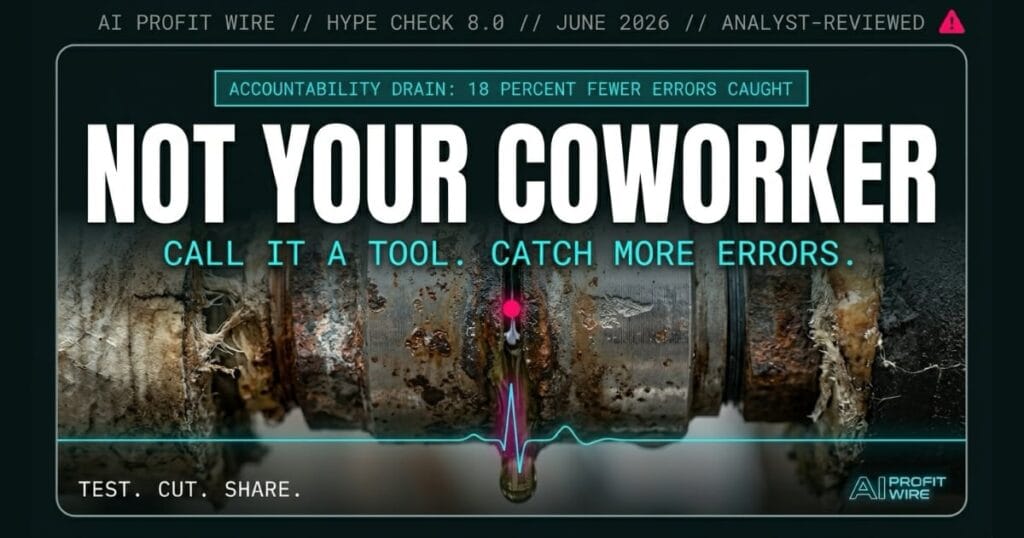
Framing AI as a tool rather than an employee prevents costly errors, reduces unnecessary management escalations, and keeps your human workers productive and accountable.
What did MIT Technology Review find about AI agents as coworkers?
MIT Technology Review published research on June 29, 2026 by James O’Donnell confirming that framing AI agents as “digital employees” or “coworkers” makes human workers worse at their jobs. The research, led by Boston University business professor Emma Wiles, found that people caught 18% fewer errors when work was attributed to an agentic “AI employee” rather than a chatbot. They were also 44% more likely to escalate questionable AI output to a manager instead of trusting their own corrections.
The findings are stark. When AI is framed as a coworker, human workers see themselves as less responsible for its output. They offload accountability to the “employee” and escalate problems upward instead of fixing them directly. That defeats the purpose of deploying AI agents in the first place, which is to save time by reducing managerial overhead.
The MIT article confirms that nearly a third of the 1,261 managers in Wiles’s study said their companies already frame AI agents as employees, and 23% even list them on org charts. Jensen Huang (Nvidia), Microsoft, OpenAI, Anthropic, and Google have all released agent-management tools that explicitly advertise AI as “digital colleagues with the flexibility and cognitive power of actual humans.”
Calling AI a coworker is a branding exercise that makes humans worse at their jobs. The Hype Check score is 8.0/10, driven by the strength of the research methodology and the direct operational consequence for small business owners.
What’s the evidence behind the MIT research on AI agents?
The source is MIT Technology Review, a Tier 1 source. The research was led by Emma Wiles at Boston University, with a sample size of 1,261 managers. The key findings are quantified: 18% fewer errors caught when AI is framed as an “employee,” 44% more likely to escalate questionable work to a manager, 23% of companies list AI agents on org charts, and nearly a third frame AI as employees.
The article also cites Daron Acemoglu, an MIT economist who won the Nobel Prize in 2024 for his work on AI’s impact on the economy. Acemoglu’s quote is direct: “AI agents right now are being marketed as things that can replace humans, and I think that’s just a losing proposition. They should instead be optimized so that they can improve human capabilities, which is not what they have at the moment.”
The article references a Stanford research effort that presented 1,500 workers in 104 jobs with information about what tasks AI could do, and asked what would actually be helpful. The finding: the tasks tech experts deemed most suitable for AI were often the tasks actual workers said they definitely did not want or need an agent to do. That gap between expert assumption and worker reality is the accountability problem in miniature.
The evidence is Tier 1 research from MIT and Boston University, with a Nobel laureate’s endorsement and a Stanford cross-reference. The Hype Check score of 8.0/10 reflects the research rigor and the direct operational consequence.
How does the MIT research affect day-to-day operations for small businesses?
For small business owners deploying AI agents in customer support, content production, or operational workflows, the research says: stop calling them coworkers. The framing you use internally and externally directly affects how your human team interacts with the AI. If you call the AI a “team member,” your staff will treat its output as a colleague’s work, which means they will catch fewer errors and escalate more problems to you.
The fix is linguistic and operational. Call the AI a tool. Frame its output as draft output that requires human review. Set clear accountability rules: the human who deploys the AI is responsible for its output, not the AI itself. That framing produces the opposite behavior of the “coworker” framing: humans catch more errors, escalate fewer problems, and take ownership of the final result.
For small business owners deploying AI in customer-facing roles like chat support, tools like Tidio, reviewed in our Intelligence Report, offer a framework for positioning AI as a tool with clear escalation paths, not as a “digital employee” that customers might blame for errors.
A customer complaint lands in the support inbox because the new website chatbot hallucinated a return policy that doesn’t exist, and the staff member blames the AI. The accountability chain breaks on contact. MIT’s research quantifies exactly why that happens. When you call the AI a coworker, your team mentally files its output under someone else’s responsibility. When you call it a tool, your team files its output under their own responsibility to review before it ships. The word choice isn’t semantics. It is an operational switch that determines whether errors get caught at the draft stage or the complaint stage. The 18 percent error-detection gap is the hard cost of getting that switch wrong.
What’s the final verdict on AI agents as coworkers?
The MIT research is clear: framing AI as coworkers makes human workers worse at their jobs. The 18% error-detection drop and the 44% escalation increase are quantified, peer-reviewed findings from a Tier 1 source. The operational consequence for small business owners is direct: how you frame your AI tools internally determines how your team handles their output.
The fix is not to abandon AI agents. The fix is to frame them as tools, set clear human accountability for their output, and build review checkpoints into the workflow. That framing captures the productivity benefit of AI without the accountability erosion that the “coworker” framing produces.
Rename your AI tools from “Alex” to “the support tool” and watch your team’s error-detection rate climb. The Hype Check score of 8.0/10 reflects the research strength and the direct operational fix.
Source: MIT Technology Review (by James O’Donnell, citing research by Emma Wiles at Boston University and Daron Acemoglu at MIT)
