Lower AI inference costs can reduce operational overhead for businesses building custom AI workflows.
What Is Anthropic’s Claude Opus 5.5?
Claude Opus 5.5 is Anthropic’s frontier model and the first release in its 5.5 family, launched on September 22, 2026. On October 14, 2026, Guillaume Princen, the company’s Head of International Startups and Digital Native, told Bloomberg Tech the model now runs about 40% cheaper than its predecessor, and that customers are splitting tasks across the 5.5 family instead of routing every request to one flagship.
The interview matters for budgets because the 40% is not a rounding error or a promotional rebate. Anthropic’s launch announcement publishes the full rate card behind the claim and the test conditions the company used to reach it.
The headline number applies to the tier Anthropic sells, and the rate card is public.
Does Opus 5.5 Cost 40% Less Than Opus 5?
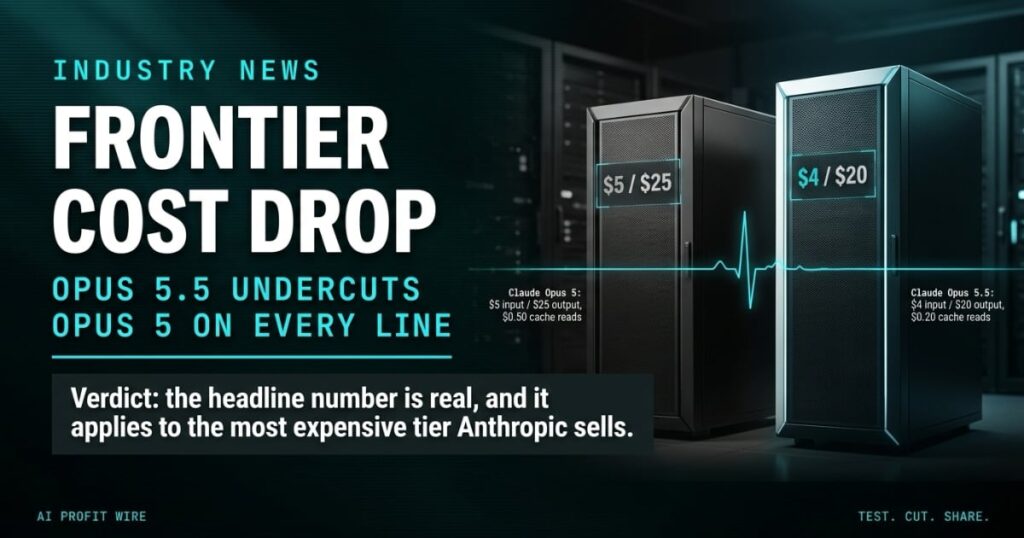
The vendor’s own tests say yes at default settings on typical workloads, and the math is published. Input and output tokens cost $4 and $20 per million against Opus 5’s $5 and $25, a 20% cut on raw tokens, while cache reads drop from $0.50 to $0.20 per million, 60% less on the line that carries most agentic and coding workloads.
The rest of the 40% comes from efficiency rather than price cuts. Opus 5.5 uses fewer tokens per task, which nets out to the full saving on typical workloads, and the same announcement states the model generates output more than 30% faster than Opus 5.
Third-party coverage reached the same numbers when the model shipped, and The New Stack walked through the migration math in the days after launch. Princen’s framing to Bloomberg adds the demand side: customers assign different models in the 5.5 family to specific tasks, and that routing decision is where the saving lands.
The 40% holds if someone routes each task to the right model, and it shrinks for teams that never touch the default.
Claude Opus 5.5 vs Opus 5: Which Should a Small Business Run?
For any workload still running on Opus 5, the replacement is cheaper on every published pricing line and faster on output, which makes the legacy tier the expensive option in the lineup. The Bloomberg interview adds a second dimension to the comparison: Anthropic holds a safety-first release posture, including a willingness to delay or limit powerful model releases such as Methos when safety concerns arise, even at the expense of near-term revenue.
That posture matters to buyers because it signals the pricing is not subsidized by skipped testing. The model was tested before release by external evaluators including Frontier Design and METR, and Anthropic publishes the results of its automated behavioral audit.
On price, speed, and published benchmarks, 5.5 replaces 5, and the switch decision is now a routing exercise rather than an evaluation project.
A founder opens the quoting tablet at 7 in the morning and prices the first job of the day off a supplier sheet last touched 14 months ago. The supplier announced a 40% price drop the week before, and every quote written since the announcement still carries the old math. Nobody reopened the sheet, so nobody priced the change.
AI model routing fails the same way: the default set in January keeps billing at October rates, and the console never volunteers the difference. The 40% Anthropic published is a rate card, not a refund, and the gap between the 2 is the token spend nobody rerouted.
The fix is boring on purpose. Open the rate card, check which model each workflow calls, move the routine steps down a tier, and let the first invoice confirm the 40%.
Who Benefits Most From the Opus 5.5 Price Cut?
Teams with long-running agent workflows feel it most, because savings compound across every step of a multi-hour task and cache reads carry most of the agentic bill. A use case that failed the ROI test at $5/$25 clears the bar at $4/$20 with a 60% cheaper cache rate behind it.
Companies in pilot mode feel it differently: the same evaluation now lands 40% lighter on the invoice. The teams leaving the entire saving on the table are the ones that priced an AI feature off old rates and never rechecked.
The cut rewards businesses already measuring token spend and costs the ones treating the AI bill as a fixed line.
Should You Move Your Workloads to Opus 5.5?
Pull the last invoice, find the 3 workflows burning the most tokens, and check which model the console routes them to by default. Reassign the routine steps to the smaller models in the 5.5 family, move the long-running jobs to 5.5, and measure the first invoice against the old one before you reforecast the quarter.
Current rates live on Anthropic’s pricing page, and we keep the cross-vendor view current in the model rates we track as vendors move them.
Move the workloads, measure the first invoice, and confirm the 40% before it changes your forecast.
Source: Bloomberg Tech
