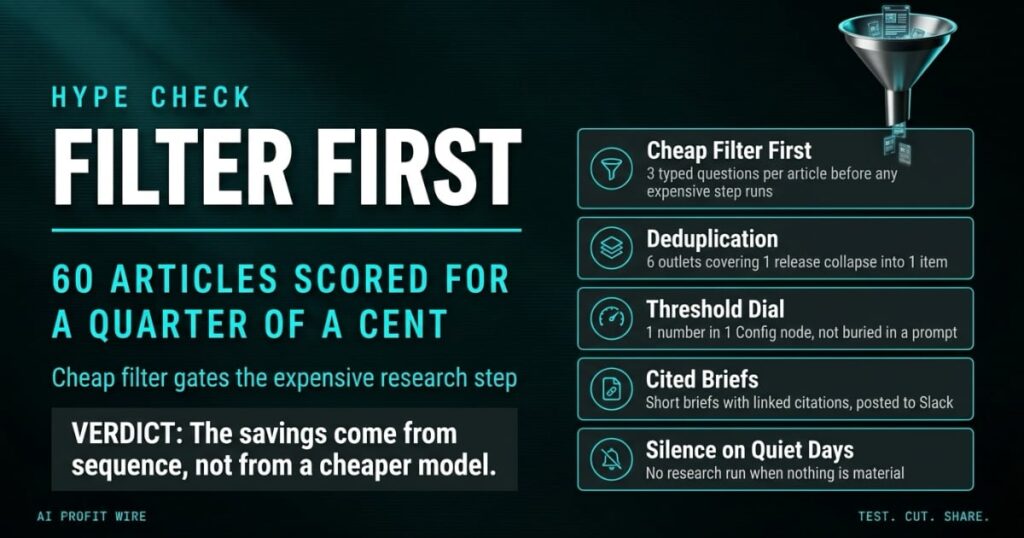
Saves hours of manual industry reading and cuts LLM API digest costs to under four cents a day.
How do you build an automated AI news briefing with n8n?
You import a free workflow template into n8n, set your topics in one Config node, and let it run every weekday at 8am. It searches the day’s AI news, filters every article through a cheap scoring model, and posts a cited brief per topic to Slack.
The workflow comes from Tyler Eastman, a Senior Software Engineer at You.com, published as a guest post on the official n8n blog. It runs on n8n Cloud or a self-hosted instance, and the You.com node installs from Settings > Community Nodes.
Each article passes through Jev, a System One model from TypeSafe AI, which answers 3 typed questions in a single call: whether the article reports a real development, whether it’s actually about your topic, and how much it matters to your team. Surviving articles get grouped by story, then You.com Research writes a short brief with linked citations and Slack posts it.
The whole pipeline exists so the expensive step, the research brief, only ever touches material that already passed a filter costing a fraction of a cent.
Does the n8n AI news briefing workflow actually save money?
Yes, and the article puts exact figures on it. A full morning of searches, filtering, and research briefs runs between 0.01 and 0.04 dollars.
The filtering step costs about 0.004 cents per article, which is 0.00004 dollars. Scoring 60 articles across 3 topics costs roughly a quarter of a cent, which is why the workflow can afford to ask 3 separate questions about every result instead of 1 vague question about all of them.
Run the order the other way, pushing a general-purpose LLM across 60 articles every morning, and you pay for 60 articles’ worth of inference to receive 4 articles’ worth of value, with the added latency of a big model judging items that were never going to make the cut. The article notes that at this filter price, the entire filtering step costs less than 1 summary from a frontier model.
Quiet days cost less still, because the research step doesn’t run for topics with nothing in them. If you track what your own model calls cost per task, the per-model rates there stay current.
The savings come from sequence, not from a cheaper model: the heavy spend runs last, on a set already cut down by a filter costing four thousandths of a cent per item.
How is this n8n workflow different from a standard AI news digest?
Most digests don’t filter, they send everything or send an LLM summary of everything, which the article calls the same thing with extra steps. This workflow filters first and stays silent when nothing material happened.
The standard digest arrives in Slack every morning at 8am whether or not anything happened, and within 3 weeks people stop opening it. The article’s line is blunt: a digest that cries wolf daily is worse than no digest.
Two structural choices separate this build. Deduplication skips anything seen in an earlier run, so a story that stays in the news cycle for 3 days doesn’t appear in 3 consecutive briefs, and 6 outlets covering 1 model release collapse into 1 item with multiple sources behind it.
The materiality threshold lives as 1 number in 1 Config node rather than buried in a prompt, so when the brief starts surfacing the wrong things you adjust a dial instead of re-litigating prompt wording. Citations on every claim make the brief forwardable: a pricing-change claim with a link is something you can send to your head of product.
Silence on quiet days is the feature that keeps people reading the brief in month 3, and no summarize-everything digest can replicate it.
The 8 a.m. digest lands and nobody opens it. 60 articles summarized into one wall of text, 4 articles’ worth of value buried in it, and the mute button gets pressed by Friday.
By week 3 the channel sits muted, which is the exact failure the You.com team built against. Their filter asks 3 typed questions per article at 0.004 cents, keeps the material items, and posts nothing when a topic has no news.
A small team tracking competitors, regulation or model releases runs the same play without the 8 a.m. wall. The filter is the product. The brief is the receipt.
Who is the n8n AI news briefing workflow for?
It’s for a founder or team that needs to track a handful of fast-moving topics, model releases, agent tooling, or AI regulation without spending an hour reading or real money on inference. The template ships with those 3 topics, and 3 is the recommended starting number because it keeps the morning post short enough to read.
The Config node asks for a description of what your team builds and what would change a decision for you, such as a competitor shipping, a price change, or a regulation with a compliance date. The article’s example: a team shipping a developer-facing API and a team running ML infrastructure for a bank will diverge sharply on the same article about an inference pricing change.
You need a You.com API key, a TypeSafe API key for Jev, and a Slack channel your bot has joined. Jev is in early access at the time of writing, with a waitlist, so there’s 1 gating step before the template runs end to end.
If your team already lives in Slack at 8am and you’re manually scanning AI news, this template replaces that habit for under 4 cents a day.
Is the n8n AI news briefing workflow production ready?
The template imports into your n8n instance with every node wired and configured, so the build work is done. The judgment work, your topics, your team description, and your threshold, is yours to tune over the first week of real mornings.
Set the materiality threshold too high and quiet days go silent in a way that feels broken. Set it too low and you’re back to a digest nobody reads, so treat the template default as a starting point and adjust after a week of watching what surfaces.
For heavier days, the Research operation has a background mode that returns a task id you poll until completion, worth adding if you raise the effort level on topics with a lot of material. Total running cost stays in the 0.01 to 0.04 dollars per morning band the article reports.
Production ready as a filter-and-brief pipeline, with 1 waitlisted dependency and 1 threshold dial you will want to calibrate against your own topics.
Source: blog.n8n.io
