Saves operational time and filtering costs by automating complex customer interaction moderation without custom training cycles.
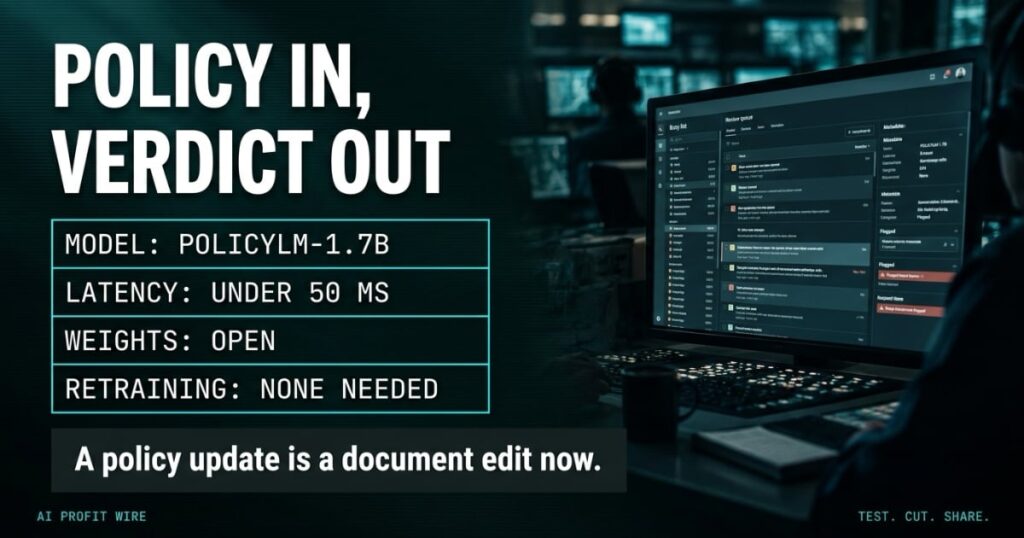
Musubi has released PolicyLM-1.7B, an open-weight decision model built for one job: applying a content policy written in plain English to messages in under 50 milliseconds. It lands in the middle of a fast-forming category, two weeks after TypeSafe AI’s Jev sparked the decision-model wave that OpenAI and Amazon quickly joined.
The model ships with open weights, so teams that self-host can run their entire moderation stack without a metered API.
Musubi packaged real-time moderation as a self-hostable decision model.
What is Musubi’s PolicyLM-1.7B?
Per the TechCrunch report, Musubi announced PolicyLM-1.7B on Tuesday as a lightweight decision model made for real-time moderation, released with open weights.
The model card on Hugging Face documents the mechanics: you give it a message and a policy, and it returns a score from 0 to 1 for the match.
Instead of generating text, the model outputs a binary judgment: either the content is in the category or it is not.
The model is a classifier with an LLM’s flexibility, not a chatbot.
How fast is PolicyLM-1.7B in production?
The design target is sub-50-millisecond evaluation of incoming messages, similar in cost and speed to the AI classifier systems that power moderation on most social platforms.
The difference sits in the architecture: because the model keeps the flexibility of a modern transformer, it can apply complex policies without special training.
Because the output space is fixed, the model skips text generation entirely, which is where the speed claim comes from. A decision about one message costs a fraction of what a generative pass costs.
The model also does not need new training when the policy changes, which lets human policy-setters iterate as much as they need.
Speed matches legacy classifiers while the policy layer stays editable in plain English.
Is PolicyLM-1.7B good enough to replace legacy classifiers?
Traditional classifiers require custom training cycles every time a company changes its acceptable use policy, which turns each policy update into an engineering project.
PolicyLM-1.7B accepts plain English policy updates without retraining, so the policy document becomes the deployment artifact and the engineering overhead drops with every iteration.
The open-weight distribution matters for cost structures too, because self-hosting removes the metered per-check API fee that proprietary moderation services charge.
Musubi’s co-founder and chief AI officer Filip Jankovic traces the team’s approach back to GLiNER, the 2024 named-entity-recognition project that deployed many of the same techniques.
Open weights plus plain English policies remove the two recurring costs of legacy moderation: retraining and metered APIs.
Who should deploy PolicyLM-1.7B for content filtering?
The model suits platform managers and product teams handling fast-growing volumes of user-generated content who need customizable moderation logic.
Technical teams with infrastructure to self-host open-weight models gain immediate control over their filtering pipelines, and Jankovic’s framing is proactive labeling at scale rather than reactive cleanup.
Businesses relying entirely on managed third-party moderation software with rigid rule engines should expect the transition to require dedicated hosting resources.
For a marketplace seller moderating reviews or a community platform clearing reports, the trade is control against convenience, and the hosting bill decides which side wins.
Self-hosting gives technical teams control over compliance logic without third-party rate limits.
486 messages. That is the review queue staring at the trust-and-safety contractor at a mid-size community platform when the shift starts, each one waiting on a policy the team rewrote 3 days ago, because every policy rewrite means retraining the classifier and the classifier owns the calendar.
The policy itself is 2 paragraphs of plain English, and that is the trap: the rules are easy to write and expensive to deploy. Under 50 milliseconds per message with no retraining flips the cost, so the queue clears on the model’s schedule and the policy changes on the writer’s.
A 1.7-billion-parameter model that runs on your own infrastructure makes moderation policy what it always should have been: a document you edit, not a training run you schedule.
Should you run PolicyLM-1.7B instead of paying for a moderation API?
If your team manages the infrastructure already, the open weights make the math simple: no per-check fees, no rate limits, and policy iteration in plain English.
If your moderation volume is small or your team has no hosting capacity, a managed API still wins on setup speed, and the honest test is measuring how many engineering hours each policy update costs you today.
Teams evaluating the decision-model category should compare against the alternatives it spawned: TypeSafe AI’s Jev, which started the wave in September, and the decision-model releases from OpenAI and Amazon that followed.
Self-host when policy agility and cost predictability outrank setup convenience.
PolicyLM-1.7B is one of several decision-model releases shipping this quarter. You can follow the other AI model releases we have covered as the category finds its shape.
Source: TechCrunch AI
