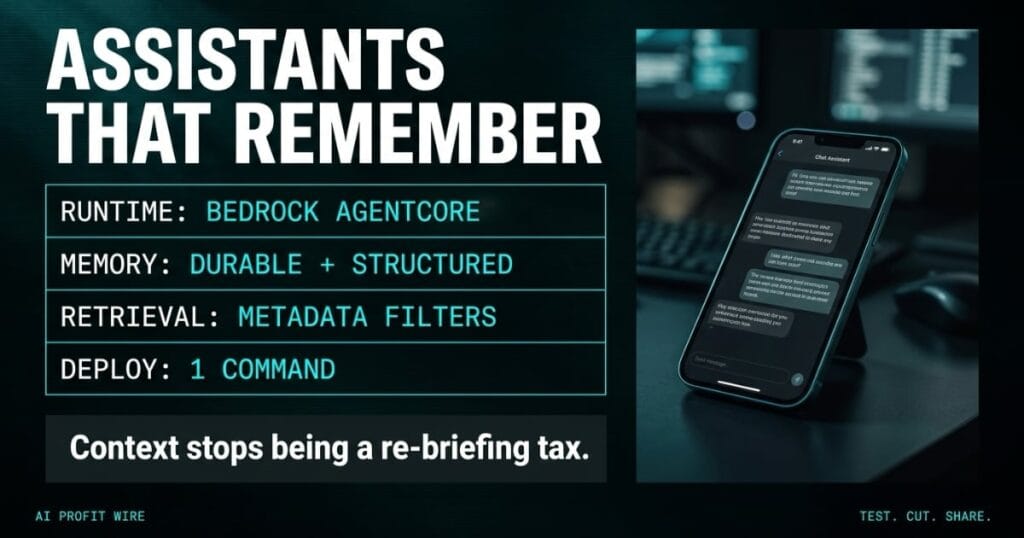
Improves operational efficiency by cutting down the time spent re-explaining context to AI tools across multiple tasks.
Off-the-shelf AI assistants answer questions well and then forget you, which turns every long-running project into a re-briefing exercise. AWS published a reference build that attacks exactly that gap: a personal assistant that accumulates context between sessions, built on OpenClaw and the Amazon Bedrock AgentCore runtime.
The post ships from AWS’s own Machine Learning Blog, and it treats memory as infrastructure rather than a chat trick.
AWS is formalizing long-term memory as a standard assistant feature.
What is the AWS AgentCore context-aware assistant build?
The AWS Machine Learning Blog post documents a personal assistant that accumulates context across conversations instead of resetting each time.
It pairs OpenClaw, an open-source agentic system, with the AgentCore runtime, where AgentCore memory converts disposable chats into durable, structured knowledge.
The running example is a gardening assistant called Sprout, and the architecture is domain-agnostic: swap the persona and skills manifest, and the same pipeline serves a support bot or an internal help desk.
The build treats memory as infrastructure, not a chat trick.
Does AgentCore memory actually work?
According to AWS, AgentCore memory is the component that accumulates context so the assistant carries knowledge forward instead of starting over, and the AgentCore Memory documentation describes the same storage and retrieval mechanism the build relies on.
Each session becomes stored knowledge tagged with structured metadata, so the assistant retrieves the records that matter for the question at hand rather than treating memory as one undifferentiated log.
The post ships as an official AWS release with the full template published, though it includes no adoption numbers or performance benchmarks.
The mechanism is documented, but independent results are not yet available.
How is AgentCore memory different from a standard chatbot?
A standard assistant forgets you between conversations, while this build treats every session as input to a persistent knowledge base.
The practical difference shows up in week 2: a standard assistant needs the full brief re-typed each time, and this design retrieves prior context through metadata filters without re-briefing.
For a support bot, that means the customer’s history arrives with the question. For an internal help desk, it means the fix documented last month answers this month’s ticket.
Retrieval is selective, which means stored context is queryable per question instead of being dumped back into the prompt wholesale.
The shift is to a tool that shows up already briefed.
What does running the AgentCore assistant require?
You need Amazon Bedrock AgentCore access, including the AgentCore runtime and AgentCore memory, plus model access for the assistant itself.
The entire system lives in a single AWS CloudFormation template that deploys with one command, and AWS states it runs on a consumption-based model that costs a few dollars a month for light personal use, consistent with the published AgentCore pricing page.
Two entry points feed the agent: Telegram messages arrive through API Gateway and a webhook function, while scheduled jobs arrive through EventBridge Scheduler, so reminders and questions converge on the same runtime.
The setup cost is a deploy command and a config file, not a platform migration.
The client brief sits open on the screen at a small bookkeeping firm, 9 a.m. on a Monday, the same brief that was retyped in March, retyped again in June, and retyped once more last week because the assistant handling their quarterly reports remembers none of it.
Each retyping costs 20 minutes of a professional’s morning, and nobody invoices for it, which is exactly why it survives every budget review. The firm does not have a memory problem, it has a session problem wearing the costume of a busy calendar.
A build that carries context forward at a few dollars a month converts that dead time into a one-time setup cost, and the metadata filters matter because a report for one client should never inherit the numbers of another.
Should you build an assistant on AWS Bedrock AgentCore?
Only if you run workloads on AWS and have a recurring workflow where forgotten context costs measurable hours.
The build is custom, so it requires someone who can stand up the runtime and configure the memory layer, and the honest test is a pilot: pick 1 workflow, measure setup time in session 1 against session 5, and let that delta decide.
Teams that want the same pattern without AWS lock-in can study the OpenClaw project directly, since the agent layer is open source and the memory pattern is documented.
Pilot it on one workflow with a before-and-after time measurement and let the hours decide.
This is one of several assistant architectures shipping as agent infrastructure matures. You can follow the other AI agent signals we are tracking as the memory layer stops being a differentiator and becomes a default.
Source: AWS Machine Learning Blog
