Provides a new paid acquisition channel for small businesses as ChatGPT ad formats expand.
What are ChatGPT Ads and how does the visual format work?
ChatGPT Ads are paid placements inside the chat interface, and the new visual format adds images showing product inspiration, product usage, or the experience a product makes possible. The format arrived in the OpenAI announcement on October 5, 2026, alongside expanded measurement tools and partner integrations.
The first tests run during image generation, with ads clearly labeled and kept separate from the image being created. OpenAI states advertising does not influence the answers ChatGPT provides, and the same announcement commits to placement guardrails for sensitive contexts.
Testing begins later this month in the US with an initial group of advertisers, and businesses can sign up for ChatGPT Ads today. The platform reaches 1.2 billion people each week, which puts a new paid acquisition surface in front of advertisers at unusual speed.
The format matters for a practical reason: images carry product context that a text link cannot, and OpenAI is pitching discovery rather than search intent. For a small catalog that means the creative load changes, and the first advertisers in each category set the visual standard.
This is the first visual format inside the largest AI-native consumer platform, and it arrives with measurement already attached.
Do ChatGPT Ads lower acquisition costs?
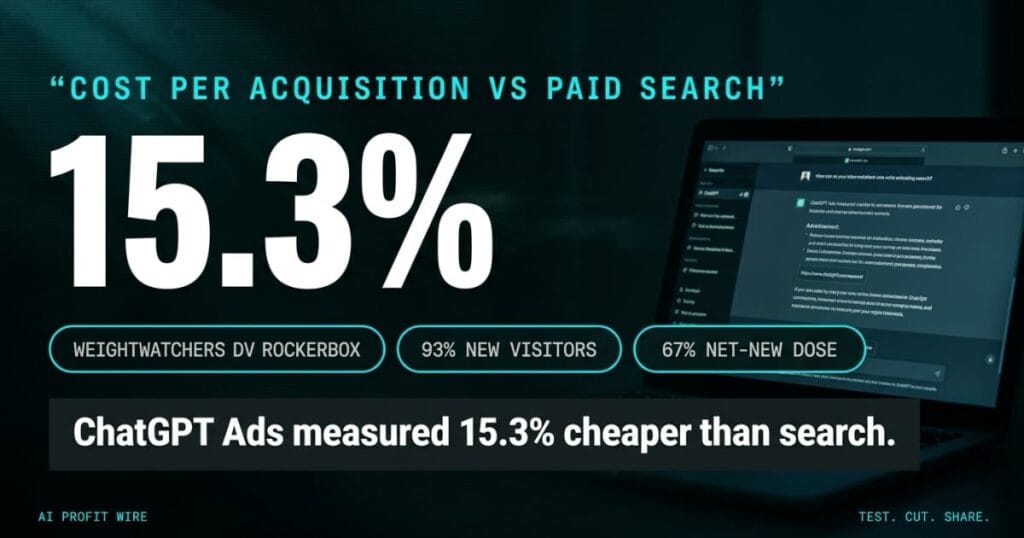
The early numbers come from partner measurement firms, and the strongest one favors the channel. According to DV Rockerbox, WeightWatchers’ attributed cost per acquisition on ChatGPT Ads ran 15.3% below its blended paid-search benchmark.
WorkMagic reported statistically significant lift for wellness brand Dose, with 67% of incremental purchases coming from net-new customers. Triple Whale counted 93% of Portland Leather’s visitors from ChatGPT Ads as new, which is a prospecting pattern rather than a retargeting one.
OpenAI lists the full measurement stack on its Ads Blog. It includes 10 attribution partners such as AppsFlyer, Triple Whale, Adjust, DV Rockerbox, Northbeam, Branch, Singular, Kochava, Airbridge, and Tenjin, plus incrementality work with Haus, Measured, and WorkMagic.
The pattern across all 3 reports is the same one: the channel reaches people who were not searching for the product yet. That is the result that matters for a small budget, because prospecting reach is the hardest thing to buy cheaply.
These are partner-reported figures from a controlled early test, so treat them as directional rather than settled. Three independent firms reporting the same pattern is still more evidence than most channels offer at launch.
The early data supports a small test budget, and it does not yet support moving core spend off proven channels.
Are ChatGPT Ads cheaper than Google and Meta ads?
No head-to-head auction comparison exists yet, and the honest benchmark says one thing: ChatGPT Ads beat WeightWatchers’ own blended paid-search number by 15.3%. What that establishes is direction, and the direction favors the newer, thinner auction.
Ads serve users on Free and Go plans according to OpenAI’s help documentation, with placement guardrails keeping ads out of emotionally vulnerable or sensitive contexts. Negative Phrases are available to qualifying advertisers who need brand-specific restrictions.
Hightouch, Tealium, and LiveRamp handle the data pipeline from your existing systems into ChatGPT Ads. DoubleVerify and Integral Ad Science are running brand suitability pilots, with IAS CEO Lidiane Jones stating the evaluation covers a broad range of scenarios without accessing private conversations.
Meta and Google still hold the larger budgets and the longer performance records, and nothing in this announcement says to move core spend. What it changes is the option set: a third major auction now exists, and it opened with published benchmarks instead of promises.
The structural difference is context: your ad appears inside a conversation where someone is actively working out what to buy.
The paid search invoice arrives before the coffee does, and the cost per acquisition line moves the wrong way while the auction gets more crowded. This quarter there is a benchmark sitting next to it that reads 15.3% lower for the same job.
That gap is the vendor tax in one line: paying the established price because the cheaper channel still feels new. The difference here is the receipt, because 3 measurement firms published the numbers a test can be judged against.
Who should test ChatGPT Ads first?
Direct-to-consumer and lead-generation founders with attribution already wired are the natural first wave, because they can measure results from day 1. If Northbeam, Triple Whale, or Rockerbox runs your reporting today, conversion data flows into ChatGPT Ads through the same Conversions API and click attribution setups you already use.
Incrementality testing with Haus, Measured, and WorkMagic is in early stages, which matters for teams that need causal proof before scaling past a pilot budget. When the question is which campaign actually produced the lead, the WhatConverts attribution report covers the verification side of that decision.
Agencies and in-house teams with weekly reporting rhythms will see the cleanest read, because the Conversions API setup mirrors what they already run for web attribution. A founder without measurement in place should fix that first, because an unmeasured test on any channel is money spent for a number you cannot keep.
The fit is widest where a new customer carries real margin, because the early evidence is about acquisition cost, not reach.
Is a ChatGPT Ads test worth the budget?
Sign up while US testing is new, because early inventory on a measured channel is the window where acquisition costs run lowest. Advertisers can create, update, and analyze campaigns through natural-language prompts in the Ads Manager, which lowers the operating lift for a small team.
Set one number as the gate before you spend: the CPA your search account cannot beat. Judge the test against your own measured number, and scale the line if the channel beats it.
Keep the test window short and the decision rule written down before launch, because channel tests fail on vague success criteria more than on bad inventory. One product line and a 2-week window give the decision its number.
Run the test on its own CPA, and the channel either earns the budget or loses it on data you own.
Source: OpenAI Blog
