Demonstrates enterprise-grade workflow automation for high-volume customer service and internal operations.
Barclays is expanding its strategic collaboration with Anthropic to integrate Claude across the bank’s global operations, targeting software development, legacy system modernization and operational efficiency, per Anthropic’s announcement. The rollout covers the systems that run the bank, from development to operations.
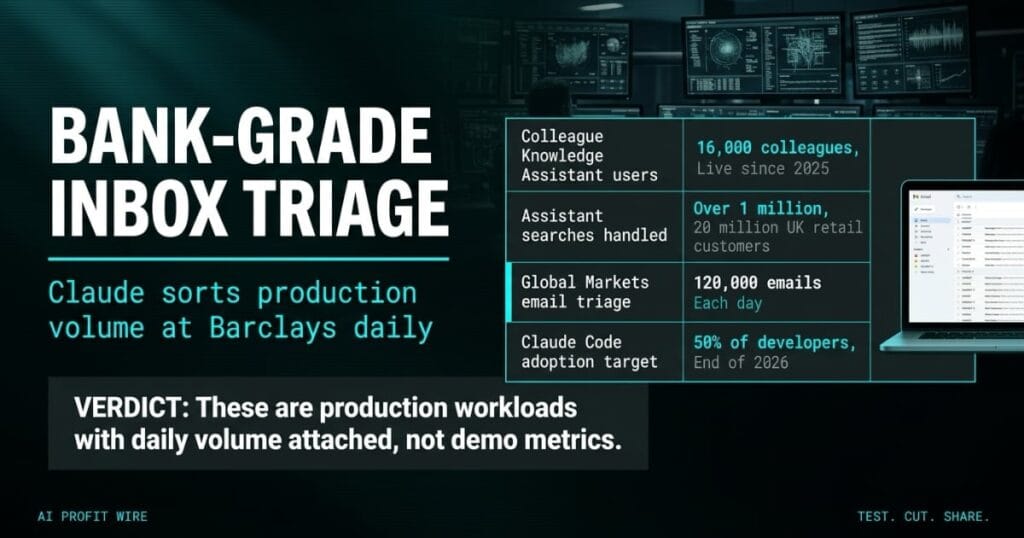
The bank expects Claude Code adoption to reach 50% of its developer population by the end of 2026, rising to a majority of software engineers in 2027. Group Co-Chief Operating Officer Anne Marie Darling framed the goal as reducing time spent on routine activities so colleagues can focus on complex problems, reimagining processes inside a secure and well-governed environment.
An enterprise deployment runs inside regulated workflows here, measured in daily throughput.
What Is The Barclays Claude Expansion?
The expansion extends a collaboration that already runs in production. Barclays is applying Claude to software development, cyber security workflows and day-to-day operations across a bank that serves millions of customers.
Anthropic positions the deal as a UK milestone, with Chief Commercial Officer Paul Smith stating that Barclays rolls Claude out with strong security and oversight. The bank applies governance, security controls and human oversight to its AI use cases as a stated condition of scaling.
A regulated bank just published its operating template for AI at scale, oversight included.
Does The Barclays Claude Deployment Actually Work At Scale?
Yes, and the volume numbers are production figures. The Colleague Knowledge Assistant has been live since 2025 through a retrieval-augmented generation architecture, more than 16,000 colleagues have adopted it, and it has handled over 1 million searches supporting staff who serve over 20 million UK retail customers. The result the bank reports is faster access to information and quicker support for customers, which is the pair of outcomes a servicing assistant exists to move.
In Global Markets, Claude models classify, enrich and route incoming emails so requests arrive with the information operations staff need. The platform processes approximately 120,000 emails each day, cutting manual handling while surfacing what needs action. Anthropic’s own summary pairs the numbers: 16,000 colleagues finding answers for customers, 120,000 emails sorted daily.
120,000 emails a day and 16,000 adopted users are production workloads with daily volume attached.
How Is The Barclays Claude Rollout Different From Earlier Pilots?
Earlier enterprise AI pilots sat at the edge of the business: a chatbot here, a summary tool there, nothing touching regulated workflows. This rollout embeds Claude into how the bank builds, tests, secures and operates technology, which is what Group Co-Chief Operating Officer Craig Bright describes as agentic capability inside the technology lifecycle.
The developer side is the tell: a 50% Claude Code target by end of 2026 is a staffing decision, and Claude Code’s documentation describes the same managed, agentic deployment model a bank would need to run it under supervision. Yahoo Finance’s coverage of the announcement frames it the same way: an efficiency push measured in adoption percentages.
The difference is volume plus governance: AI as operational plumbing, measured in daily throughput.
The service advisor opens the shop inbox at 7 and finds overnight messages stacked in arrival order: a warning-light video, an appointment ask, a photo of an invoice, and the angry subject line that matters most. The day gets decided by whatever opened first, and the urgent message waits its turn.
Barclays routes 120,000 emails a day through a classifier before a person touches one, so the colleagues who read mail start with what needs judgment. The volume belongs to the bank, and the reading order is the part worth stealing.
What Does The Barclays Claude Rollout Mean For A Small Business?
The transferable mechanism is classification before human attention. Every inbound request gets sorted, enriched and routed by AI first, and people spend their hours on the work that needs judgment instead of the work that needs a folder.
That pattern already exists at small-team scale: Tidio’s AI support chat runs the same classify-then-answer pattern on live customer conversations, and the enterprise news here is that the pattern just got a governance template a bank is willing to publish. Classification errors are visible and correctable before a customer ever feels them, which is what makes the routing layer the safe first step.
Copy the sequence and shrink the scale to fit: classify first, answer what is repeatable, escalate what is not.
Does The Barclays Claude Deal Change Anything This Quarter?
It raises the baseline for response-time expectations. When a bank sorts 120,000 emails daily and runs an assistant behind 1 million-plus searches, your customers’ tolerance for a slow inbox keeps shrinking.
The concrete move this quarter: count the inbound requests your team touches by hand each week, pick the highest-volume queue, and automate the classification step before a human sees it. Keep judgment calls human, and measure containment weekly.
Automate the sorting, keep the judgment, and your team’s capacity numbers start compounding this quarter.
Source: Anthropic
