Directly reduces API infrastructure and operational costs for businesses running complex, multi-turn AI agents.
What did OpenAI change in GPT-6 prompt caching?
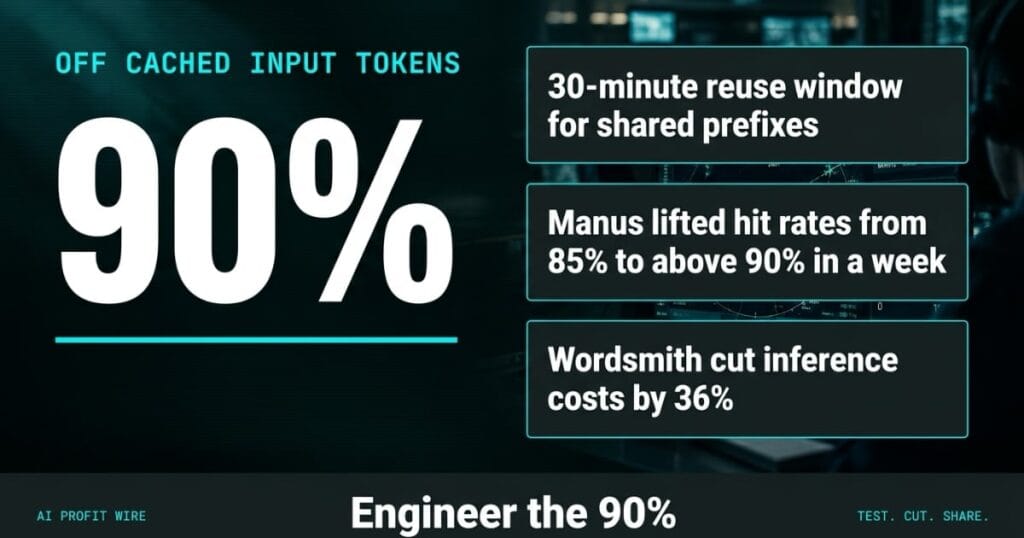
OpenAI launched an improved prompt caching system for GPT-6 on September 22, 2026, built for persistent agents that carry context across many API requests. Cached input tokens now bill at 10% of the full input price across the GPT-6 models, per the API pricing documentation, with cache discounts applied to eligible shared prefixes reused within a 30-minute window.
OpenAI also shipped new developer tools to monitor cache performance, diagnose misses, and set explicit cache breakpoints, plus a prewarming option that prepares known context before a request arrives. The default retention setting keeps a cached prefix eligible for 30 minutes after its most recent write or reuse, and prewarming is available on GPT-5.6 and later models through the prompt_cache_options.prewarm flag.
Control caching as a deliberate cost lever for your multi-turn agents.
How effective is GPT-6 prompt caching for cost reduction?
Early production teams report real savings, although every figure comes from companies OpenAI chose to quote in its own announcement. GitHub Chief Product Officer Mario Rodriguez said Copilot reduced the share of prompt tokens requiring fresh processing by more than 50% across billions of requests, relative to its previous baseline.
Manus moved its cache hit rate from about 85% to above 90% in less than a week, and Wordsmith raised hit rates from 83% to 91%, cutting inference costs by 36% and cache writes by about two-thirds. Strawberry Browser reported a 20% cost reduction from the diagnostics and dashboard alone, gaining a few percentage points of hit rate, and its CTO says the team now uses Codex agents to diagnose the root cause when alerts fire.
The discount is real, and every published result came from teams that tuned their setup; no quoted team hit these numbers on defaults.
How is GPT-6 prompt caching different from the old approach?
The old model treated caching as an automatic byproduct of repeated requests, and the GPT-6 system adds explicit control over what gets reused and why reuse fails. Developers can now set explicit cache breakpoints, append developer messages to override older instructions, and adjust reasoning effort between responses without breaking cache, per the prompt caching guide.
A new diagnostics view explains specific misses, comparing a request against a recent response to flag changes to tools, settings, or inputs that blocked reuse, with token counts attached so you can see the size of the prefix you lost. OpenAI’s documentation recommends keeping tool definitions and ordering stable and using allowed_tools instead of removing definitions when tools are not needed, and the diagnostics reference names tools_changed as the classic miss reason.
Engineering determines your final savings.
Who is GPT-6 prompt caching for?
It matters most for teams running persistent agents that work for hours on tasks like codebase refactoring or research documents, where every turn re-sends the same instructions and tool definitions. A single-shot chatbot sees little benefit, because the discount only pays when shared prefixes repeat across requests inside the 30-minute window.
For small teams tracking what AI itself costs, use a tracker that logs these rate and discount changes as they land; every pricing move like this one gets captured in the daily signals archive, and pair it with the official caching documentation when you set breakpoints for the first time.
If your agents make fewer than a handful of chained calls per session, this update changes nothing on your bill.
The inventory gauge in a warehouse reads a steady level all morning, and nobody thinks about the supply chain until the monthly balance sheet shows up higher than the last one.
Cached input tokens work the same way in reverse: every time your agent re-sends the same 10-page intake protocol, you either pay full price again or you pay 10 cents on the dollar, and the meter never tells you which one it chose.
Manus found its cache hit rate sitting at about 85% and pushed it above 90% in under a week, which means even a tuned system was leaking 15% of its context spend until someone looked at the gauge.
What should you do about GPT-6 prompt caching now?
Use it if you run multi-turn agents on OpenAI models, because the tuning work is measured in days rather than months and the source data shows returns inside one week. Start in the caching dashboard, check your current hit rate against the 85% to 91% range the quoted teams reported, then use the diagnostics view on any request where cached and uncached tokens look wrong.
Stabilize tool definitions and ordering before touching breakpoints, since OpenAI guidance names tools_changed as a cache miss reason, and use the prewarming option for shared instructions your agents load at startup.
Engineer your system to capture the 90% discount.
Source: OpenAI Blog
