Accurate online product data prevents AI shopping bots from misrepresenting your business to potential customers.
What are AI shopping bots?
AI shopping bots are software agents that search, compare, and buy products on a shopper’s behalf, and Bloomberg reports they still struggle to separate accurate web information from fiction. The core failure is source judgment: these agents read whatever product data they find online and treat it as usable, whether it came from your official page or a stale third-party listing.
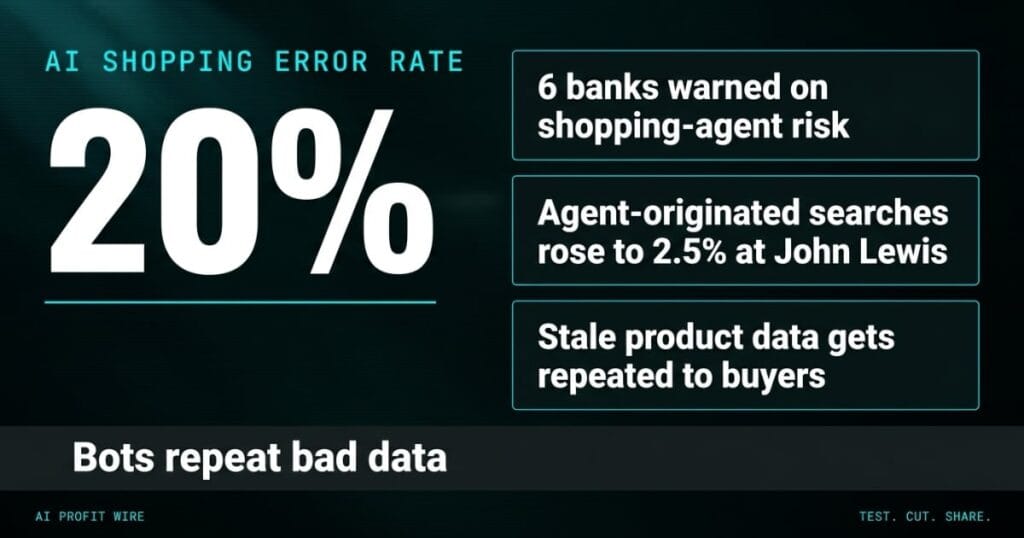
The output a buyer sees reflects the worst data available about your business. Bloomberg’s Tech In Depth reporting frames the problem for marketers, and the numbers behind it are blunt: error rates run as high as 20% when shopping tools comb the open web for product answers, per Bluefish AI chief executive Alex Sherman.
Your online product information is now read by machines before it reaches humans, and machines cannot vouch for it.
How often do AI shopping tools get product info wrong?
The claim holds. Bloomberg documents AI shopping assistants giving shoppers wrong information about smartphones, dog food, and other researched products, with the 20% error-rate figure attached to web-surfaced shopping data.
The same day, Reuters reported that 6 banks including NatWest and Bank of America set out risk principles for shopping agents, warning they could increase scams, fraud, and data-privacy breaches. The banks flagged a specific fear: agents may buy the wrong thing, spend too much, or lose the customer’s money to fraud.
The channel is already transacting. Stripe’s agentic commerce documentation describes agents completing purchases on behalf of the people they serve, and OpenAI’s Instant Checkout already lets ChatGPT users buy from Etsy sellers, with over a million Shopify merchants queued for access.
The warning now comes from banks and payment rails, which means the risk is priced into the system.
How is selling to AI shopping bots different from selling to human shoppers?
Human shoppers can spot a suspicious listing, but a shopping bot cannot apply that judgment, so it trusts structured data over presentation. A human buyer notices when a price looks wrong or a description reads like a knockoff. A bot reads the same page as plain text and passes the wrong figure straight to its user.
The reach is also growing from a real base. Reuters reports that AI-agent-originated searches at retailer John Lewis rose to 2.5% of search traffic from 0.3% a year earlier, with the trend accelerating. That is a small share moving fast, and every point of it reads your data instead of your ads.
The supply side is thinner than it looks. “There’s a famine of content from brands,” WPP Enterprise Solutions’ Molly Schonthal told Bloomberg, which means agents fill the gap with third-party listings, reseller pages, and whatever else ranks.
Humans forgive bad data and keep shopping, bots repeat bad data and lose you the sale without a trace.
Who loses when a shopping agent quotes the wrong price?
Small businesses lose the sale without ever seeing it happen, because the agent quotes whatever is live at the moment a buyer asks. The practical work is unglamorous: consistent pricing, current specs, accurate availability, and clean product descriptions across your own site and any marketplace or directory that lists you.
Customer-facing AI needs the same discipline. An AI support agent grounded in your own documented product information answers from sources you control, which beats an external agent guessing from whatever it scraped last week.
Your product data is now a sales asset with machine readers, and stale data is a silent leak.
The crew lead hands you a signed inventory sheet at the end of a long-haul move, and the truck is empty, the customer paid. 3 weeks later a cracked dresser turns into an insurance claim because the paper trail says your team delivered it clean.
An AI shopping agent runs the same play with your product data. It reads whatever listing it finds, reports a successful answer to its user, and Bloomberg found error rates as high as 20% when shopping tools comb the web for product information.
The moving company fixes it with a walkthrough checklist signed on site. You fix it the same way: verify the source data yourself, because the agent reporting success is the last place to look for accuracy.
What should you do about AI shopping bots now?
Audit every public instance of your product data, because anything wrong online gets amplified to buyers through agents you never interact with at all. Start with the pages that carry the most revenue and check price, specs, and availability everywhere your catalog appears.
The cost of skipping this is invisible: a bot quotes your old price, the buyer’s agent completes or abandons the purchase, and you never see the lost transaction in any report. The banks’ risk principles point the same direction: assume the agent shops with your data, and make the data worth trusting.
Fix the data feed before agent traffic scales, because the channel is already transacting.
Source: Bloomberg Tech
