Provides executive reassurance on AI adoption and workforce evolution for growing businesses.
What Did PwC US CEO Paul Griggs Say About AI and Hiring?
Paul Griggs, PwC’s US Senior Partner and CEO, told Bloomberg on September 18 that AI should be viewed as a business transformation rather than a technology upgrade, and he rejects the idea that adoption means job losses.
His core point: the companies most exposed to AI are seeing stronger productivity and stronger hiring at the same time. PwC is living the claim by adding engineers, data scientists, and machine-learning experts as its own workforce evolves around AI.
The venue matters less than the position. The head of a firm that advises thousands of companies on transformation, through the AI practice those clients buy, is telling them the doom framing misses what the payroll data shows. Griggs started at PwC as an intern about 30 years ago and now runs the US firm, which is the biography his transformation framing comes from.
The CEO of PwC US is telling founders the hiring freeze is the risky bet, and his firm’s own dataset backs him.
Is the AI Job Doom Claim Actually True?
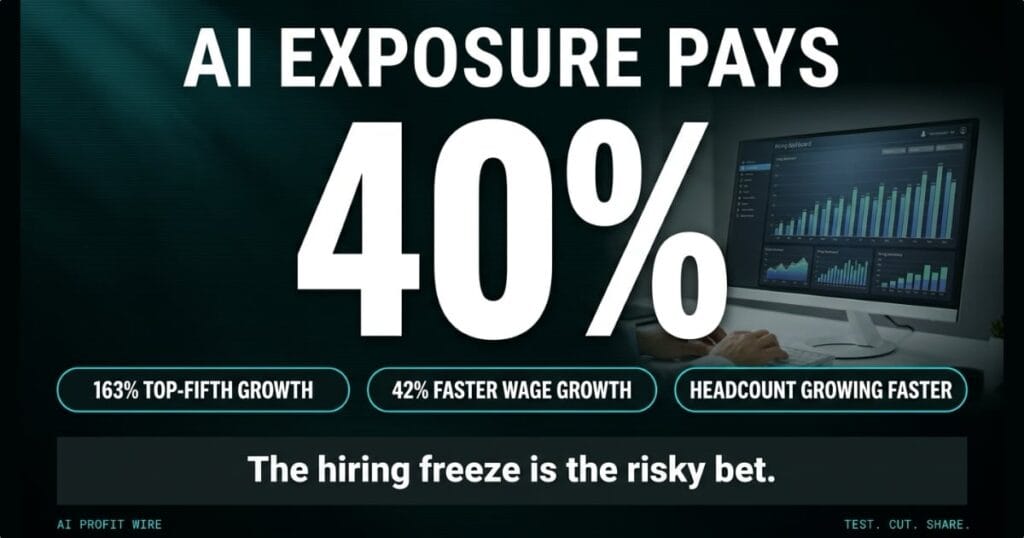
Against PwC’s own numbers, the doom claim fails. The 2026 AI Jobs Barometer, published June 15, found productivity growth 40% higher at companies most exposed to AI versus least exposed.
The pattern compounds. Since 2022, when AI adoption soared, the most exposed companies tripled their productivity lead, and the top fifth of exposed companies averaged 163% productivity growth.
Hiring follows the same line. Headcount growth at the most exposed companies outpaces the least exposed, wages grow faster there too, and jobs professionalised by AI are growing twice as fast with 42% faster wage growth since 2021.
The skills data points the same direction. Skills tied to the most AI-exposed jobs are changing more than twice as fast as those in the least exposed roles, and the new tasks landing in those jobs lean on empathy, judgment, and creativity, the capabilities AI absorbs last.
The firms deepest into AI are hiring more and paying more, which is the opposite of the replacement story.
How Is This Different From the 2023 Layoff Panic?
The 2023 version of the story came from model demos and headcount announcements, and it read as software eating seats. The 2026 data describes firms redesigning the seats instead.
PwC’s Barometer finds the most AI-exposed junior roles are 7 times more likely to demand senior skills like leadership, and seniorised entry-level postings grew 35% since 2019 even as overall early-career postings flatlined in the most exposed sectors.
That compression changes what you hire for. The junior who arrives with judgment plus AI fluency compounds, and the one hired to grind routine output competes against a per-token price.
Hiring survived, the shape of the roles didn’t, and the firms that read it first are the ones pulling away.
What Does the PwC Data Mean for a Growing Team?
If you run a team between 2 and 200 people, the finding lands as budget arithmetic. Output per seat is the metric that moves, and it moves most when the hire and the tool arrive together.
The risk runs both directions. Freeze hiring and you cap output while AI-exposed competitors compound, or over-hire into roles AI already covers and burn runway on seats that don’t stack.
The Barometer’s own advice to leaders points the same way: use AI to pursue growth over efficiency alone, and reinvest in skills rather than treating the technology as a headcount subtraction. That trade is the one we watch week to week in the signals we publish.
Write the role around what the person does with the tool, and the headcount question answers itself with math instead of mood.
The headcount plan lands on your desk with 2 open roles and a note that says hold until AI settles. The competitor across town posted the same 2 roles yesterday with different titles, and their last release shipped a month before yours.
Griggs is describing the second company: transformation budget, roles rewritten around the tools, hiring up. His Barometer puts 40% higher productivity growth behind that approach, a gap that compounds while the hold note sits unsigned.
The hold feels safe because it delays a decision. The invoice for delaying shows up as output per seat, the number your board reads first.
What Should You Do About AI and Hiring This Quarter?
Rewrite your next open role around AI output: which tasks the tool handles, which tasks the person owns, and what combined weekly production looks like. Post it only after that math exists on paper.
Pilot the pairing on your next 2 hires rather than reorganizing the whole team. Measure output per seat for 90 days against your current baseline, and let the delta set the pace.
Read the Barometer’s wage and skills data as your quarterly prompt, because the premiums move faster than most companies’ planning cycles.
Hire the person, hand them the tools, and measure the pair as one unit.
Source: Bloomberg Tech
