Enables faster hands-free customer support workflows and multi-step business planning directly through voice interfaces.
What is Gemini 3.8 Live and what does it do?
Gemini 3.8 Live is Google DeepMind’s new live dialogue model, launched September 15, 2026 alongside a heavier variant called 3.8 Live Extended Thinking. Both models carry on real-time voice conversations while executing tools and API calls in the background.
3.8 Live is built for scale and cost efficiency, with fluid dialogue and visual grounding across 97 supported languages. 3.8 Live Extended Thinking targets high-complexity work, narrating multi-step tasks out loud as it completes them, acknowledging prompts with early verbal cues like “Let me check that” and walking users through live progress on background tasks as they run.
Google’s demos show the range: the model plays chess while talking through its reasoning, turns raw sketches into functional React components from spoken direction, and coordinates multi-step bookings without interrupting the conversation.
Access rolls out through the Gemini API and Google AI Studio for developers, private preview in Gemini Enterprise for large organizations, and Search Live plus the Gemini app for consumers. Extended Thinking reaches Google AI Pro and Ultra subscribers in Workspace in Docs, and all Google AI subscribers in Gmail and Keep.
Voice AI now acts on your systems during the call instead of after it.
How accurate is Gemini 3.8 Live?
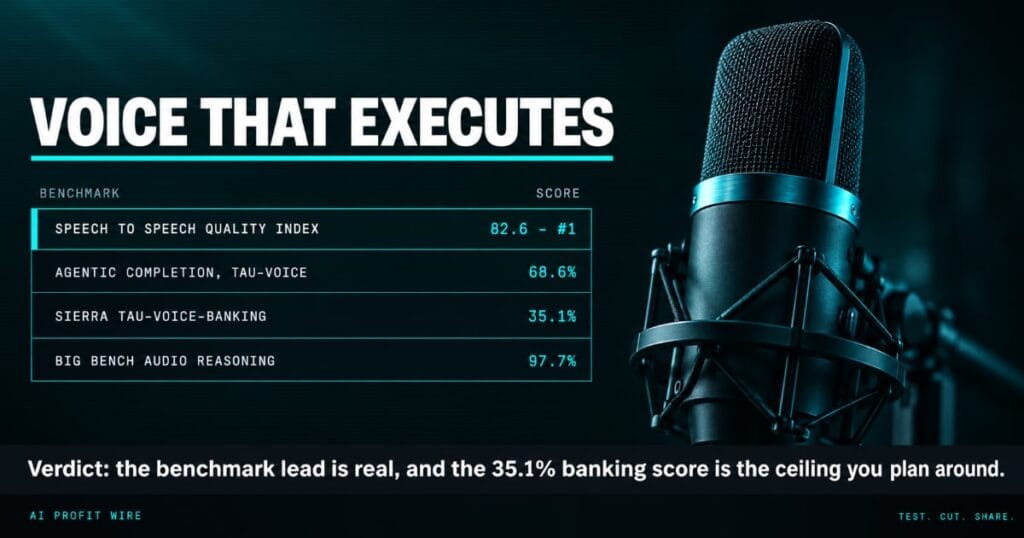
The headline benchmarks check out against the published numbers. 3.8 Live Extended Thinking captured the #1 overall spot on Artificial Analysis’ Speech to Speech Quality Index at 82.6, and 3.8 Live took second place in the Speech Agent Arena.
On agentic task completion it scored 68.6% on tau-Voice and 35.1% on Sierra’s tau-Voice-banking benchmark, and it posted 97.7% on Big Bench Audio for reasoning. On ServiceNow’s EVA-Bench, run on the Live API on the Gemini Enterprise Agent Platform, the models push the Pareto frontier for complex workflows.
All audio output carries SynthID watermarking, an imperceptible marker woven into the audio so AI-generated speech stays detectable. That matters for any business publishing voice content or running outbound calls.
The benchmark lead is real, and the 35.1% banking score is the honest ceiling for regulated work today.
Is Gemini 3.8 Live production ready?
For teams already inside Google Workspace, 3.8 Live removes the case for a separate voice layer, because the model already lives in Docs, Gmail, Keep, and Search. Partners including Salesforce, Genspark, and Lumeris build on it, citing latency and tool-calling as the draw.
Dedicated voice platforms still win on telephony plumbing, call routing, and compliance recording, none of which Google’s launch post addresses. The Live API handles the intelligence, and your stack still handles the phone line.
Developer platforms including Agora, LangChain, LiveKit, Pipecat, and Vercel integrate the same API, so teams keep their existing streaming setup and swap the brain, which keeps migration cost near zero.
Replace the model, keep the plumbing: 3.8 Live is an upgrade to your voice stack, not a substitute for one.
Who is Gemini 3.8 Live actually for?
The clearest fit is a small team drowning in inbound calls that follow repeatable patterns: bookings, status checks, intake, troubleshooting. Google demos the model building business plans and marketing toolkits by voice, guiding employee onboarding, and handling step-by-step Search troubleshooting.
Enterprises get private preview access first, with Workspace business customers next in line, and developers can start today through the Gemini API.
If your voice work is published content rather than live calls, AI voice synthesis tools like ElevenLabs cover that side of the shift, and the same access-control questions travel with it.
Scripted inbound volume is the buyer, and judgment-heavy calls are the waitlist.
A booking call runs past midnight with nobody at the desk, and the voice on the line confirms the appointment, writes the ticket, and takes the deposit while the caller is still talking. The receipt lands in the inbox before the call ends.
That is the 68.6% model at work, and the same number means about 3 in 10 of those background sequences still go sideways. A midnight agent that mischarges a card creates a morning problem with no human witness.
Treat it like the newest hire with the most access: one scripted workflow, a 2-week audit log, and no hands on the money until the log comes back clean.
What should you do about Gemini 3.8 Live now?
Start with one low-risk inbound workflow, like bookings or status checks, and audit every background tool call the model makes for 2 weeks.
Keep payment collection and account changes on humans until the audit comes back clean, because the 35.1% banking score is the honest ceiling for regulated work.
Google describes pricing as competitive with frontier models, and the launch post names no per-minute rate, so model the bill against your own call volume before scaling.
Pilot it on one scripted workflow this quarter, and let the audit log decide the rollout.
Source: Google DeepMind
