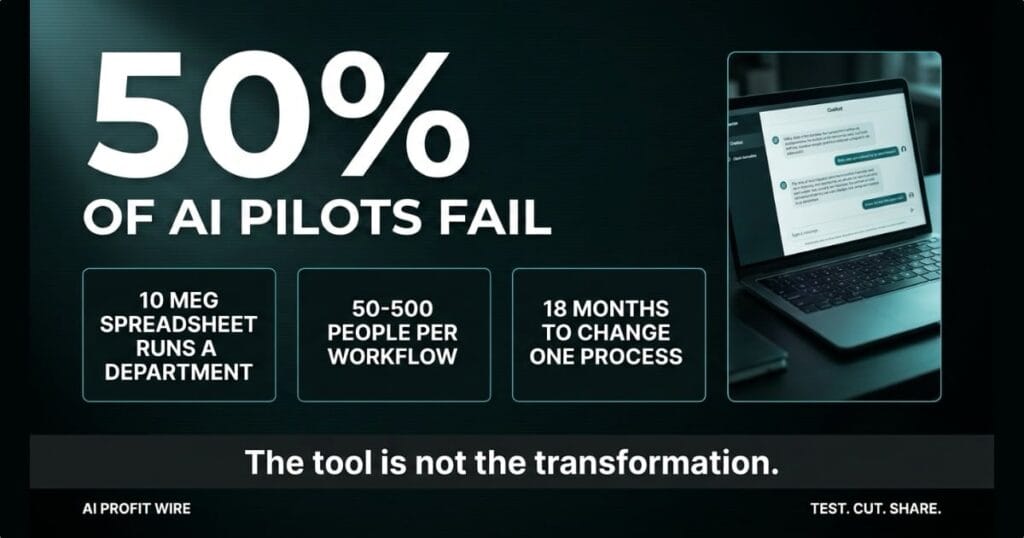
Prevents SMB owners from wasting resources on superficial AI pilots by highlighting the need for structural process redesign.
What Is AI Business Transformation?
AI business transformation is the process of redesigning structural workflows around generative AI, not adding a chatbot to an existing role and calling it automation. The distinction comes from Benedict Evans’ September 2026 essay on AI tools and transformation, which argues the technology only pays off when the work itself is rebuilt.
The typical big American company runs hundreds, and perhaps thousands, of different pieces of software, and very often nobody knows exactly what is being used or what it is paying for. That sprawl runs right down to the 10 meg spreadsheet running a department, and the company is still full of boring, repetitive tasks.
The temptation is obvious. There’s an old joke that an engineer is someone who’ll spend an hour building a tool that automates a 10-minute task, and with AI you can now make that tool in 5 minutes without writing code.
Transformation means changing how the work is done, not which tool does it.
Why Do AI Pilots Fail?
Roughly half of AI pilots fail, and Evans calls that the normal hit rate, which is exactly why they’re pilots. A pilot is a trial of a product, bought or built, that uses AI to automate a process you couldn’t automate before, not a transformation strategy.
The wider data backs him up on the pattern. An MIT NANDA study of enterprise GenAI found 95% of organizations getting zero return despite $30-40 billion invested, and S&P Global found the share of companies abandoning most of their AI initiatives jumped from 17% to 42%, with the average organization scrapping 46% of its proof-of-concepts.
Every big company already gave everyone Copilot, ChatGPT or Claude, and a small number of people use it constantly while a lot of the rest of the company barely opens it. That is the same shape as handing out PCs and Lotus 1-2-3 in 1983, because deployment was never how you transformed invoice processing, and OpenAI’s own enterprise rollout documentation treats setup, identity and training as a program of work for exactly that reason.
A chatbot lifts productivity for a few individuals, and it doesn’t rebuild a supply chain.
Will AI Replace SaaS?
No, and the belief that it sweeps everything away is the first mistake Evans flags. AI expands the apps you already have, creates new vertical apps, and makes the chatbot itself a new freeform space sitting next to Excel and email.
Bain’s 2025 technology report reached the same conclusion from the market side: agentic AI will disrupt SaaS, and in some cases that disruption grows the market while in others it commoditizes it. The SaaS era itself was an organic flow of bundling and unbundling, and Carta is a $4bn company that manages one spreadsheet for your CFO.
AI doesn’t change the question, it creates new choices and moves the thresholds. A small company hiring 10 graduates can stay in Google Sheets far longer because AI makes the sheets scale further, while PwC hires 3-4,000 graduates a year on dedicated institutional software.
The movement runs in both directions, which is why a consultant Evans cites said half their jobs were telling people to move from Excel to a database and the other half were the opposite. Thresholds move, and the spectrum from improvised to institutionalized stays.
SaaS changed where software lived, and AI changes what software can actually execute.
The 10 meg spreadsheet running your department still opens every morning, so nobody calls it a problem. It lives in the same improvised stack of email, shared folders and Google Sheets every small firm runs on, and the week ships because one person knows how it works.
The trouble arrives when that task starts carrying revenue and risk, because then it needs audit, security, maintenance and accountability that a spreadsheet doesn’t have. At company scale Evans puts it at hundreds of people wasting an hour a day before anyone notices the desire path, and in a 10-person firm that same path is somebody’s whole Tuesday.
Pave the path and pay to set it in stone. AI doesn’t change the question, it just moves the threshold for when that bill comes due.
Which Business Processes Should You Automate With AI?
The candidates are the tasks you do all the time, the same way, with lots of people involved. At scale those workflows touch 50 or 500 people across 5 different departments, 3 different systems of record and 4 different regulatory regimes, which is why nobody redesigns one on a lunch break.
Most employees are not tool builders, and a great matrimonial lawyer spends the day thinking about cases, not about what great legal discovery software would do. That gap is where the forward-deployed engineer comes from: a builder who walks the floor and spots the opportunities the practitioners can’t see, although even then many successful products only emerged after half a dozen failed attempts.
Where the improvised space is your customer inbox, moving replies into an AI support desk that logs every touchpoint is the same institutionalization move in miniature.
The people who feel this most are the ones moving a task out of a fuzzy shared folder and into a fixed corporate process.
What Should You Do About AI Automation This Quarter?
Stop running isolated pilots and audit the improvised workflows that keep the business running instead. Find the 10 meg spreadsheets and the shared folders first, because those are the primary candidates for institutionalization.
Ask one question of each task: should AI make a human faster, or remove the human from the loop entirely. The answer decides whether you buy a tool or rebuild the process, and changing how a whole company works has always been a purchase, a decision, and an 18-month sales process.
Stop buying chatbots and start mapping the tasks that currently live in a spreadsheet.
Source: ben-evans.com
