Increases revenue and reduces labor costs by automating multimodal order intake on a popular consumer channel.
What is the WhatsApp AI ordering bot on Amazon Bedrock?
Amazon’s Machine Learning Blog published a deployment framework that puts a multimodal ordering assistant on a single WhatsApp Business number, and the walkthrough from Salman Ahmed, Sergio Barraza, and Ravi Kumar shipped on September 4 with the full code. It is built with Amazon Bedrock AgentCore and Amazon Nova 2.
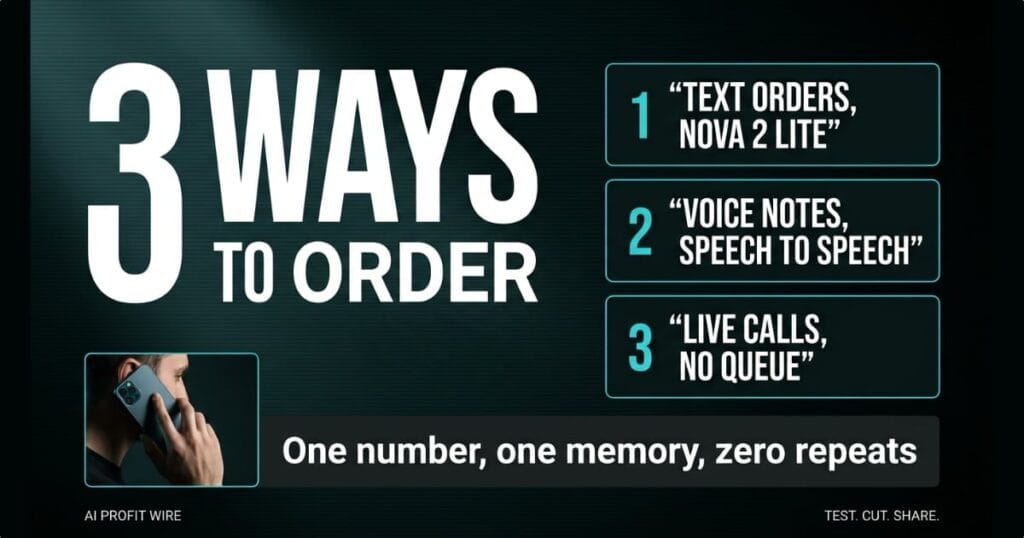
Customers order by text, voice note, or live call, and an AI agent takes each order end to end from greeting to confirmation. All 3 channels share 1 backend and 1 cross-channel memory, so a customer who texts today and calls tomorrow is recognized as the same person.
The reach math in the article is the reason to care: WhatsApp reaches more than 2 billion people, and none of them need to install anything or sign in to place an order.
It is a complete order-taking stack running inside the app your customers already open daily.
Does a WhatsApp AI bot actually handle voice orders?
Yes, and the voice path is the most engineered part of the build. Amazon Nova 2 Lite handles text through the Amazon Bedrock Converse API, while Amazon Nova 2 Sonic runs real-time speech on voice notes and calls.
Voice notes arrive as OGG Opus audio, decode to 16 kHz PCM, and feed a bounded Nova 2 Sonic speech-to-speech session. The source is explicit that there is no transcription service in the path, it is true voice-in, voice-out.
Live calls run over WebRTC through Meta’s Calling API, with media relayed through the Amazon Kinesis Video Streams managed TURN relay and each conversation isolated in its own microVM. The AgentCore documentation describes the platform as a managed way to build, deploy, and operate agents at scale with no infrastructure to manage, which is what makes the isolation claim routine rather than remarkable.
The voice support is native speech-to-speech, not a text bot wearing a transcription layer.
How is the Bedrock WhatsApp bot different from a standard chatbot?
A standard chatbot owns one channel and forgets everyone between sessions. This architecture keeps the WhatsApp layer, the agent runtimes, and the ordering backend as 3 separate layers, so the backend does not change when you add or remove a channel.
AgentCore Gateway exposes the restaurant backend as named MCP tools, GetMenu, AddToCart, PlaceOrder, and every runtime calls them by name. AgentCore memory holds 1 shared cross-channel record keyed by a hashed customer ID, and inbound traffic lands on 1 HTTPS webhook that acknowledges instantly and processes asynchronously so no request blocks another.
The full system is public: AWS hosts the deployment code in a sample repository with 3 agent containers, the AWS CDK infrastructure, and setup scripts that wire the webhook to your account.
The difference is memory and separation, 1 customer record across 3 channels and a backend that survives channel changes.
Who is a WhatsApp AI ordering bot actually for?
The source frames it for quick-service restaurants that spread ordering across an app, a website, a phone line, and the counter, where each channel is a separate system to build and run and each one fragments the customer’s history, making the same person look like a stranger on every channel.
The same shape fits any business that takes repeat orders by phone, and the voice behavior is documented rather than promised, because Meta’s WhatsApp Business Platform documentation confirms businesses on the platform can send voice messages in open chats.
It suits teams that cannot staff a full-time order line but lose orders whenever the phone rings out.
Any order-driven business that lives on repeat customers is the target user.
The phone at an auto parts counter rings while the man behind it holds a brake pad in one hand and a delivery ticket in the other, and the caller on the line is comparing pad brands from memory. A text with a VIN photo sits unanswered in the same inbox, and the shop loses whichever conversation gets handled second.
That shop does not need 3 systems, it needs 1 number that carries text, voice notes, and live calls without dropping any of them. Amazon put that pattern in public code, on the channel more than 2 billion people already have open, with the cross-channel memory included.
Amazon’s own walkthrough clocks the first build of each container at roughly 8 to 12 minutes, which is less time than the shop currently spends returning the voicemails it missed before noon.
What should you do about WhatsApp AI ordering now?
Start free: Meta’s sandbox test number for the WhatsApp side costs nothing extra for a demo and needs no business verification, so you can hear the voice flow before committing money to a production number.
Deploy into us-east-1, the US East Region the walkthrough recommends as a starting point, and enable Amazon Bedrock model access for Nova 2 Lite and Nova 2 Sonic first, because the agent cannot reply until that access is in place. The temporary access token for testing expires in about 24 hours, so plan the first session inside a day.
Run the sandbox test against your real menu and compare the 3-channel setup against the phone line you run today, and keep an eye on the daily AI signals we track, because order intake keeps moving toward conversational channels.
Test it in the sandbox this week, and keep your phone line until the bot has taken a full week of real orders.
Source: AWS Machine Learning Blog
