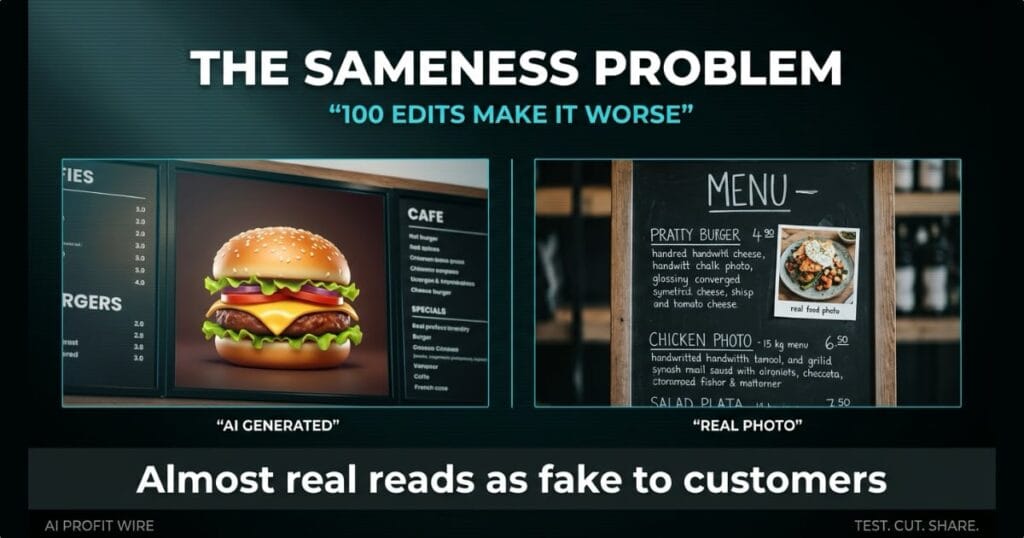
Prevents brand damage and loss of revenue caused by using synthetic imagery that repels diners.
What is AI image convergence on menus?
AI image convergence is the process where generative models shave the unique edges off an image to hit a narrow, pleasing aesthetic. TechCrunch’s report on AI-generated menus documents the result: food illustrations that look eerily flawless, precisely symmetrical, and oddly smooth.
Reality Defender CTO Alex Lisle told TechCrunch the models are optimizing for pleasingness, and that optimization turns into homogenization. His shorthand is blunt: a lot of this stuff looks like a Chili’s menu from 2015, because that era is the corpus of work the models drew from.
Ask for a fast food menu and the model references the Wendy’s, Burger King, and McDonald’s menus it has already seen, which share a style the output then reinforces.
Convergence isn’t model collapse, but they’re related. Researchers writing in Nature found that models trained recursively on their own output suffer irreversible defects, and Lisle compared full collapse to mad cow disease.
Convergence is the milder version, degrading output quality without making it entirely useless.
Convergence replaces authentic detail with a synthetic sameness customers can feel before they can explain it.
Why do AI generated food images make customers uneasy?
The aversion is measurable. Researchers at the University of Duisburg-Essen in Germany ran the uncanny valley study on AI food images and found that images which looked almost real elicited more disgust and unease than images that were obviously fake.
The cultural backdrop intensifies it. Lee Rainie, director of Elon University’s Imagining the Digital Future Center, told TechCrunch that people have an almost unexplainable sense of when they’re looking at something AI-generated, and he linked that sensibility directly to the backlash against restaurants using AI menus.
Editing makes the problem worse over time. Restaurants revise AI menus repeatedly for small changes like prices and item names, and with each edit the food becomes a little more round and smooth.
An X user named Labtec edited a ChatGPT menu 100 times and watched the food look less and less like it should, writing that the end result actually makes him uncomfortable, and TechCrunch replicated the experiment with similar results.
The closer an AI food image gets to real without hitting real, the harder it repels.
How is AI convergence different from traditional food styling?
Traditional food styling is a targeted enhancement of a real object, like a Big Mac arranged by a prop designer to look maximally appetizing in a commercial. The textures stay grounded in an actual burger, and the goal is a better version of something that exists.
Convergence has no real object underneath. The model predicts a generic average of what a burger should be, which is how outputs land on cheese with a bubbly plastic texture, and how Lisle ended up describing shrimp that appear to be eating their own tails as Lovecraftian food horrors.
Styling exaggerates reality, convergence simulates it, and the simulation keeps landing just short of believable. Customers aren’t judging the image, they’re judging the food they suspect is behind it.
Styling sells a better version of real food, convergence sells a simulation that reads as alien.
Who do AI generated menus actually repel?
The discomfort shows up in people who can’t articulate why. Rainie’s point is that customers kind of know it when they see it, which is exactly why the backlash stories about restaurants using AI menus hit so hard.
The trend isn’t isolated to one report. Food & Wine flagged AI slop menus as a trust problem for restaurants back in August, and the Duisburg-Essen findings crossed our desk in the daily AI signal reviews shortly after.
What looked like a one-off complaint now has research and a pattern behind it.
Synthetic menu imagery turns appetite into unease, and unease doesn’t order dessert.
The product photographer runs the 100th edit on the sandwich shot for the menu board. The bun is smoother than it left the oven, and the sesame seeds have started to arrange themselves in rows.
It looks less like food with every pass, and the client approves it anyway. That’s the exact mechanism the Duisburg-Essen researchers measured: images that look almost real elicit more disgust than images that are obviously fake, and the 100th edit is deep inside the almost-real zone.
What should small business owners do about AI menus now?
Audit your physical and digital menus this week for food imagery that looks too smooth or too symmetrical, and replace it with real photography. The research says obviously fake reads better than almost real, and nothing reads better than actual food.
Stop iterating on AI food images entirely. Every retouch pushes the food further into the uncanny valley, so the harmless-looking price and item-name edits are the ones doing the damage, and real photos, even imperfect ones, carry more trust than a converged average.
Real photography wins on trust, and trust is what fills the seats.
Source: TechCrunch AI
